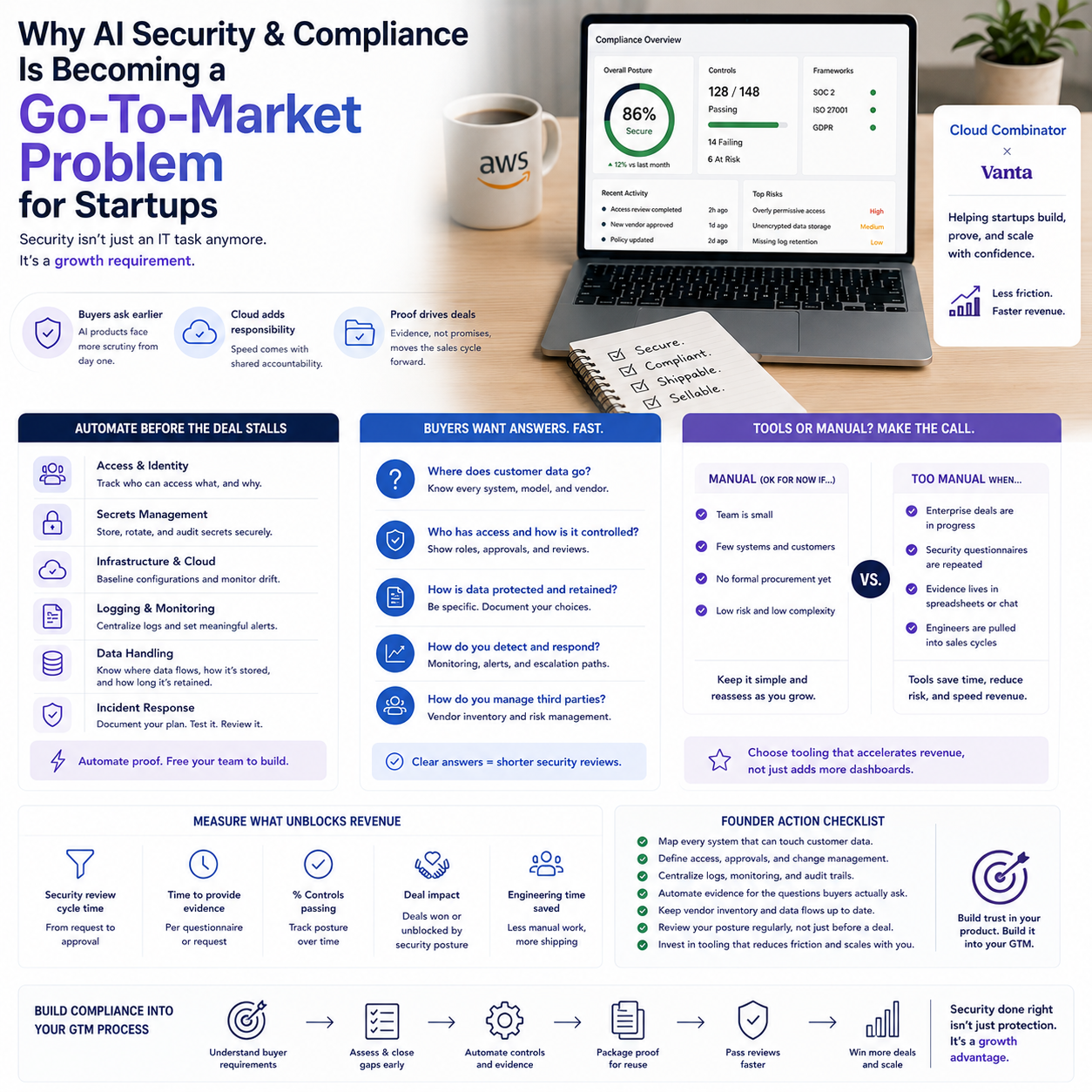
For startups building with generative AI, the hard part is no longer just shipping a product. The real bottleneck is proving that the product can be trusted by customers, cloud partners, and enterprise buyers without slowing the team down.
The recent Cloud Combinator and Vanta partnership points to a practical shift: security and compliance are moving from back-office paperwork to a go-to-market requirement. For founders, that changes the order of operations. You do not wait until the sales cycle is already blocked to think about controls, evidence, and audit trails.
Why AI startups are feeling compliance pressure earlier
Traditional SaaS teams could often defer some controls until they had larger customers or a formal procurement process. AI products do not get that luxury as often. Once a model is touching customer data, prompting workflows, or producing outputs that affect business decisions, prospects start asking sharper questions about access, retention, logging, data handling, and vendor dependencies.
The issue is not just security in the abstract. It is whether your team can show, quickly and consistently, how the system behaves under real operating conditions. That means documenting the product stack, knowing where data moves, and being able to answer questions about cloud configuration, model providers, and internal permissions without scrambling.
Cloud Combinator’s focus on AWS startups also matters because many early AI companies are building on shared cloud infrastructure. That can make deployment fast, but it also means the startup inherits a set of operational responsibilities around identity, monitoring, incident response, and evidence collection. If those responsibilities are handled ad hoc, the sales process can get stuck later.
What founders should automate before the first serious enterprise deal
The smart move is to treat compliance work like product infrastructure, not like a last-minute document sprint. The highest-leverage automation is usually around repetitive proof, not policy writing. Founders should aim to reduce the number of times humans have to manually assemble the same evidence.
That starts with a basic system for tracking access and changes. Who can enter production? Who can approve new tools? Where are secrets stored? Which AI services are connected to customer data? When those answers live in a live system rather than scattered messages, it becomes much easier to pass security reviews and onboard larger customers.
Evidence capture should also be built into normal work. If you are already using cloud and compliance tooling, you want logs, approvals, and control status to be available on demand. The point is not to create bureaucracy. The point is to avoid one of the most common startup failure modes: the founder or engineer becoming the human compliance database.
What most people miss
The real cost is not the compliance tool itself. It is the engineering time wasted every time the team has to reconstruct how a system was secured, which vendor was approved, or whether a control was actually operating. If that work is repeated for every prospect, compliance becomes a hidden sales tax.
How to decide whether to buy tools or stay manual for now
Not every startup needs a heavy compliance stack on day one. But there is a clear decision point: if enterprise buyers are already asking for security questionnaires, data handling details, or proof of controls, manual tracking becomes expensive fast.
A lightweight setup can work when the product is early, the team is small, and the customer profile is mostly self-serve. In that case, the founder can often manage basic policies, cloud permissions, and evidence in a simple system. But once deals depend on passing procurement, the question changes from “Can we manage this ourselves?” to “How fast can we answer customer due diligence without disrupting product work?”
That is where the Cloud Combinator and Vanta angle becomes useful. The point is not that every startup needs the same stack. The point is that startups moving toward enterprise or regulated customers should evaluate whether compliance tooling reduces friction in the revenue process. If it shortens security review cycles, lowers internal coordination cost, and keeps engineers focused on shipping, it may be worth adopting earlier than founders expect.
What this means for operators building on AWS and AI infrastructure
For teams already standardized on AWS, the biggest opportunity is consistency. Cloud environments tend to sprawl quickly as AI experiments turn into production services. That sprawl creates blind spots: unused credentials, unmanaged integrations, unclear data paths, and uneven logging.
Operators should care because these are not just technical risks. They affect revenue timing. A startup with no clean answer to “Who has access?” or “How do you separate customer data?” can lose weeks in procurement even if the product is strong. In competitive sales cycles, that delay can matter more than feature count.
There is also an internal scaling issue. As the team grows, the number of people touching infrastructure, prompts, datasets, and deployments rises. Without standardized controls, the company can end up with inconsistent behavior across squads or products. The earlier the startup defines the operating model, the easier it is to add people without multiplying risk.
What founders should do next
If you are building an AI product now, the practical goal is to make security and compliance part of your operating system before customer pressure forces the issue. The work should be narrow, specific, and tied to revenue readiness.
- Map every system that can touch customer data, including AI model providers, cloud services, and internal tools.
- Define who can approve production changes, who can access secrets, and where those approvals are recorded.
- Centralize evidence for common buyer questions: access control, logging, data retention, vendor usage, and incident response.
- Identify which controls are needed to pass your next likely customer review, not a hypothetical audit you may never face.
- Automate repetitive evidence collection before your sales team starts reusing the same answers manually.
- Review whether your current stack makes it easy to explain security posture in one call, not after three follow-ups.
- Choose tooling only if it reduces engineering interruptions, shortens procurement, or improves your ability to sell into larger accounts.


