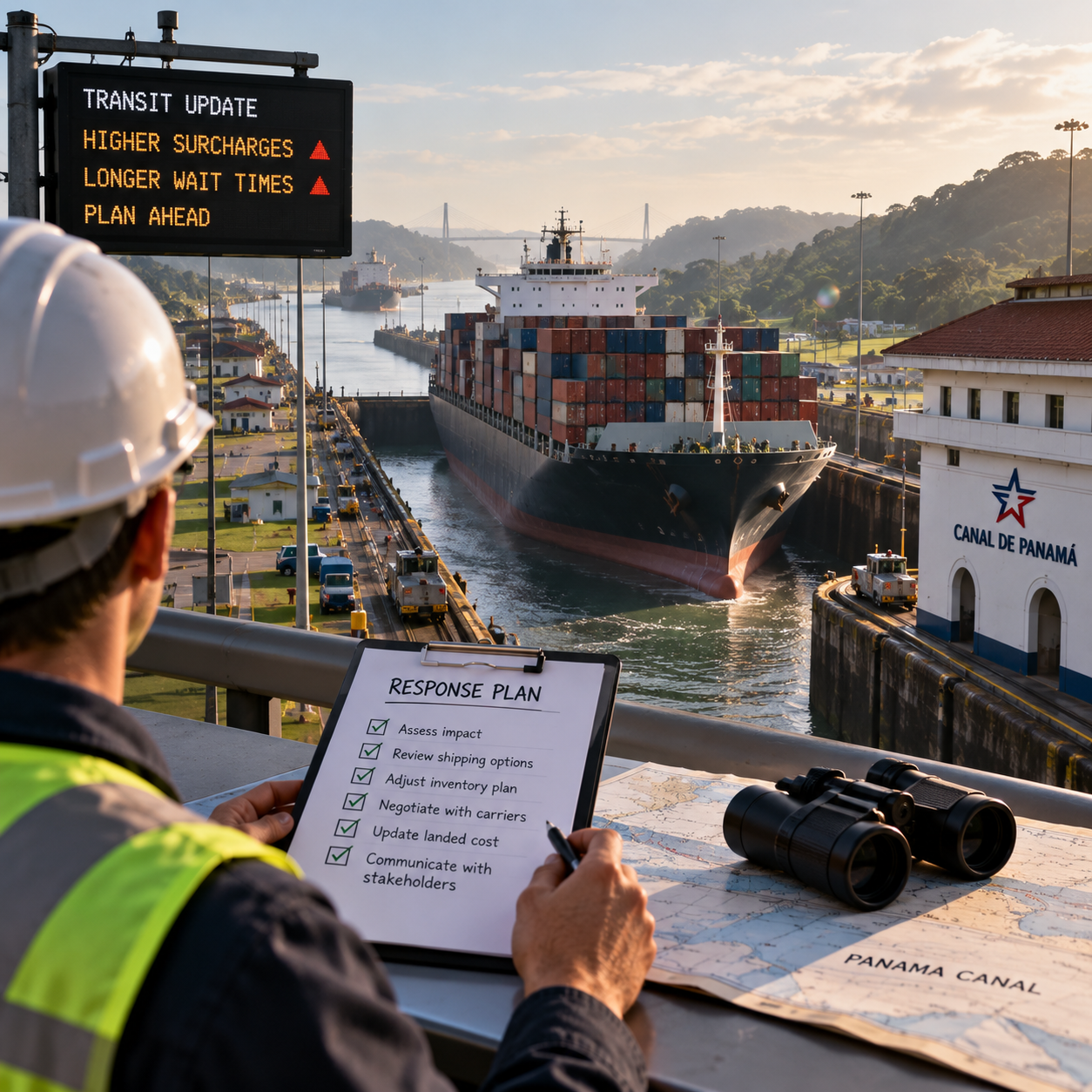
Panama Canal restrictions create more than a freight-rate problem for importers. When vessel draft limits persist and carriers introduce or increase fees, the effects can spread across landed cost, booking availability, transit reliability, inventory timing and customer margins. A shipment that still follows its normal route may cost more, while rerouting it can introduce longer lead times and additional handling.
Supply Chain Dive reports that continuing draft restrictions have prompted surcharge action by ocean carriers, including MSC and CMA CGM. For importers, the immediate task is not to predict water levels. It is to identify which open and planned shipments are exposed, recalculate commercial assumptions and establish a repeatable routing decision while conditions remain uncertain.
Map exposure by lane, vessel and booking status
Begin with a shipment-level register rather than a general list of suppliers. Canal exposure depends on the actual service and routing, not merely the origin and destination countries. A carrier may change a rotation, transship cargo, pass through the canal under operating restrictions or apply a fee according to its own effective date and scope.
For every open purchase order and forecast booking, record the origin port, destination port, carrier, service, planned canal passage, container type, booking date, sailing date, arrival commitment and quoted surcharge terms. Separate the register into four groups: cargo already on the water, confirmed bookings, requested but unconfirmed bookings, and future orders not yet placed.
This separation matters because the available response differs. Cargo already moving may leave little routing flexibility, making cost recovery and customer communication the priorities. Confirmed bookings require a check of whether the surcharge applies and whether the carrier can change routing. Unconfirmed and future shipments offer more scope to compare services, consolidate orders or alter inventory timing.
Ask the carrier or forwarder to confirm the service string and fee in writing. The source reports surcharge action by MSC and CMA CGM, but an importer should not assume identical applicability across carriers, lanes or contract types. Verify the charge name, amount, currency, effective date, calculation basis, origin and destination scope, and whether it applies according to booking, gate-in, bill-of-lading or sailing date.
Recalculate landed cost at shipment and product level
A canal-related fee should be incorporated into landed cost before accepting a route or issuing a customer quote. Add the confirmed carrier charge to base ocean freight, other carrier fees, inland transport, port and terminal costs, customs-related costs, insurance and any incremental handling. Then allocate the total across products using a defensible basis such as container space, weight, units or customs value.
Do not stop at the invoice from the carrier. Draft restrictions can alter vessel utilisation and schedule performance, while an alternative route may increase days in transit. The commercial comparison should therefore include:
- the canal surcharge and any related carrier fees;
- incremental transshipment, port or inland transport costs;
- the financing cost of inventory held for additional transit days;
- safety-stock requirements caused by less predictable arrivals;
- demurrage, detention or storage exposure where schedules become unstable;
- expediting costs if delayed inputs threaten production or customer service;
- the margin effect of missed delivery windows or contractual penalties.
Run at least three scenarios: the current canal service with the confirmed fee, an alternative routing, and a disruption case in which transit takes longer than quoted. Use supplier and carrier quotes for the inputs rather than unsupported assumptions. This creates a range for management decisions without pretending that operating conditions are certain.
Compare routes on total cost, lead time and reliability
A lower freight quote is not automatically the cheapest option. Alternatives might involve another canal, a different coast, transshipment, a land bridge or a revised origin or destination port. Each possibility changes the cost structure and operational risk.
Build a route comparison table containing total landed cost, port-to-port transit, expected door-to-door lead time, number of handoffs, sailing frequency, capacity confidence, schedule reliability and the consequences of delay. Include the operational effort required to change customs instructions, inland transport, documentation or warehouse appointments.
The correct route can differ by product. High-margin, time-sensitive or production-critical cargo may justify a more expensive but more reliable service. Low-margin and predictable goods may tolerate a longer route if inventory can be ordered earlier. Bulky products can be especially sensitive to container-level surcharges, while seasonal merchandise may lose much of its value if it arrives after the selling window.
A practical decision rule is to retain the canal route when its all-in cost and risk remain below the cost of the best feasible alternative. Reroute when avoided fees and improved reliability outweigh additional transport, inventory and handling costs. Split volume when no single option provides acceptable capacity and timing. Document the assumptions and set an expiry date for the decision because fees and restrictions can change.
Reset inventory timing and quote validity
Procurement teams should translate routing uncertainty into ordering decisions. Review reorder points and required-arrival dates for exposed products, giving priority to production inputs, contractual customer orders and seasonal stock. Bringing every order forward can create excess inventory and cash pressure, so timing adjustments should be based on the cost of a late arrival versus the cost of holding stock longer.
Commercial quotes also need shorter, clearer validity rules. A long-validity delivered-price quote can leave the importer carrying a surcharge introduced after the customer accepts. State how long freight-inclusive pricing remains valid and identify which transport charges may be passed through or repriced. Avoid vague language: define the triggering event, supporting documentation, notice period and treatment of confirmed versus future orders.
For internal approvals, add a freight contingency threshold. Below it, logistics or procurement may proceed; above it, finance or commercial management should review the margin and customer commitment. This prevents small operational changes from silently turning profitable orders into loss-making ones.
Revise supplier and customer responsibilities
Check the Incoterm and transport clauses on each affected transaction. The party arranging ocean freight may receive the carrier invoice, but that does not automatically determine who ultimately bears the economic cost. Responsibilities depend on the agreed term and contract wording.
With suppliers, clarify whether open orders can be consolidated, advanced, delayed or moved through another port. Request visibility into cargo-ready dates because a cheaper route has little value if production timing makes the sailing impossible. If suppliers nominate freight, require disclosure of new fees before shipment and confirmation of the service used.
Customer communication should distinguish confirmed facts from possible disruption. Explain the affected order, the verified fee or routing issue, the options under consideration and the deadline for a decision. Where a price adjustment is contractually permitted, provide the carrier evidence and show how the charge is allocated. Where it is not, quantify the margin impact before promising the original price and delivery date.
Run a recurring canal-risk review
Assign one owner to refresh the exposure register at least weekly while restrictions and carrier responses remain fluid. The review should cover new carrier notices, booking acceptance, routing confirmation, charge applicability, projected arrivals and orders approaching their quote-validity deadline.
For each exposed shipment, complete five actions: obtain written fee and route confirmation; update landed cost; compare the best alternative on total cost, lead time and reliability; decide whether inventory timing must change; and notify the relevant supplier, customer and finance owner. Escalate cases where the carrier cannot confirm routing, the new cost breaches the margin threshold or a delay threatens production or a customer commitment.
The aim is not to choose a permanent replacement for the Panama Canal. It is to stop uncertain restrictions and carrier fees from entering the business as unmeasured costs. Shipment-level visibility, time-limited routing decisions and explicit commercial terms give importers room to respond as operating conditions change.