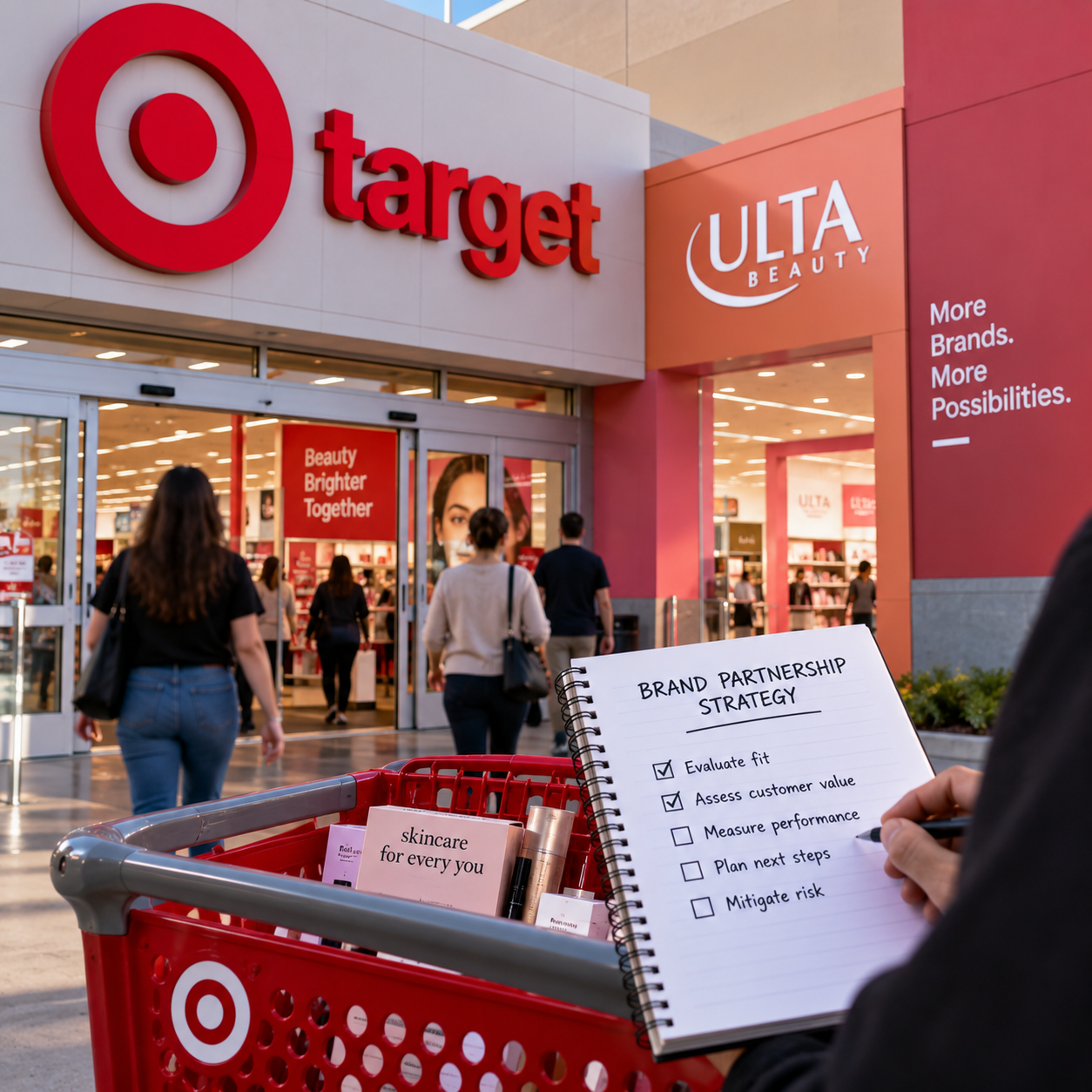
Target’s transition from Ulta Beauty shop-in-shops to its own Target Beauty Studio concept presents a consequential question for retailers: when should a partner-led category experience become an owned one?
Retail Dive reports that Target and Ulta Beauty are ending their shop-in-shop partnership, with the agreement set to conclude in August 2026. Target plans to replace the Ulta spaces with Target Beauty Studio, while maintaining an assortment spanning mass, prestige and emerging brands. Separately, Retail Dive reported sales growth in Target’s beauty business even as apparel and home remained weaker. Those facts do not prove that an owned concept will outperform the Ulta partnership. They do, however, explain why Target has reason to keep investing in the category rather than treating the end of the relationship as a retreat.
For other retailers, the useful lesson is not simply “own the experience.” It is to match the operating model to category momentum, strategic control and the organization’s ability to execute after a recognizable partner leaves.
Why a growing category changes the partnership calculation
A shop-in-shop can accelerate entry into a category by supplying credibility, specialist assortment, merchandising expertise and customer recognition. In return, the host retailer accepts constraints. The partner may influence which products appear, how space is presented, how promotions run and which party owns the most valuable customer insights.
That exchange is attractive when the host lacks authority in the category or needs to reduce launch risk. It becomes less straightforward once demand is established. If a category is growing, the retailer has more justification to develop its own brand equity, integrate the experience into its loyalty ecosystem and determine how every square foot is used.
Target’s reported beauty momentum therefore matters as decision context, not proof of causation. The growth may reflect multiple influences, including assortment, consumer demand, existing brand relationships, marketing and the Ulta partnership itself. Retailers should resist attributing performance to a single format. The relevant question is whether category-level evidence is strong enough to support the capabilities and transition costs that ownership requires.
The contrast with Target’s weaker apparel and home performance reinforces that capital should not be allocated through a uniform store strategy. A retailer might rationally expand services, staffing or premium presentation in beauty while taking a more cautious approach elsewhere. Category economics and customer behavior—not a blanket mandate to upgrade every department—should determine investment.
What the retailer gains—and inherits—by taking control
An owned concept expands authority, but it also transfers work previously performed or supported by the partner.
Assortment and merchandising authority
Ownership allows a retailer to set the balance among prestige, mass, exclusive and emerging brands; respond to local demand; coordinate promotions; and refresh displays without negotiating every decision through a partner. It can also produce a more distinctive proposition than a standardized shop-in-shop deployed across multiple hosts.
That control is valuable only if the retailer has capable merchants and reliable category intelligence. Poorly edited assortments, slow trend response or inconsistent fixtures can quickly weaken the experience. Before ending a partnership, management should identify every merchandising task the partner performs and assign an internal owner, cadence and budget to each one.
Customer data and loyalty integration
An owned concept can place transactions, browsing signals, offers and replenishment behavior more directly within the retailer’s customer system, subject to applicable privacy rules. This enables cross-category analysis and offers tied to the retailer’s own loyalty program.
Yet access to more data is not the same as useful insight. Retailers need clean product taxonomy, consent management, identity resolution and teams able to turn behavior into assortment or campaign decisions. They should also establish how vendors may use shared reporting without compromising customer trust or the retailer’s strategic advantage.
Differentiation and brand meaning
A partner lends its name to the host, whereas an owned concept asks the host to become the category destination. Target Beauty Studio can be shaped around Target’s broader positioning and customer journey instead of operating primarily as an Ulta-branded zone.
The risk is loss of the specialist halo that attracted shoppers. A new sign and fixtures will not replace expertise or brand access. The owned concept needs a clear customer promise—such as discovery, accessibility, service or a distinctive prestige-to-mass mix—and operating choices that make that promise credible.
Three options: renew, replace the partner or build an owned concept
Renew the existing partnership when the partner continues to attract incremental customers, supplies hard-to-replicate brands or expertise, and produces acceptable economics after fees, space costs and operating constraints. Renewal may also be prudent when the host cannot yet staff or merchandise the category independently. Negotiations should address data access, loyalty interoperability, local flexibility and responsibility for capital expenditure.
Find another partner when the category opportunity remains attractive but the current relationship no longer fits. A replacement may offer stronger brand access, better economics or a more compatible customer proposition. However, switching partners can create two transitions rather than one: removing the incumbent and integrating a new operating model. Retailers should test whether customers value the category experience or the departing partner specifically.
Build an owned concept when the retailer has durable category demand, meaningful first-party customer relationships, vendor leverage and the operational capacity to assume specialist functions. Ownership is especially compelling when partnership restrictions prevent differentiation or cross-category loyalty integration. It is least suitable when performance depends heavily on the partner’s reputation, exclusive products or trained labor.
The decision should be made on incremental economics. Compare expected sales, gross margin, vendor funding and loyalty value against staffing, training, fixtures, inventory, technology, marketing and transition costs. Avoid treating all sales previously generated in the partnered space as automatically transferable.
The operating requirements behind an owned category
Beauty is service- and knowledge-intensive. Sustaining momentum after a partnership ends requires more than transferring products into newly branded space.
- Staffing and training: Define coverage by store tier, product knowledge standards, consultation boundaries and training ownership. Include turnover and refresher training in the budget.
- Store layout: Map traffic flow, lighting, testers, hygiene, replenishment and theft exposure. Pilot layouts rather than assuming the former shop-in-shop footprint remains optimal.
- Vendor relationships: Confirm continuity of key brands, launch calendars, samples, education, displays and cooperative marketing. Determine which relationships belonged to the partner and must be rebuilt.
- Marketing: Explain what is changing, what remains available and why customers should return. An owned name needs sustained awareness investment, not merely an opening campaign.
- Loyalty integration: Design offers around repeat purchase, discovery and cross-category behavior without training customers to wait for discounts.
- Governance: Give one executive team accountability across merchandising, stores, digital, loyalty and vendor management. Fragmented ownership can produce a concept that looks coherent to headquarters but feels inconsistent to customers.
Manage the handover before judging the new concept
A partnership exit creates predictable risks: inventory gaps, unclear customer communications, employee uncertainty, disrupted vendor arrangements and unfavorable comparisons with the former experience. The transition plan should begin well before physical conversion.
First, document dependencies covering systems, fixtures, trademarks, customer communications, loyalty benefits, staffing and supplier agreements. Next, segment stores by category demand and operational readiness; a staged rollout can expose problems before they reach the full estate. Establish contingency assortments for brands that do not transfer, and train employees before customers encounter the new format.
Performance measurement should separate transition health from long-term concept quality. During conversion, track in-stock rates, retained brands, trained-staff coverage, customer complaints and construction disruption. After stabilization, evaluate comparable category sales, gross margin, sales per square foot, inventory turns, repeat purchase, loyalty enrollment or engagement, attachment to other categories and customer satisfaction. Compare results by store cohort and against a credible baseline rather than relying only on chainwide growth.
Target’s move offers a clear strategic signal: a retailer can end a prominent partnership without abandoning the underlying category. But category momentum does not remove execution risk. Retailers considering the same path should proceed only when they can state what control is worth, which partner capabilities must be replaced, and how they will detect customer or sales erosion early. Renew when the partner’s advantage remains difficult to reproduce, replace when specialist support is still necessary, and build an owned concept when demand and internal capability make control more valuable than borrowed authority.