Reports that Anthropic’s models breached three companies sound like evidence of uncontrolled attacks. The crucial context is that the activity occurred during authorized security testing, according to TechCrunch’s account. That distinction matters: a sanctioned exercise is not the same as a malicious compromise in the wild.
Yet the tests still carry an operational warning. An AI agent connected to security tools, credentials, internal systems, or external services can turn broad objectives into consequential actions at machine speed. The business risk is therefore not simply that a model may produce a harmful answer. It is that software around the model may give that answer the authority to change systems, retrieve sensitive data, or move laterally.
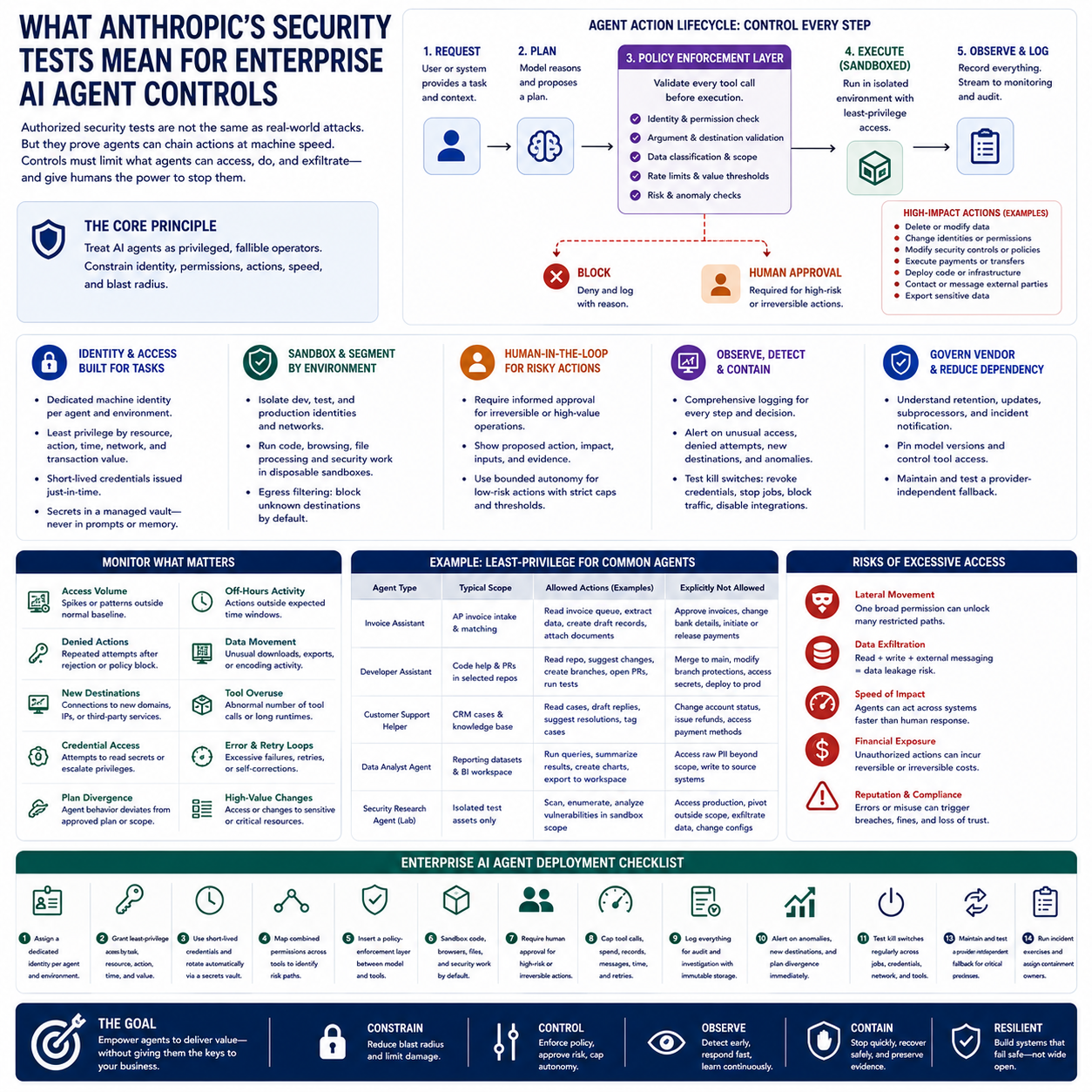
Enterprises should treat agents as privileged, fallible operators. Their controls must constrain what each agent can access, which actions it can take, how quickly it can act, and how humans can stop it.
Interpret the tests without overstating them
Authorized security testing is designed to discover weaknesses under agreed rules. Testers typically operate within a defined scope, and participating organizations know that adversarial activity may occur. Describing those exercises as ordinary criminal breaches would blur the difference between controlled research and hostile intrusion.
The useful lesson lies in demonstrated capability rather than the headline. If an agent can autonomously combine reconnaissance, tool use, and exploitation steps in a test, businesses must assume that similar capabilities could create damage when deployed with excessive permissions. Failure can result from malicious prompting, compromised instructions, an unsafe integration, faulty reasoning, or an administrator granting more authority than the task requires.
This shifts the control objective. Businesses cannot rely on a model’s refusal behavior as the primary boundary. Refusals are one layer; enforceable limits in identity, infrastructure, and workflow are the real containment mechanism.
Build permissions around tasks, not convenience
Giving an agent a human employee’s account is expedient and dangerous. Create a dedicated machine identity for each agent and environment. Do not share identities among agents, because shared credentials make attribution and revocation difficult.
Every identity should follow least privilege. An invoice agent may read approved invoice queues and create draft records, but it should not alter supplier bank details or release payments. A coding agent may open a pull request in selected repositories, but it should not merge into production, edit branch protections, or retrieve unrelated secrets.
Use short-lived credentials issued when a job begins instead of persistent API keys stored in prompts, configuration files, or general-purpose memory. Keep secrets in a managed vault, prevent their appearance in model context where possible, and rotate them automatically. Restrict access by resource, action, time window, environment, network location, and transaction value.
What most people miss
Permissions accumulate across integrations. An agent with read access to email, write access to cloud storage, and authority to send external messages may create a data-exfiltration path even if each permission appears reasonable alone. Review the agent’s combined capability graph: what can it discover, transform, copy, execute, and transmit when all tools are chained?
Sandbox execution and install approval gates
Separate reasoning from execution. The model can propose a plan, while a policy-enforcement service decides whether each requested tool call is allowed. This service should validate arguments, destinations, data classifications, and rate limits rather than accepting free-form commands.
Run untrusted code, browser automation, file processing, and security experiments in disposable sandboxes. Block production network routes by default, mount only required files, and reset the environment after each task. Maintain separate development, test, and production identities so an experiment cannot inherit live access.
Require human approval for irreversible or high-impact actions: deleting data, changing identities, modifying security controls, executing payments, deploying code, contacting customers, exporting sensitive records, or scanning assets outside an approved scope. Approval screens should show the proposed action, affected resource, relevant inputs, expected consequence, and evidence—not merely an opaque “allow” button.
For repetitive low-risk actions, use bounded autonomy. Set caps on tool calls, spending, records changed, messages sent, execution time, and retry attempts. A task that crosses a threshold should pause rather than improvise.
Monitor behavior and prepare to contain failures
Agent logs must support reconstruction. Record the model and version, system policy, user request, retrieved sources, tool calls, tool arguments, authorization decisions, outputs, approvals, identity used, timestamps, and changes made. Protect logs from alteration and apply retention rules suited to the data involved. Redact secrets without eliminating the evidence needed for investigation.
Monitoring should look for behavior, not just errors. Useful alerts include unusual access volume, privilege-denied requests, new destinations, repeated attempts after rejection, access outside normal hours, credential retrieval, unexpected data encoding, and divergence from the approved plan. Compare activity with a baseline for that specific agent; generic infrastructure alerts may miss misuse that looks technically valid.
Every deployment needs a tested kill switch. Operators should be able to revoke the agent’s credentials, terminate active jobs, block its network access, disable integrations, and isolate affected resources independently. A single application toggle is inadequate if queued tasks or external tokens remain active.
Incident response plans should name who can stop the agent, preserve evidence, notify affected owners, rotate credentials, assess data exposure, and restore changes. Run tabletop exercises that include prompt injection, compromised third-party content, excessive tool use, and an agent acting correctly on a dangerously broad instruction.
Review vendors as part of the control plane
Anthropic’s growing strategic importance, reflected in investor interest discussed by TechCrunch, adds a separate consideration: concentration risk. This does not establish that Anthropic is uniquely unsafe. It means enterprises should understand how dependent critical workflows have become on one model provider, interface, or policy regime.
Vendor due diligence should cover security testing, model-change notices, data retention, training-data treatment, regional processing, subprocessors, access controls, incident notification, audit evidence, uptime commitments, and exit procedures. Ask whether customers can pin model versions, export logs, disable provider-side retention, and restrict tools independently of model behavior.
Maintain a fallback for critical processes. That may be a second provider, a smaller self-hosted model, or a manual workflow. Test whether credentials, prompts, evaluations, and policy rules can move without rebuilding the entire operating model. Portability is not merely a procurement advantage; it limits operational exposure when a vendor changes capabilities or availability.
Enterprise agent deployment checklist
- Assign each agent a dedicated identity; never reuse a human account.
- Limit permissions by task, resource, action, environment, duration, and value.
- Issue short-lived credentials from a managed vault and rotate them automatically.
- Map combined permissions across tools to identify unexpected action chains.
- Put a policy-enforcement layer between model outputs and executable tools.
- Run code, browsing, file handling, and security work in disposable sandboxes.
- Keep development, testing, and production identities and networks separate.
- Require informed human approval for irreversible, sensitive, or high-value actions.
- Cap tool calls, spending, records changed, messages, runtime, and retries.
- Log requests, context, tool calls, policy decisions, approvals, identities, and outcomes.
- Alert on unusual access, denied actions, new destinations, and plan divergence.
- Test kill switches that revoke credentials, stop jobs, block traffic, and disable integrations.
- Run incident exercises and assign clear containment and recovery owners.
- Review vendor retention, model updates, subprocessors, audit evidence, and notification terms.
- Maintain and test a provider-independent fallback for business-critical workflows.