B2B and B2C are often described as two sales styles, but for operators they are two different systems. The distinction affects how leads are qualified, how pricing is presented, how fast deals move, and what your team needs to measure every week.
If you run a small business, the real question is not which one is “better.” It is which sales motion matches your product, your cash flow, and the amount of process you can support without creating friction.
Why the B2B versus B2C split matters operationally
The biggest mistake founders make is copying the wrong selling motion. A B2C offer that depends on a quick checkout does not behave like a B2B offer that needs approvals, procurement, or a demo. Likewise, a B2B team trying to sell like a consumer brand can create more leads but less revenue visibility.
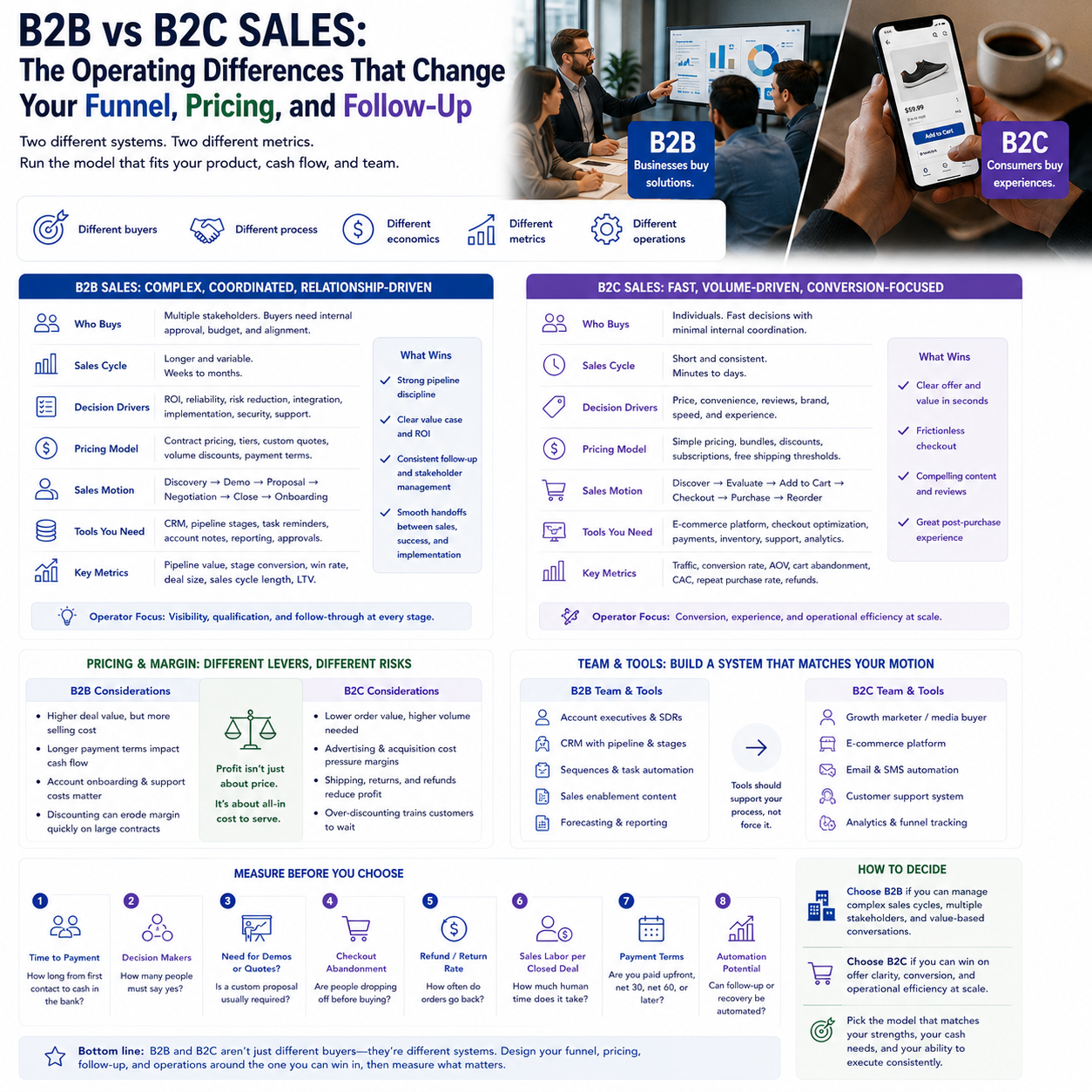
In practical terms, the sales model shapes your workflow. B2C usually favors shorter cycles, simpler checkout paths, higher volume, and tighter attention to conversion rates. B2B usually rewards structured qualification, pipeline stages, account notes, follow-up discipline, and CRM hygiene. The same product can even require different motions depending on who buys it and why.
That means your decision is not just about messaging. It affects staffing, tooling, and how quickly you can turn interest into cash.
What B2B sales needs that B2C usually does not
B2B sales tends to require more control over the process. A founder selling to businesses often needs visibility into where each account sits: contacted, meeting booked, demo completed, proposal sent, legal review, negotiation, and closed. Without that structure, revenue becomes hard to forecast and deals stall without warning.
Another difference is deal context. A B2B buyer is rarely buying only for themselves. They may need internal approval, a budget owner, or a technical stakeholder. That changes the content your team needs to provide. Instead of just product benefits, you may need implementation details, pricing logic, onboarding steps, security notes, and response timelines.
What most people miss
Many small businesses think B2B means “sell more expensive things to companies.” The real difference is that B2B often adds a coordination cost. Every extra approver, step, or dependency increases the chance that the deal will slow down. If your business does not track that friction, you will misread interest as pipeline strength.
That is why B2B operators should watch stage conversion rates and time-to-close by deal size, not just total lead volume. A healthy funnel with too many stalled deals can look busy while actually starving cash flow.
What B2C sales needs that B2B usually does not
B2C sales is usually less about account management and more about conversion design. The user journey matters: page speed, offer clarity, checkout steps, payment options, abandonment recovery, and post-purchase messaging. If the buying decision is low-friction, a small drop in checkout performance can have an outsized effect on revenue.
For operators, the issue is often not persuasion but process. Can the customer understand the offer in one screen? Can they pay with their preferred method? Can the business handle returns, refunds, and support requests without eroding margin? In B2C, operational leakage often appears in cart abandonment, support tickets, shipping errors, and refund rates.
This is also why B2C teams often need tighter experimentation loops. Product pages, bundles, discounts, upsells, and remarketing flows should be measured quickly, because consumer demand can change fast and the bottleneck is often the page or the offer rather than the sales rep.
How the sales motion changes pricing and margin
Pricing in B2B and B2C is not just a number; it is part of the operating model. B2B pricing can support higher average order values, but it also usually brings higher sales labor, longer payment terms, and more expectation around service or implementation. That means gross margin alone is not enough. You need to understand selling cost, onboarding cost, and support cost per account.
B2C pricing is often easier to present but harder to protect. Consumers compare quickly, so discounting can become a crutch. If you rely on promotions to move product, you need to know whether the margin can absorb those discounts after shipping, fulfillment, payment processing, and returns.
For founders deciding between the two, the useful question is: where does profit get lost? In B2B, it is often lost in time, labor, and elongated payment cycles. In B2C, it is often lost in acquisition cost, fulfillment, and post-purchase service. The better model is the one where your economics stay intact after the real operating costs are included.
How to set up your team and tools around the right model
The sales motion should determine the tools, not the other way around. A B2B team usually needs a CRM with deal stages, task reminders, notes, pipeline reporting, and maybe approval workflows. If the deal cycle is longer, automation should focus on follow-up discipline and handoff quality, not just lead capture.
B2C teams usually need stronger commerce infrastructure: checkout optimization, payment processing, inventory visibility, abandoned cart recovery, customer support routing, and fulfillment tracking. If the business uses multiple channels, it also needs consistent product and pricing data across those channels.
Small businesses often overbuild too early. A founder who needs a simple B2C checkout should not buy an enterprise sales stack. A founder running B2B outbound should not rely on a lightweight storefront tool with no pipeline visibility. The wrong stack creates invisible costs in training, reporting, and lost opportunities.
What to measure before you choose a motion
Before committing to B2B or B2C, measure the operational path from lead to revenue. The point is to see where the friction lives and whether your team can support it consistently. If the product is simple but the buying process is complex, you may need a B2B motion. If the buying decision is fast but volume is the game, a B2C motion may fit better.
- Average time from first contact to payment
- Number of decision makers involved in the sale
- Need for demos, proposals, or custom quotes
- Checkout abandonment or cart drop-off rate
- Refund, return, or support volume after purchase
- Sales labor required per closed deal
- Payment terms and cash collection timing
- Ability to automate follow-up, reminders, or order recovery
Use those signals to decide where your process is strongest. If your team can manage structured follow-up and multi-step approval without losing momentum, B2B may fit. If your advantage is a clear offer and smooth checkout, B2C may be the better operating model.