Corporate taxes are not just a filing issue. For small business owners, they affect how much cash stays in the company, how aggressively you can reinvest, and whether your current entity structure still makes sense. If you are building a business with thin margins or uneven cash flow, tax treatment can quietly shape every major operational decision.
This article focuses on the practical side: what corp taxes change in day-to-day business planning, where owners often misread the trade-offs, and how to use tax timing as part of your operating model rather than treating it as year-end paperwork.
Why corporate taxes affect more than the tax bill
The obvious effect of corporate taxes is the amount owed to the government. The less obvious effect is how they alter the amount of capital you can keep inside the business. That matters when you are paying for inventory, hiring help, funding ads, or upgrading software.
For owner-led businesses, tax structure also changes the timing of decisions. A company that expects tax payments later in the year may look profitable on paper while still facing a cash squeeze. That can lead to bad timing on hires, inventory purchases, or vendor commitments.
Founders should think of corp taxes as part of working capital management. The tax rate, deductible expenses, and payment schedule all influence how much room you have to operate without borrowing or delaying other obligations.
What small business owners should model before choosing an entity
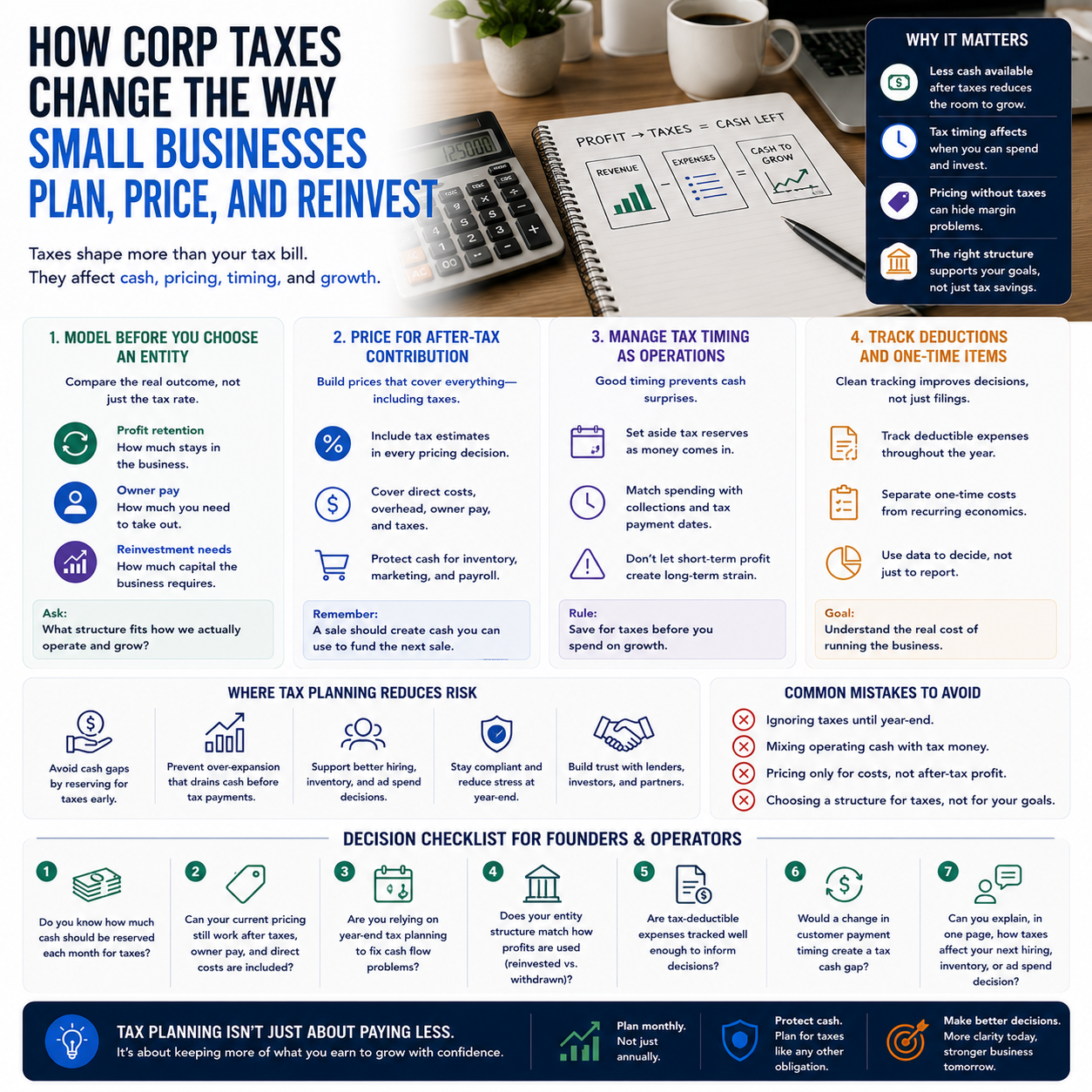
Before changing structure or assuming a corporate setup is better, model the business from three angles: profit retention, owner pay, and reinvestment needs. A structure that looks efficient on paper may leave less flexibility if the business needs to distribute cash regularly to the owner.
Compare how taxes affect the company if earnings stay inside the business versus how they affect the owner if profits are withdrawn. For some businesses, keeping funds in the company for expansion is the point. For others, the priority is predictable owner income. Those are different tax planning problems.
You should also review how deductible expenses are likely to change over the next 12 months. If you plan to spend on software, contractors, travel, or equipment, those expenses may reduce taxable income in ways that change the real cost of expansion.
What most people miss
The mistake is treating tax planning as something separate from pricing. If you price services or products without accounting for tax burden, you may think a margin is healthy when it is only healthy before taxes and owner compensation. That gap is one reason businesses grow revenue without improving cash.
How corp taxes influence pricing and margins
Pricing decisions should be made on after-tax contribution, not just gross margin. A product line with attractive markup can still drain cash if tax obligations reduce the funds available for inventory reorders, fulfillment, or marketing.
This is especially important for businesses that sell through channels with delayed payouts. If a marketplace or B2B customer pays later, but taxes are still due on schedule, you can end up financing growth with your own reserves. That is not a pricing problem alone; it is a tax timing problem.
Owners should build a simple pricing model that includes tax estimates alongside direct costs, fulfillment, and overhead. The goal is not perfect accuracy. The goal is to see whether each sale creates enough cash after taxes to support the next sale.
Service businesses should be especially careful with labor-heavy pricing. If tax obligations reduce the amount left after payroll and contractor costs, the business may need either higher rates or narrower service scope to stay resilient.
Where tax timing creates operational risk
Tax timing is one of the most common hidden risks in small business operations. A company may book strong sales in one quarter and still struggle to cover later tax payments because the cash was spent too early.
This risk grows when owners mix operational cash with funds intended for taxes. A practical fix is to set aside tax reserves as money comes in, not after the quarter closes. That does not remove the liability, but it keeps the tax obligation visible in the same way rent or payroll is visible.
Another risk appears when businesses expand too quickly after a profitable period. If profit is used to hire, stock inventory, or increase ad spend without reserving for taxes, the business may be forced to slow down exactly when it seemed ready to accelerate.
Owners should also watch how deductible losses, equipment purchases, or one-time costs affect future periods. A year with a major write-off may look better on taxes, but it can also mask the underlying operating cost of the business if you do not separate one-time events from recurring economics.
How to use tax planning in your operating system
Tax planning should sit inside your monthly operating review. That review does not need to be complex. It only needs to answer whether current profitability, reserves, and expected tax payments are aligned.
Start with a monthly estimate of taxable income, then compare that against cash collected and cash committed. If the gap is widening, the business may need a stricter collection policy, higher pricing, delayed spending, or a reserve account for tax obligations.
Owners who use accounting software should make sure tax categories are actually being tracked cleanly. If expense classification is sloppy, tax estimates will be unreliable, and the business may understate what it owes. Clean categorization also makes it easier to see whether spending is supporting growth or simply absorbing cash.
If you are considering a structure change, do not decide from tax savings alone. Compare tax effects with admin burden, distribution flexibility, and the need to retain earnings for growth. The right structure is the one that supports how the business really operates.
Decision criteria for founders and operators
Use the checklist below when deciding whether your current tax setup still fits the business:
- Do you know how much cash should be reserved each month for taxes?
- Can your current pricing still work after taxes, owner pay, and direct costs are included?
- Are you relying on year-end tax planning to fix cash flow problems that should be handled monthly?
- Does your entity structure match whether profits are mostly reinvested or mostly withdrawn?
- Are tax-deductible expenses being tracked well enough to inform decisions, not just filings?
- Would a change in payment timing from customers create a tax cash gap?
- Can you explain, in one page, how taxes affect your next hiring, inventory, or ad spend decision?
For small businesses, the real value of understanding corp taxes is not avoiding paperwork. It is making sure tax obligations do not distort pricing, spending, or growth decisions. Once that connection is visible, tax planning becomes an operating advantage instead of a surprise cost.