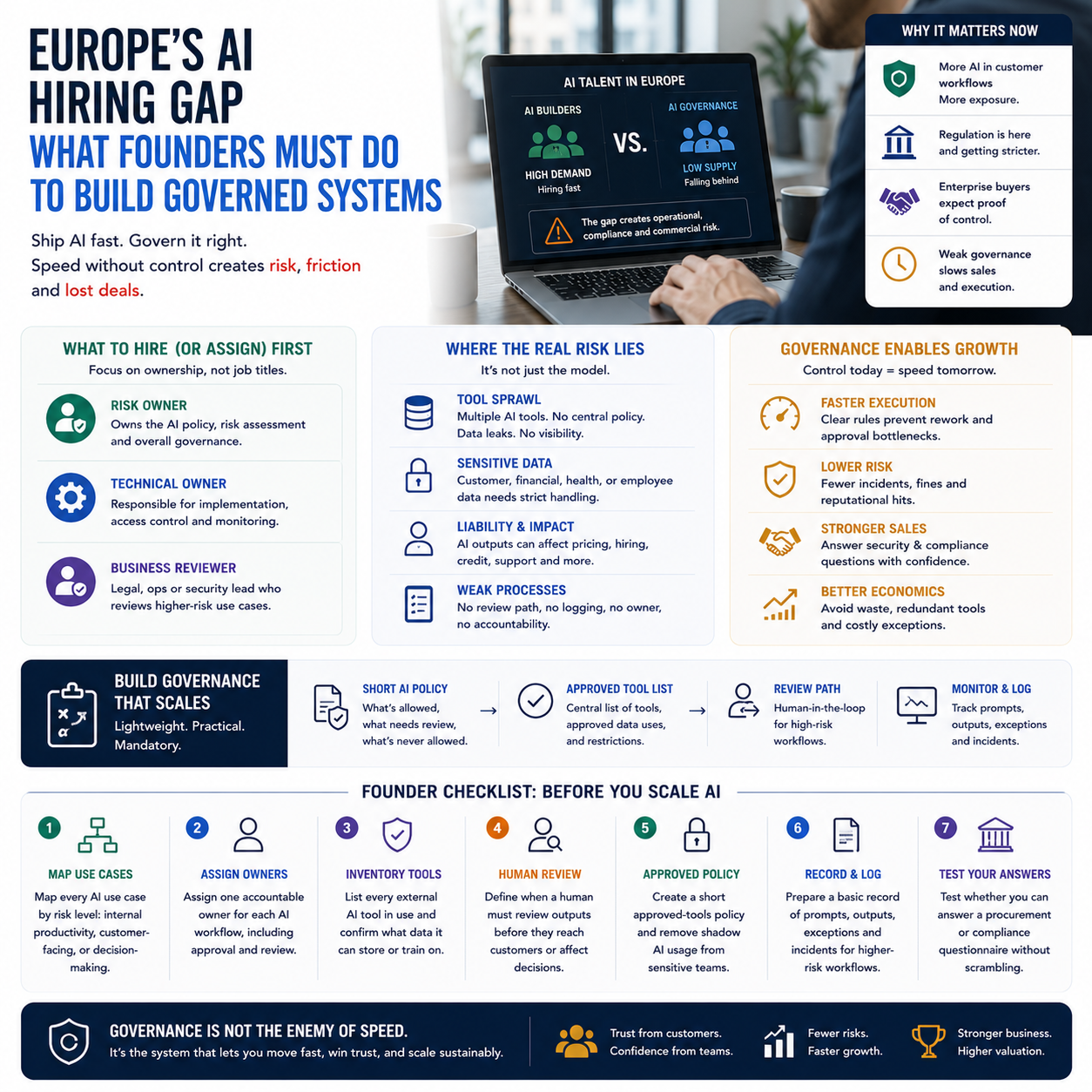
European startups are hiring to build AI systems quickly, but the governance layer is lagging behind. That creates a practical problem for founders: the faster you ship AI into customer workflows, the more you need clear ownership for compliance, review, access control and model oversight.
For small businesses and scale-ups, this is not an abstract policy issue. It affects how you staff, what you document, which tools you can safely connect, and how quickly you can sell into regulated customers.
Why the hiring imbalance matters for operators
The core signal is straightforward: companies are adding more AI builders than people who can govern AI risk. That gap matters because AI systems do not fail only at the model level. They fail in the operational layers around them: data permissions, human review, logging, vendor control, and responsibility when something goes wrong.
If you are a founder, this should change how you think about AI hiring. The first hire is often not the best prompt engineer or the most impressive model researcher. The early question is whether the company can control the system once it is connected to sales, support, finance, or customer data.
What to hire before you scale the AI stack
Most smaller teams cannot justify a full governance department. But they can assign the right responsibilities early. That usually means one person accountable for AI policy, one technical owner for implementation, and one reviewer from legal, operations or security depending on the business model.
For many founders, the better move is to define roles around risk, not job titles. Someone should own data access rules. Someone should approve external AI tools. Someone should decide when a human must review an output before it reaches a customer or internal decision.
What most people miss
Governance is not just about avoiding fines. It is also about preserving execution speed. Teams without clear AI controls often slow down later because every new workflow has to be audited from scratch, every customer asks different security questions, and every integration becomes a custom exception.
That is why governance should be built into the operating model early. The real cost is not only regulatory exposure. It is the hidden drag on sales cycles, procurement, and internal confidence when nobody knows who approved what.
Where the real operational risk sits
The biggest risk for smaller businesses is not usually the model itself. It is the combination of weak process design and tool sprawl. A team adopts an AI writing tool, then a support assistant, then an analytics layer, then an internal chatbot, and suddenly sensitive information is being copied across systems with no central policy.
That becomes especially relevant if your business handles customer data, health data, financial data, employee records or B2B contracts. In those cases, your AI stack is part of your compliance posture. If you cannot explain where the data goes, who can access it, and how outputs are checked, you are creating a commercial risk as much as a technical one.
Founders should also think about liability in customer-facing use cases. If AI is drafting pricing, recommending products, screening applicants or responding to support requests, a human fallback is not a nice-to-have. It is part of the control structure.
How to build governance without slowing growth
The most useful approach is to make governance lightweight but mandatory. You do not need a six-month policy project. You need a working system that tells the team what is allowed, what needs review, and what must never be automated.
That usually means creating a short AI use policy, an approved-tool list, and a review path for higher-risk workflows. A founder-led business can do this with a simple internal process, but the ownership has to be explicit. If ownership is vague, adoption becomes chaotic.
For companies selling into enterprise customers, governance is also a sales asset. Security questionnaires, data processing questions and AI risk reviews are already part of procurement. A business that can answer them quickly often moves faster than a competitor that has to improvise answers.
There is also a cost angle. Governance reduces wasted work by preventing teams from rebuilding the same approvals for every department. It also helps avoid vendor lock-in to tools that cannot meet data-handling or audit requirements later.
What founders should decide now
If you are evaluating AI investment, the important decision is not whether to hire “AI governance” as a standalone role. The decision is whether your current operating structure can prove control. If it cannot, then scaling AI use is a process problem, not a talent problem.
That means reviewing three things before expanding AI adoption: the risk level of the workflow, the sensitivity of the data involved, and the customer impact if the system is wrong. If any of those are high, governance needs to be embedded before rollout, not after.
- Map every AI use case by risk level: internal productivity, customer-facing, or decision-making.
- Assign one accountable owner for each AI workflow, including approval and review.
- List every external AI tool in use and confirm what data it can store or train on.
- Define when a human must review outputs before they reach customers or affect business decisions.
- Create a short approved-tools policy and remove shadow AI usage from sensitive teams.
- Prepare a basic record of prompts, outputs, exceptions and incidents for higher-risk workflows.
- Test whether you can answer a procurement or compliance questionnaire without scrambling.