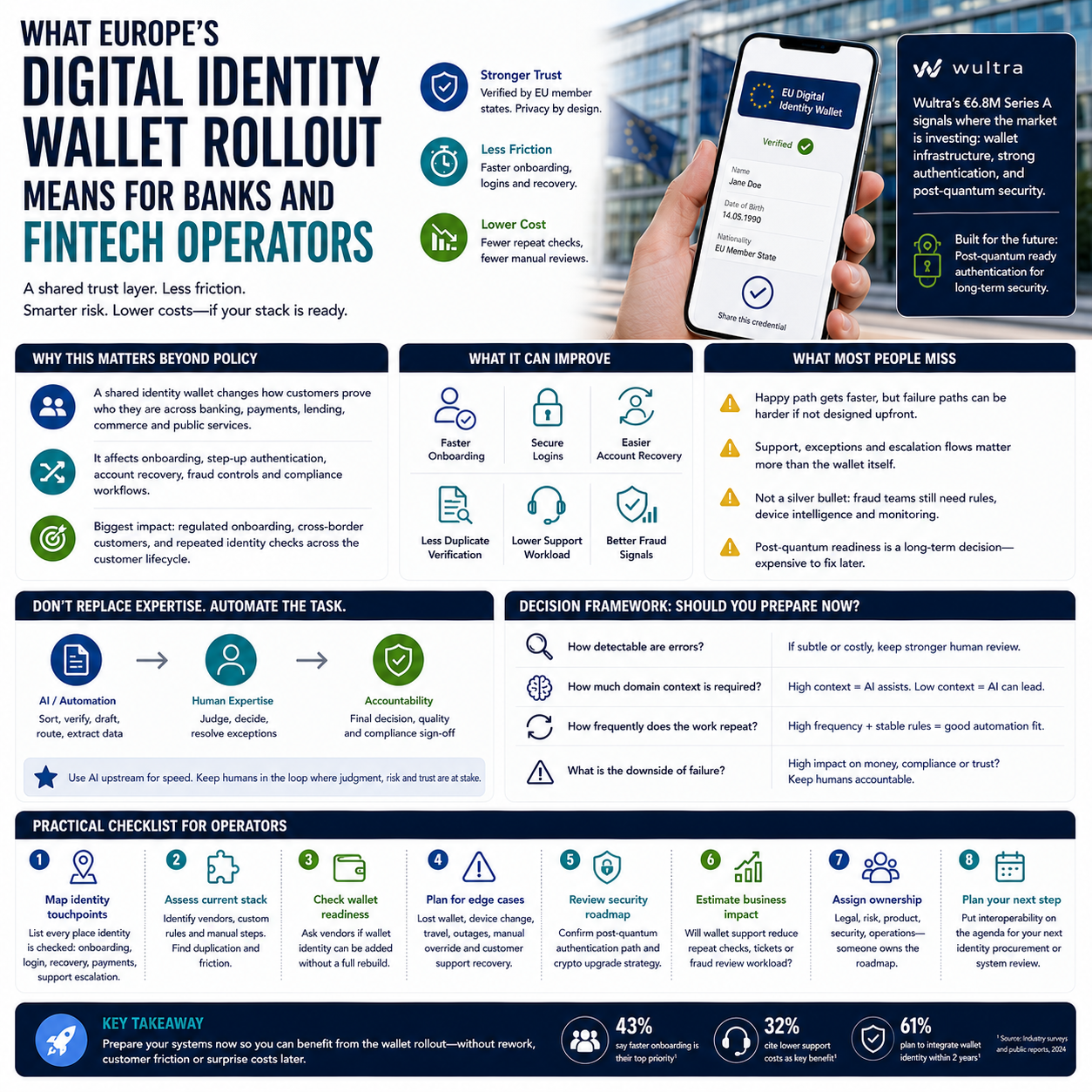
Europe’s digital identity wallet rollout is moving from policy ambition to implementation work. For banks and FinTechs, that changes the conversation from “should we track this?” to “which systems will need to connect first, and what breaks if we wait?”
The recent €6.8 million Series A raised by Wultra is a useful signal because it sits at the intersection of authentication, wallet infrastructure, and post-quantum security. The practical question for operators is not whether the rollout matters, but where it touches onboarding, login, fraud controls, and compliance workflows.
Why this matters beyond identity policy
The European Digital Identity Wallet is not just another digital government project. If adoption grows, it becomes a shared trust layer that can affect how customers prove who they are across banking, payments, lending, and regulated platforms. That changes the economics of identity checks, step-up authentication, and account recovery.
For founders and operators, the main implication is workflow design. Today, many businesses bolt together separate tools for sign-up verification, authentication, fraud scoring, and customer support escalation. A wallet-based identity flow can reduce friction in some parts of that stack, but only if the business has mapped where identity is checked, where it is re-checked, and where manual review still exists.
The firms that will feel this first are those with regulated onboarding, cross-border customers, and repeated identity checks across the customer lifecycle. If your business handles repeated KYC, age verification, or account recovery, the wallet rollout could alter both your vendor choices and your support load.
What Wultra’s funding signal suggests for operators
Wultra’s raise is useful because it points to where vendor investment is going: post-quantum authentication and digital identity tooling for banks and FinTechs. That tells operators that the market expects identity to become more embedded in product architecture, not just compliance operations.
If you buy identity services today, the question is no longer only about login convenience. It is about whether your authentication stack can support wallet-based identity proofs, future cryptographic requirements, and integration with the identity systems that European customers may increasingly expect to use.
For smaller companies, the takeaway is to avoid overbuilding. You do not need to redesign your entire onboarding flow around the wallet today. But you do need a vendor and integration review so you know whether your current stack can accept wallet-based verification later without a full rebuild.
What most people miss
Most coverage focuses on the wallet itself. The operational issue is the layer around it: support, exceptions, fraud handling, and escalation paths. Identity tools only save time when they reduce the number of cases that reach a human. If wallet verification speeds up the happy path but creates a harder failure path, your support cost can rise instead of fall.
That is why founders should study the edge cases first. What happens when a customer cannot access the wallet, changes devices, travels, loses access, or needs a manual override? If those scenarios are not designed upfront, the product team will simply push complexity into customer support or compliance teams.
This is also where post-quantum messaging matters. Many businesses will not need to become cryptography experts, but they should know whether their authentication vendor has a migration path. A long-lived customer identity system is expensive to replace. If you are choosing infrastructure now, vendor roadmaps matter more than feature demos.
The decision founders need to make now
The right decision is not “adopt wallet identity immediately” versus “ignore it.” The real choice is whether to prepare your stack for interoperability. That means deciding if wallet support should be part of your next identity procurement, next onboarding redesign, or next fraud program review.
For a bank, this may mean involving identity, risk, legal, and product together before committing to new authentication tooling. For a FinTech, it may mean asking whether wallet support can reduce repeated verification costs across multiple products. For an e-commerce operator in a regulated category, it may mean waiting for clearer adoption signals while making sure your existing identity vendor can integrate later without a custom project.
In practice, the most useful planning question is: where would wallet-based identity reduce friction, and where would it create exceptions? That answer will be different for consumer lending, remittances, age-gated commerce, and enterprise SaaS.
How to assess your current stack
Start with the systems that touch identity most often. Look at onboarding, login, recovery, fraud review, and support authentication. Then ask whether each system depends on a vendor, a custom rule, or a manual process.
If your stack already has fragmented identity checks, the wallet rollout is a reason to simplify, not add another layer. If your stack is already centralized, the wallet may become a new input rather than a new workflow. Either way, the biggest value comes from reducing duplicated verification and unnecessary human review.
It is also worth checking contract terms with vendors. Some identity and authentication tools charge by verification, by user, or by workflow volume. If wallet support changes verification patterns, your cost base may move in ways that are not obvious from product brochures.
What most people miss
Wallet infrastructure will not automatically lower fraud. It may improve trust, but fraud teams still need rules for takeover attempts, social engineering, and device-level risk. In other words, the wallet can be an input to risk scoring, not a replacement for it.
Practical checklist for operators
- Map every place identity is checked: onboarding, login, recovery, payments, and support escalation.
- Ask vendors whether wallet-based identity can be added without replacing core authentication or KYC workflows.
- Review failure handling: lost wallet, device change, travel, manual override, and customer support recovery.
- Check whether your vendor has a stated path for post-quantum authentication or cryptographic upgrades.
- Estimate whether wallet support would reduce repeat verification, support tickets, or fraud review workload.
- Decide who owns the rollout internally: product, risk, compliance, security, or operations.
- Put interoperability on the agenda for your next identity procurement or system review, even if you do not plan immediate adoption.