Europe’s energy transition is no longer only about regulation, subsidies, or long-term climate goals. It is increasingly shaping where industrial plants get built, which inputs become viable, and how much operational risk sits inside a company’s supply chain.
For founders and operators, the practical question is not whether the energy transition matters. It is how to translate that shift into a better location decision, a more resilient sourcing model, or a new product category that can survive higher input scrutiny.
Why the new energy story matters to operators
The source material points to two signals that business builders should not ignore. First, a Spanish startup focused on bio-based chemicals is investing in a commercial-scale plant in Portugal, backed by private and public capital. Second, a broader view of Europe’s energy reset argues that industrial opportunity is moving into areas once considered too expensive or too risky.
That combination matters because energy is not just a utility bill. For manufacturers, e-commerce brands with heavy packaging needs, logistics operators, and industrial software vendors, energy shapes product economics, supplier selection, and the ability to lock in long-term margins.
The real business issue is not “clean energy” in the abstract. It is whether a company’s cost base is exposed to fossil-linked inputs, grid volatility, permitting delays, or capex needs that become unmanageable if the firm picks the wrong geography or production model.
What Catalyxx’s Portugal decision signals
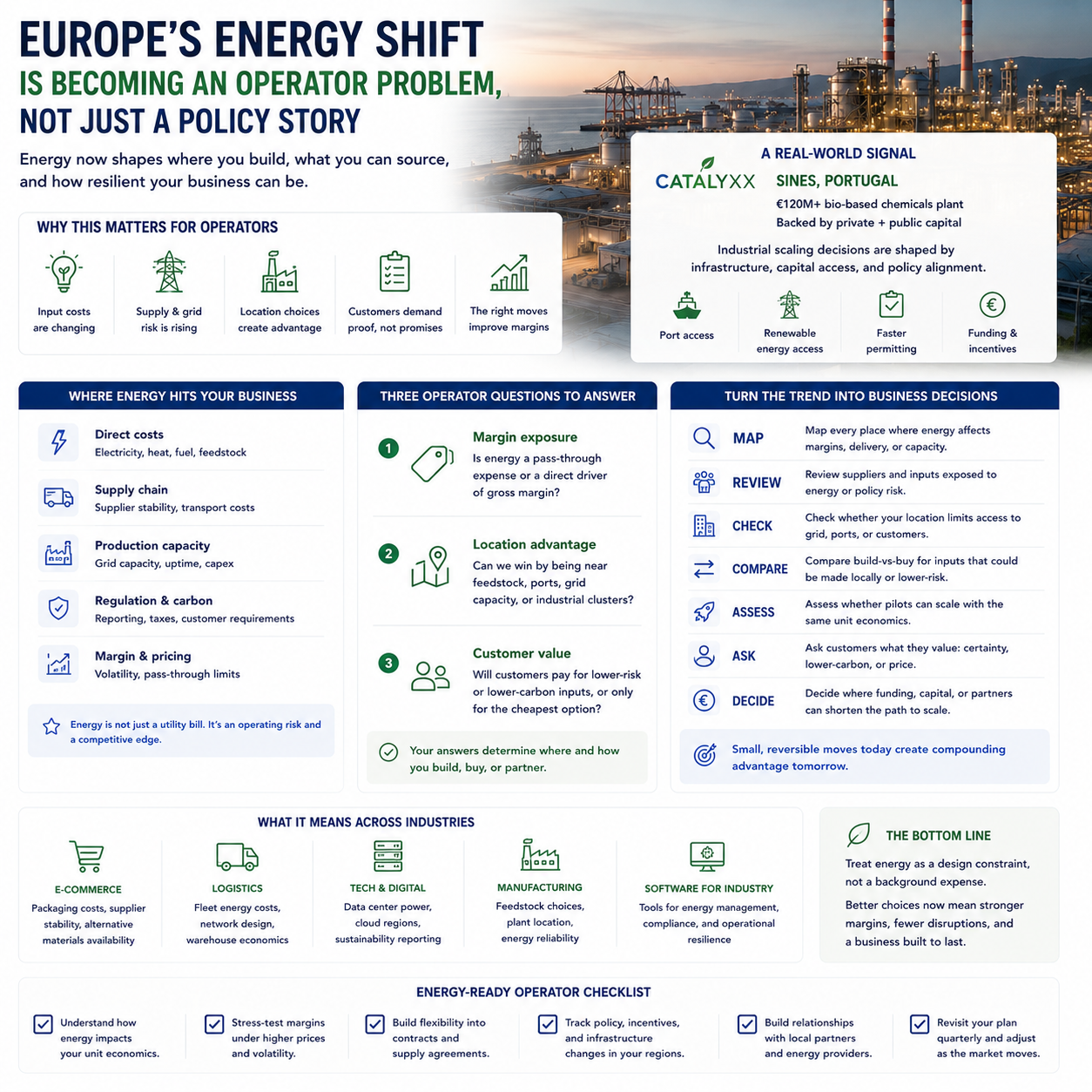
Catalyxx’s plan to build a €120 million bio-based chemicals facility in Sines, Portugal, is a useful signal for founders because it shows how industrial scaling decisions are increasingly shaped by infrastructure, capital access, and policy alignment at the same time.
The lesson is not that every company should move production to Portugal. The lesson is that site selection now has to be treated as a multi-variable operating decision. A location can change:
- energy input cost and reliability,
- access to public funding or development support,
- logistics to ports and industrial customers,
- permitting speed,
- and the credibility of a long-term supply story for enterprise buyers.
For product companies, especially those replacing petrochemical or fossil-derived inputs, this changes the sales conversation too. Buyers are not only asking whether the alternative works technically. They also want to know whether the supplier can scale, fund the plant, and keep unit economics stable enough to avoid future disruption.
How founders should think about energy-linked business models
The energy transition creates a useful filter for business models. Some businesses are merely exposed to higher energy costs. Others can turn those costs into a moat if they build around them early.
That means founders should ask three practical questions before doubling down on an energy-sensitive model:
- Is energy a pass-through expense, or does it directly determine gross margin?
- Can the business win by locating near feedstock, ports, grid capacity, or industrial clusters?
- Will the customer pay for the lower-risk or lower-carbon version, or only for the cheapest version?
If the answer to the first question is yes, the company needs procurement discipline and pricing flexibility. If the answer to the second is yes, location becomes strategic rather than administrative. If the answer to the third is yes, then the product needs a stronger proof point than sustainability language alone.
What most people miss
Many operators treat energy as a utilities issue handled by finance or facilities. That misses the fact that energy can determine whether a product is financeable at scale.
Once a business crosses from pilot to commercial production, the key question becomes whether the operating model still works when lenders, industrial buyers, and public agencies all demand evidence that the unit economics can hold under real-world constraints. That is where infrastructure, capital structure, and procurement strategy start to overlap.
What this means for companies outside heavy industry
This is not just a chemicals or manufacturing story. Even digital-first businesses should pay attention because energy market shifts ripple into packaging, warehousing, last-mile delivery, data infrastructure, and third-party manufacturing.
For e-commerce operators, this can affect packaging costs, supplier stability, and the ability to source alternative materials from vendors that are actually scalable. For logistics-heavy businesses, it affects fleet planning and warehouse economics. For software and services firms selling into industrial clients, it changes the language of value: uptime, predictability, and supply continuity often matter more than headline sustainability claims.
There is also a strategic upside. The companies that understand energy-linked operating costs early can spot partners and categories before they become crowded. That could mean choosing suppliers with better grid access, backing regional manufacturers with credible expansion plans, or building software that helps industrial customers manage energy-linked volatility.
How to turn the trend into a business decision
The useful response is not a broad sustainability strategy deck. It is a narrow operating review focused on where energy risk enters the business model and which decisions are still reversible.
Start by mapping every place where energy affects your margins, delivery promises, or production capacity. Then decide whether the correct response is to hedge, relocate, redesign, or partner.
- Review whether electricity, heat, fuel, or process inputs directly affect gross margin.
- Identify suppliers whose economics depend on stable energy pricing or industrial subsidies.
- Check whether your current location limits access to grid capacity, port logistics, or industrial buyers.
- Compare build-vs-buy decisions for any input that could be made locally from lower-risk feedstock.
- Assess whether a pilot can scale without requiring a totally different capex plan.
- Ask customers whether they value supply certainty, lower-carbon inputs, or price above all else.
- Decide where public funding, private capital, or strategic partnerships could shorten the path to scale.
For many founders, the real decision is whether to treat energy as a background expense or as a design constraint. The companies that make that shift early are more likely to choose better locations, price more intelligently, and avoid building a business that only works under ideal conditions.