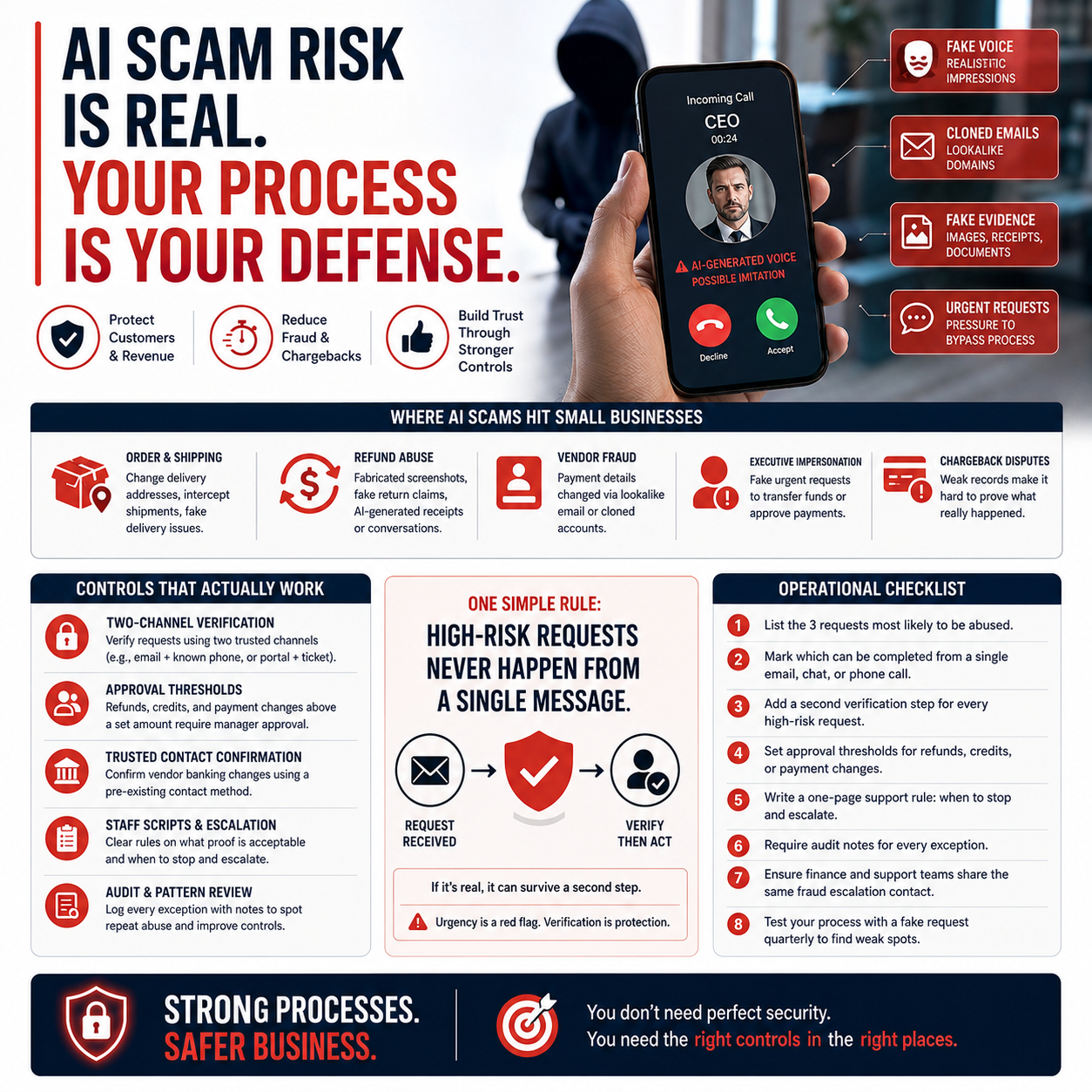
AI-generated scams are moving from obvious phishing attempts to realistic voice, image, and chat impersonation. For small businesses, that changes fraud from a back-office nuisance into an operating decision: who can authorize payments, who can request refunds, and how customers are verified before money moves.
The useful question is not whether AI scams exist. It is where your current workflow assumes trust and how quickly an impostor could exploit that assumption.
Why this matters for operators now
The Savi launch points to a broader shift: consumer-facing fraud is becoming more convincing, and businesses are often the middle layer where the damage lands. A scammer does not need to break your system if they can persuade a customer support agent, a warehouse clerk, or a finance assistant to override a normal process.
That makes fraud prevention an operational design problem. The same workflows that speed up service can also speed up loss if they rely on a single channel or a single human judgment call. If your team can approve a refund, change a delivery address, or release an order from one message thread alone, you already have a risk surface.
For founders, the decision is not whether to buy another security tool first. It is whether your business has enough identity checks and approval layers for the level of impersonation risk you now face.
Where AI scams usually hit small businesses
Most small businesses will not be targeted by elaborate ransomware-style attacks. The more likely exposure is simpler: someone pretending to be a customer, vendor, executive, or family member and using AI-generated evidence to support the story.
Common pressure points include:
- Customer support requests to reroute shipments or reset account access.
- Refund claims that use fabricated screenshots, audio, or email threads.
- Vendor payment changes sent from lookalike domains or cloned inboxes.
- Executive impersonation asking finance to rush a transfer.
- Chargeback disputes where internal records are too weak to prove what happened.
The issue is not only financial loss. A scam that reaches your support queue can create operational drag, customer frustration, and staff uncertainty about when to escalate. If the team does not know the verification rule, they will improvise.
The controls that matter more than generic fraud advice
Small businesses do not need enterprise-grade identity infrastructure to get meaningfully safer. They need a few controls that are hard to bypass and easy to follow.
What most people miss
The biggest weakness is usually not the payment system. It is the exception path. Businesses build a standard process, then quietly allow staff to override it when the request sounds urgent, emotional, or high-value. That is exactly where AI impersonation works best.
To reduce that risk, define the few actions that can never happen from a single message alone. Examples include changing a payout account, redirecting a shipment, issuing a refund above a threshold, or resetting a privileged account. If a request is real, it can survive a second step.
Useful controls include:
- Two-channel verification for sensitive requests, such as email plus known phone number, or customer portal plus support ticket.
- Refund thresholds that require manager approval above a set amount.
- Vendor banking changes confirmed through a pre-existing contact method, not the email that sent the request.
- Scripts for support staff that define what proof is acceptable and when to stop the interaction.
- Locked audit notes for every exception, so repeated patterns are visible later.
The goal is not friction everywhere. The goal is to place friction only where a fake request would be expensive.
What this means for e-commerce, services, and finance workflows
Different business models should expect different attack patterns. E-commerce operators are more exposed to order interception, address changes, and refund abuse. Service businesses are more exposed to account access resets, fake rescheduling, and impersonated client approvals. Finance-heavy operations are exposed to vendor payment redirection and urgent transfer requests.
If you run e-commerce, check where support can override fulfillment after an order is placed. If your team can change shipping details by email alone, a scammer may only need a convincing message and a few personal details. For service businesses, the vulnerability often sits in admin tools: a fake client request can lead to access changes, file releases, or password resets. For finance teams, the highest-risk point is usually payments approval, especially when a request arrives outside the normal purchasing flow.
This is also a training problem. Staff should not be asked to detect deepfake voices or perfectly cloned emails by intuition. They should be given a narrow decision rule: which requests are always escalated, which proof is accepted, and which channels are never used to authorize sensitive actions.
How to evaluate tools without overbuying
The Savi story is a reminder that there will be more products aimed at AI scam detection. Some will be useful; some will simply add alerts without changing the workflow. Before buying, decide what problem you are actually trying to solve.
If the issue is customer impersonation, you may need verification and case-management controls more than detection. If the issue is internal payment fraud, you may need approval routing and audit logs more than consumer-facing identity checks. If the issue is support abuse, you may need queue rules and scripted escalation more than another security dashboard.
Ask vendors three practical questions: what exact workflow does this protect, what exception does it stop, and what happens when the signal is uncertain? If the answer does not map to a real business step, the tool is probably too abstract for a small operator.
Operational checklist for founders and operators
- List the three requests most likely to be abused: refunds, address changes, vendor payment changes, password resets, or transfer approvals.
- Mark which of those requests can currently be completed from a single email, chat message, or phone call.
- Add a second verification step for every high-risk request, using a channel already on file.
- Set a numeric approval threshold for refunds, credits, or payment changes that require a manager.
- Write a one-page support rule that says when staff must stop and escalate.
- Require audit notes for every exception so repeat abuse can be spotted.
- Review whether your finance and support teams share the same fraud escalation contact.
- Test your process with one fake request per quarter to see where staff improvise.
If you fix only one thing, fix the place where urgency beats verification. That is where AI scams do the most damage, and where a small business can gain the most protection with the least operational complexity.