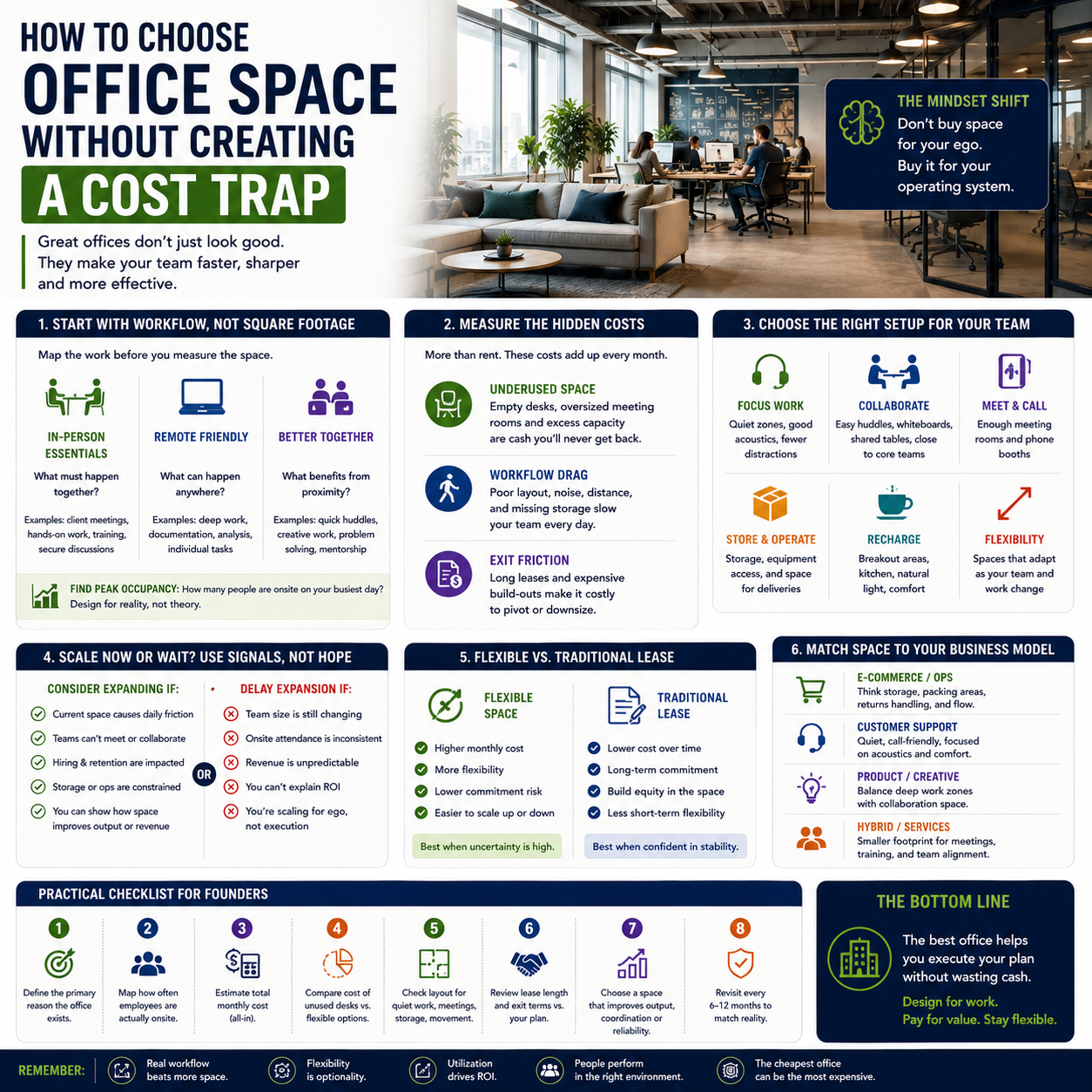
Office space decisions often get treated like a branding exercise, but for small businesses they are usually an operations decision with long-term cost consequences. The wrong layout can slow hiring, complicate collaboration, and lock a founder into rent that doesn’t match the business model. The right approach is to treat space like any other operating system: define the function first, then pay for only what improves execution.
Why office space planning is an operating decision
The strongest reason to care about office planning is not aesthetics. It is the relationship between workspace and how your team actually works. A sales team needs call volume, quiet focus, and meeting rhythm. An operations team may need storage, equipment access, or predictable workflow handoffs. A growing service business may need enough room for hybrid attendance without paying for empty desks five days a week.
When founders choose space too early or too aggressively, they often create a fixed cost structure that outgrows revenue. That is especially risky if the business is still refining team size, work patterns, or client-facing needs. The better question is not “What office looks impressive?” but “What layout supports the work without adding friction or waste?”
Start with workflow, not square footage
Before comparing leases, map the actual activities that happen in the business. List the work that must happen in person, the work that can happen remotely, and the work that benefits from proximity. This creates a more useful brief than headcount alone.
For example, if your team spends most of the day in deep work, open seating may reduce performance. If your business depends on short internal handoffs between sales, support, and operations, distance between teams may slow response times. If most meetings are client calls, phone booths and private rooms matter more than decorative common areas.
That workflow map should also identify peak occupancy. Many businesses pay for permanent capacity based on a theoretical full team, even though real attendance is far lower. If you know the space will only be full two days a week, your lease terms, seating plan, and meeting room count should reflect that reality.
Measure the hidden cost of a bad layout
Rent is only one line item. Office space also affects setup costs, utilities, cleaning, insurance, equipment, and the amount of time managers spend solving avoidable friction. A layout that looks efficient on paper may still cost more if it creates interruptions or duplication.
There are three hidden cost buckets founders should watch:
1. Underused space. Empty desks and oversized meeting areas are a direct drag on cash flow. If a space is designed for a team that does not yet exist, the business is effectively prepaying for growth that may take longer than expected.
2. Workflow drag. If people repeatedly move between floors, chase down equipment, or use meeting rooms for storage because the plan was poorly designed, the business absorbs that inefficiency every day.
3. Exit friction. A long lease or expensive build-out can be hard to unwind if hiring slows or the business shifts remote. Flexibility has value because it reduces the cost of changing direction.
What most people miss
Many founders assume office planning is about making people comfortable. Comfort matters, but the operational question is whether the space reduces decision fatigue and unnecessary coordination. A good office is not one with the most amenities; it is one where the team can do the right type of work without constant interruption.
That is why the most useful planning variables are often boring ones: desk density, acoustics, storage access, meeting-room availability, and how easily teams can regroup around shared tasks. If those basics are wrong, nicer furniture will not fix the problem. In practice, a smaller space with a better workflow can outperform a larger one with a poor layout.
How to decide between scaling now or waiting
Founders usually reach office decisions when growth starts to feel visible, but timing matters more than pride. Expanding too early can damage runway; waiting too long can create operational strain. The decision should rest on signals, not hope.
Consider expansion if your current setup is causing measurable friction: people cannot meet privately, teams cannot collaborate efficiently, storage is affecting operations, or your current arrangement is hurting hiring or retention. On the other hand, delay expansion if your team is still changing quickly, your attendance pattern is inconsistent, or you cannot explain how the extra space will improve output.
If you are choosing between flexible space and a traditional lease, think in terms of optionality. Flexible arrangements may cost more per month, but they reduce commitment risk. A traditional lease may be cheaper over time, but only if you are confident the team, workflow, and location will remain stable.
Use the space to support the business model
Different business models need different office setups. A customer support team may need a quiet, call-friendly environment. A product or creative team may need collaborative zones plus deep-work zones. A hybrid services business may need a smaller office used for meetings, training, and coordination rather than daily attendance.
This is where office planning becomes strategic. The office should reinforce the operating rhythm the company actually needs, not the one the founder imagines. If the company sells remotely, the office should not become a prestige expense. If the business depends on in-person execution, the office should be treated as part of production capacity.
The best office is the one that helps the business run with fewer interruptions, clearer routines, and lower wasted cost. That means designing for behavior, not just square footage.
Practical checklist for founders
- Define the primary reason the office exists: sales, collaboration, operations, storage, hiring, or client meetings.
- Map how often employees are actually expected onsite, not how often they could be onsite.
- Estimate the monthly cost of rent, utilities, cleaning, fit-out, and equipment before signing anything.
- Compare the cost of unused desks against the cost of flexible or smaller space.
- Check whether the layout supports quiet work, meetings, storage, and movement without bottlenecks.
- Review lease length and exit terms against your hiring plan and revenue stability.
- Choose a space only if you can explain how it improves output, coordination, or revenue reliability.