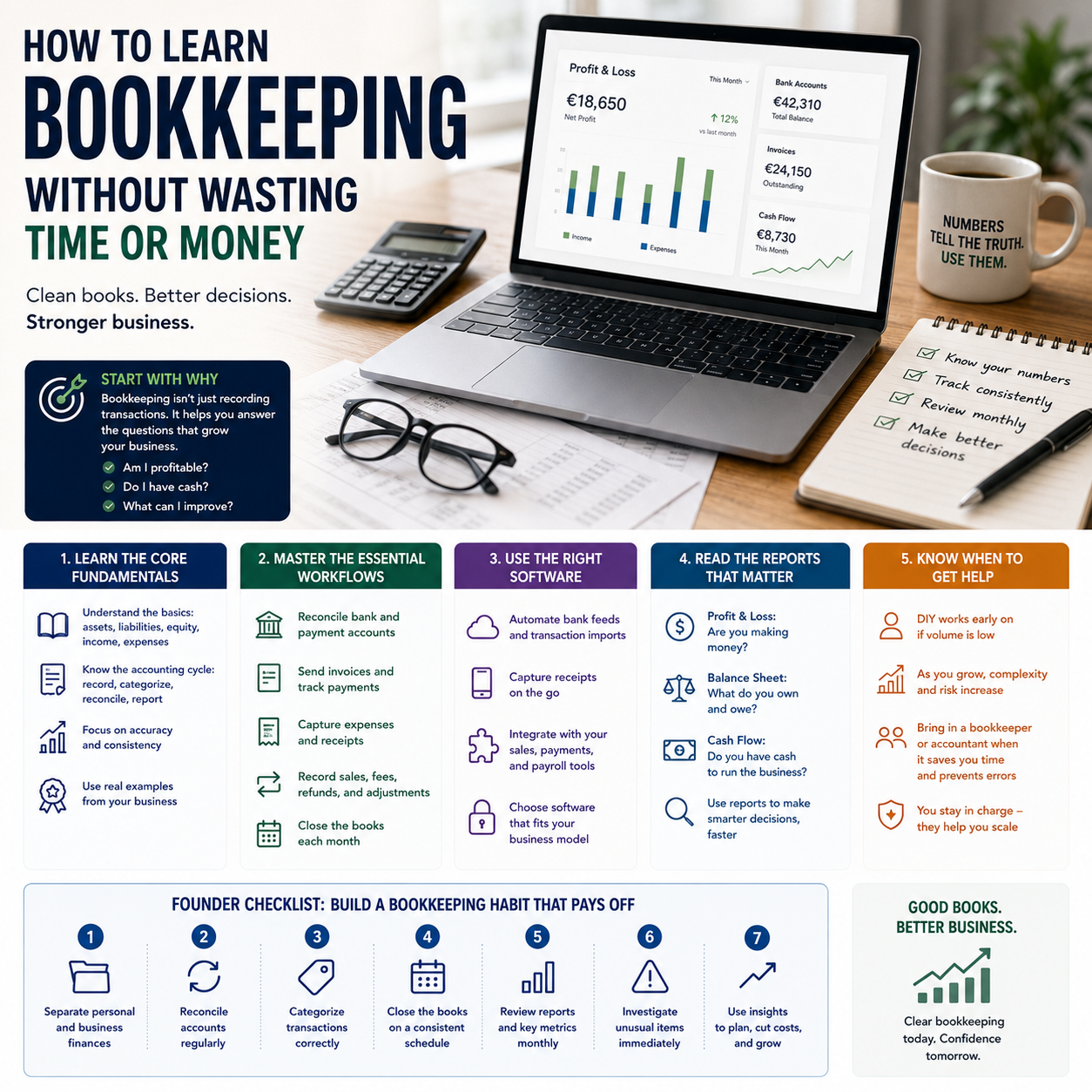
Bookkeeping is one of those skills founders often postpone until the numbers become messy. But if you run a small business, bookkeeping is not just an admin task; it is the system that tells you whether sales are real, margins are shrinking, and cash is actually available.
The useful question is not whether you should “learn bookkeeping.” It is how much you need to know to make better decisions, avoid costly errors, and choose the right setup between doing it yourself, delegating it, or bringing in outside help.
Start with the bookkeeping decisions that affect operations
Before buying a course or opening software, define what bookkeeping will need to support in your business. For a founder, the goal is usually not to become a full-time bookkeeper. The goal is to keep records clean enough to answer basic operational questions quickly: What do we owe? What do customers owe us? Which products or channels are actually profitable? Which expenses are recurring and which are optional?
If you sell online, this matters even more because payment processors, marketplace fees, refunds, inventory movements, and ad spend can make revenue look healthier than it is. Good bookkeeping creates a clear trail from sale to payout to expense, which helps you see whether the business is generating cash or just activity.
Choose the learning path based on how hands-on you need to be
The best way to learn bookkeeping depends on your role. If you are a solo founder handling your own records, a structured intro course and a simple monthly close process may be enough. If you manage a growing team, you need to understand bookkeeping well enough to supervise categorization, reconcile accounts, and review reports.
The source on learning bookkeeping highlights several practical routes, and the right one depends on your time, budget, and business complexity. For many operators, the fastest path is not theory-heavy education but a narrow focus on business tasks: reconcile bank accounts, match transactions to invoices, separate owner spending, and read the basic reports that matter each month.
What most people miss
Many founders assume bookkeeping is about “recording expenses.” That misses the real value. The important part is timing and classification. A payment can be recorded in the wrong period, duplicated across systems, or categorized in a way that hides the real cost of acquisition, fulfillment, or payroll. If you run ads, subscriptions, or ecommerce operations, those misclassifications can distort pricing decisions and make it harder to know what to cut.
Use bookkeeping software to reduce manual work, but only after the process is clear
Software does not fix unclear processes. It amplifies them. Before you automate anything, decide how transactions should flow. For example: which bank account is used for business spending, how receipts are stored, who approves payments, and when reconciliation happens.
Once that is defined, software can remove a lot of friction. Bank feeds can pull in transactions automatically, receipt capture can reduce lost records, and recurring entries can handle predictable costs such as software subscriptions or rent. For a founder, the value is not just time savings. It is cleaner monthly reporting and fewer surprises when tax time or cash forecasting arrives.
If you are comparing tools, look for software that fits your business model rather than the one with the broadest feature list. An ecommerce operator may need inventory and sales channel integrations. A service business may care more about invoicing, expense tracking, and simple reporting. The wrong stack creates extra cleanup work, which defeats the point of automation.
Learn the reports that actually change decisions
Bookkeeping becomes useful when it feeds decisions. At a minimum, founders should know how to read three outputs: the profit and loss statement, the balance sheet, and the cash position. Each answers a different question. Profit and loss tells you whether operations are earning enough after costs. The balance sheet shows what the business owns and owes. Cash shows whether you can keep paying bills next week.
From there, use bookkeeping to monitor a few practical signals. Are merchant fees rising faster than expected? Are contractor costs creeping up? Are refunds or chargebacks concentrated in one channel? Are inventory purchases turning into sales fast enough? These are the kinds of questions that turn bookkeeping from compliance into management.
If you cannot read those reports confidently, that is a training gap worth fixing. It is often cheaper to learn the basics well than to discover problems after several months of incorrect categorization or missed reconciliations.
Decide when to keep it in-house and when to outsource
Not every founder should do their own bookkeeping forever. A useful rule is to keep it in-house only while the transaction volume is manageable and the owner still benefits from seeing the numbers directly. Once the business adds multiple sales channels, inventory layers, payroll complexity, or frequent reimbursements, the risk of error rises fast.
Outsourcing does not remove responsibility. It changes it. The founder still needs a review process: monthly bank reconciliations, exception checks, and a shortlist of questions for the bookkeeper or accountant. If those review points are missing, outsourcing can hide bad data instead of fixing it.
The practical decision is whether your time is better spent on learning enough bookkeeping to supervise the system or on building the business while a professional handles the records. For many small businesses, the answer changes as the business grows.
Checklist: how to learn bookkeeping in a way that helps the business
- Define the business decisions bookkeeping must support: cash flow, profitability, tax prep, or channel-level performance.
- Learn the core workflow first: capture transactions, categorize them, reconcile accounts, and review monthly reports.
- Pick software only after you know how your money actually moves through the business.
- Separate business and personal spending immediately to avoid cleanup work later.
- Set one monthly closing routine so books are updated on a predictable schedule.
- Track a small set of operating metrics from the books, such as fees, refunds, contractor costs, and inventory turnover.
- Outsource once volume, complexity, or reporting risk starts consuming founder time.
- Keep a review habit even if someone else does the data entry: reconcile, question anomalies, and check the cash balance regularly.