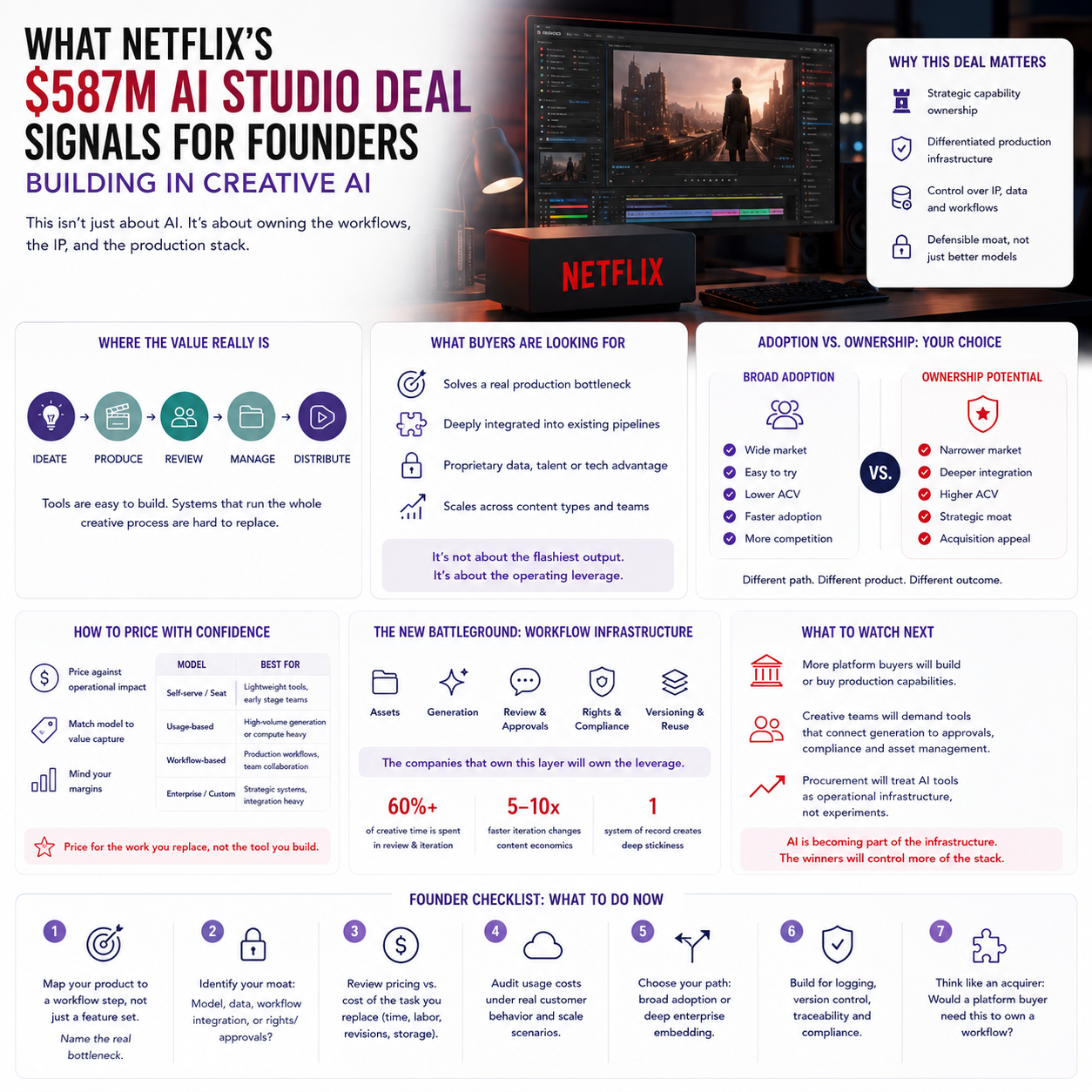
Netflix’s reported $587 million cash deal for an AI filmmaking startup is not just a media headline. For founders and operators, it is a signal that AI in creative workflows is moving beyond standalone software and into strategic infrastructure, IP control, and acquisition logic.
That matters if you build tools for content, video, design, localization, or production workflows. The real question is no longer whether AI can help teams make media faster. It is what parts of the workflow are defensible, what should remain a vendor relationship, and when a platform buyer may prefer to own the capability outright.
Why this deal matters to operators, not just entertainment watchers
A buyer like Netflix does not spend at this level merely to “add AI.” It is more likely looking at a workflow that can reduce production friction, improve content iteration, or create a differentiated capability that is hard to replicate with generic third-party tools. For founders, that changes the value equation.
If your startup sits in creative AI, you are not only selling features. You are selling control over a production bottleneck, integration into an existing pipeline, and possibly access to proprietary data or talent. Those are very different businesses from a point solution that adds a nice-to-have feature to a creator app.
The practical implication is that acquirers may value AI startups on strategic fit rather than current revenue alone. That can be good news for founders with a narrow but deeply embedded workflow product. It also means the product has to live inside a real operating process, not just in a demo.
What this says about the market for AI workflow tools
The most important signal in a deal like this is where the money goes: toward capability ownership. In creative software, the winners may not be the tools that generate the flashiest output. They may be the ones that sit closest to planning, asset handling, approvals, versioning, rights management, or post-production.
That is because those layers are harder to swap out once they are integrated. A founder building in AI should ask whether the product helps a team produce one asset faster, or whether it changes the operating system around how content is made. Buyers tend to pay more for the second category.
This also suggests that the market is shifting from “AI feature” to “AI system.” That shift matters for pricing. A feature is often priced per seat or bundled. A system can justify usage-based pricing, workflow-based pricing, enterprise contracts, or even acquisition interest if it becomes deeply embedded.
What most people miss
Many founders assume a successful AI product must win through model quality. In practice, the defensibility may come from workflow ownership: where files enter, how teams approve output, how rights are tracked, and what gets logged for compliance or reuse. If the product becomes the system of record for creative work, the buyer is purchasing more than generation quality.
The founder decision: build for adoption or build for ownership
When a major platform buys an AI startup, it forces a hard choice for smaller companies in the same space. Do you optimize for fast adoption across many customers, or do you build a narrower product that a strategic buyer would want to own?
If you choose broad adoption, your priorities are distribution, usability, and clear ROI for many buyer types. If you choose ownership potential, your priorities shift toward integration depth, proprietary datasets, and workflow stickiness. The latter can be harder to sell in the short term, but it may be much more attractive to platform buyers.
For example, a tool that generates assets for anyone is easy to demo. A tool that sits inside a media company’s production pipeline, learns its review patterns, and manages handoffs between legal, editorial, and production teams is less viral but more strategic. That distinction should shape product roadmap and go-to-market decisions.
How to think about pricing if your product touches production workflows
Creative AI products often underprice themselves because teams compare them to generic software instead of the cost of the work they replace. That is a mistake. If your product shortens revision cycles, reduces contractor dependence, or speeds up asset approval, you should price against the operational burden it removes.
That does not automatically mean charging more. It means matching price model to value capture. A lightweight generation tool may fit a low-friction self-serve plan. A workflow product tied to approvals, asset management, and team collaboration may justify a higher enterprise tier or a usage-based model tied to production volume.
Founders should also think carefully about margin structure. AI products can look attractive on the surface and still break under heavy usage if inference, storage, review, or integration costs are not understood. If the product sits in a media workflow, the cost of one customer can vary wildly depending on asset size, team size, and how often the tool is used in production.
What to watch if you build tools for media, content, or design
There are three practical signals to watch after a deal like this. First, see whether larger platform buyers start talking about owning more of the production stack rather than partnering for it. Second, watch whether creative teams begin asking for tools that connect generation to approvals, compliance, and asset management. Third, track whether procurement teams start treating AI software as operational infrastructure instead of experimental software.
For small businesses and startups, that changes how you pitch and package the product. The buyer is not just asking, “Does it work?” They are asking, “Can this become part of our operating system, and can we trust it under real workload?”
Checklist: what founders should do now
- Map your product to a workflow step, not just a feature set. If you cannot name the operational bottleneck, the product is easier to replace.
- Identify whether your moat is model quality, workflow integration, proprietary data, or approvals/rights handling. Do not rely on a vague “AI advantage.”
- Review pricing against the cost of the task you replace, including labor, revisions, storage, and review time.
- Audit usage costs under real customer behavior, especially if the product processes large files or high-volume output.
- Decide whether your roadmap favors broad self-serve adoption or deeper enterprise embedding. Those paths require different sales motions.
- Build for logging, version control, and traceability if your product touches content creation or asset reuse.
- Watch for acquisition logic: if a platform buyer would need your product to own a workflow, your product strategy may be on the right track.


