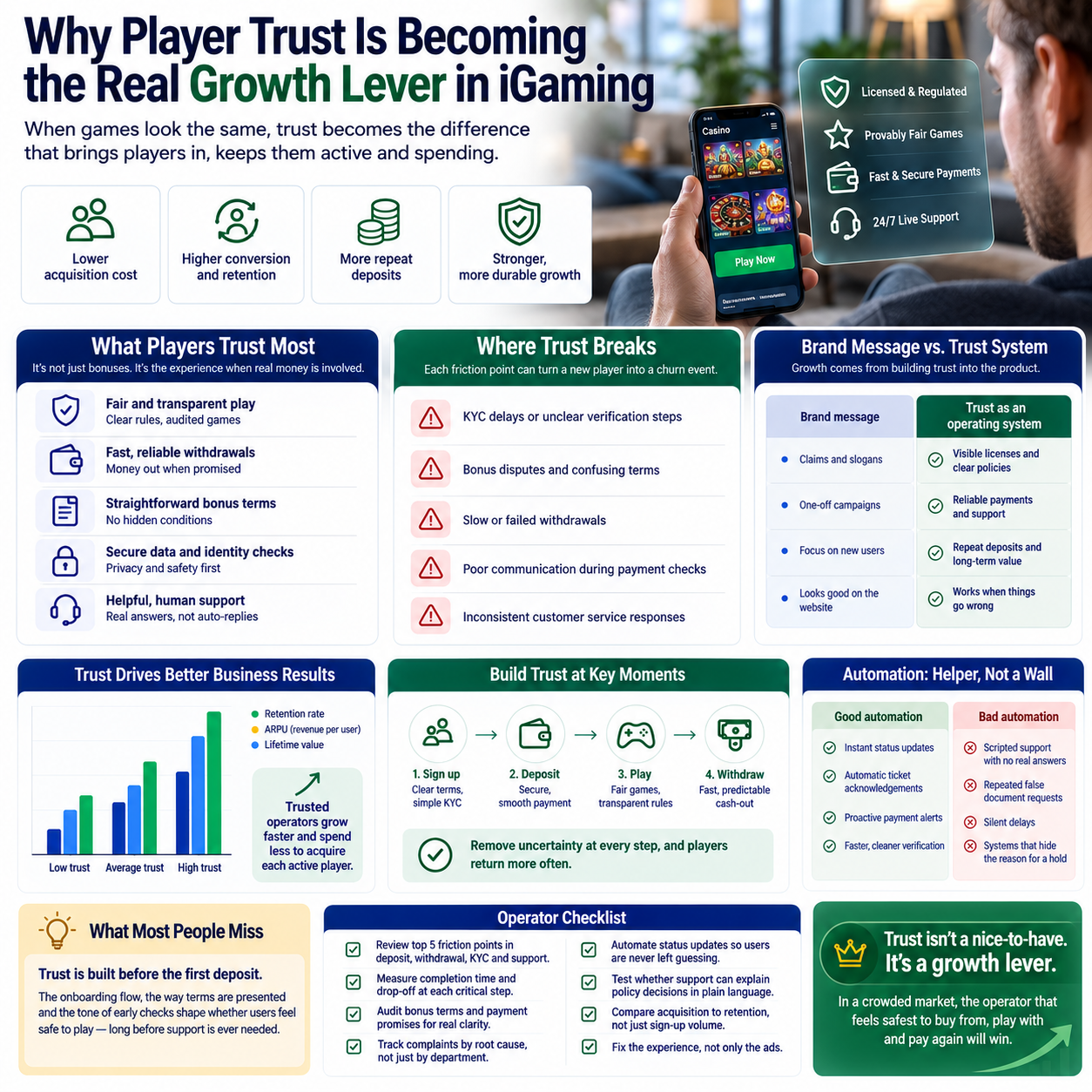
For European iGaming operators, the old growth playbook is getting harder to rely on. Better bonuses, faster payments, and new market entries still matter, but they are increasingly easy for competitors to copy. The more interesting shift is that trust is becoming a commercial asset: it shapes acquisition cost, conversion, retention, and the willingness of players to deposit again.
That matters well beyond gambling. Any regulated digital business with recurring payments, identity checks, and high-friction onboarding should pay attention to what iGaming is learning now: when products look similar, trust becomes part of the product.
Why trust is moving from brand language to operating system
The EU-Startups piece on player trust points to a market where users are making decisions with less room for superficial differentiation. If a player sees similar games, similar payment options, and similar bonus mechanics across operators, then trust becomes the signal that reduces hesitation. That trust is not just a marketing claim; it comes from visible reliability in payments, support, fairness, dispute handling, and the consistency of the experience.
For founders and operators, this changes the question from “How do we attract attention?” to “What removes friction at the point of deposit, play, withdrawal, and support escalation?” The practical answer is usually operational rather than creative. It involves fewer avoidable surprises, clearer policies, cleaner UX, and support that can resolve issues without forcing the user into a long email chain.
What this means for growth teams and operators
The key decision is whether trust is being treated as a brand message or as a measurable system. A trust-led growth model needs evidence that users can see or feel. That can include visible licensing information, transparent bonus terms, payment timelines that are not buried, and support channels that behave predictably.
Growth teams should also think about where trust breaks. Common breakpoints are KYC delays, bonus disputes, slow withdrawals, unclear terms around wagering, and inconsistent customer service responses. Each one can turn a profitable acquisition into a churn event. In practice, that means operators should map the user journey around moments where money or identity is involved, then assign an owner to each failure point.
This is especially useful in regulated markets where compliance and conversion often pull in opposite directions. The better question is not whether to add friction, but where friction protects the business and where it simply creates abandonment. If a step adds legitimacy but also causes drop-off, it should be redesigned rather than defended as a compliance inevitability.
Where automation helps and where it should not
Trust-building does not mean human intervention everywhere. In fact, some of the strongest trust signals come from automation that reduces uncertainty. Clear withdrawal status updates, instant acknowledgement of support tickets, automated verification prompts, and proactive alerts about payment failures can make a service feel more reliable.
But automation can also damage trust if it becomes a wall rather than a helper. Scripted support that cannot explain a payment hold, or automated moderation that flags the wrong documents repeatedly, creates the sense that the operator is hiding behind the system. The operator’s job is to automate routine clarity, not to automate away accountability.
What most people miss
Many operators think trust is built after the sale, but in iGaming the most important trust signals often appear before a player ever deposits. The onboarding sequence, the way terms are presented, and the tone of the first compliance checks all influence whether the user feels the operator is safe to deal with. If the first experience feels opaque, later marketing will have to work much harder.
This is why trust should be reviewed alongside conversion metrics, not separately from them. A smoother journey can improve conversion, but only if the clarity is genuine. If the only thing that improves is the speed of signup while withdrawals remain messy, the business has not built trust; it has simply accelerated disappointment.
How founders should evaluate trust as a business metric
Trust is easy to discuss and hard to operationalize, so it helps to turn it into a few measurable questions. Operators do not need a perfect sentiment model to make better decisions. They need a short list of indicators that expose whether the customer experience is stable enough to support repeat deposits and lower support load.
Useful metrics usually sit close to the money and the support queue. Withdrawal completion time, KYC completion rate, first-response time, repeat contact rate, complaint volume, and bonus-related ticket frequency are all more actionable than generic satisfaction scores. If one of these gets worse after a campaign or product change, the operator can see exactly where trust is being damaged.
For smaller businesses, the lesson is broader than gambling. In subscription software, marketplace commerce, fintech, and managed services, trust often determines whether growth is efficient or expensive. If users need repeated reassurance, growth costs rise. If the experience is predictable, retention becomes easier to defend.
What operators should do next
Use the trust lens to audit the parts of the business where money, identity, and expectation intersect. That usually surfaces more growth issues than a new ad channel will solve.
- Review the top five customer friction points tied to deposits, withdrawals, verification, or support escalation.
- Measure how long it takes a user to complete each critical step, and where drop-off increases.
- Audit bonus terms, payment promises, and verification language for clarity, not just legal coverage.
- Automate status updates and ticket acknowledgements so users are never left guessing.
- Track complaint themes by root cause, not just by department, so product and operations can fix the source.
- Test whether support can explain policy decisions in plain language without sending users back into a loop.
- Compare acquisition performance against retention and withdrawal behavior; if the first improves while the second worsens, trust is eroding.
For iGaming operators, trust is becoming a growth lever because it shortens the distance between interest and action. For everyone else, the lesson is the same: if your category is getting crowded, the winning business may be the one that feels safest to buy from, use, and pay again.