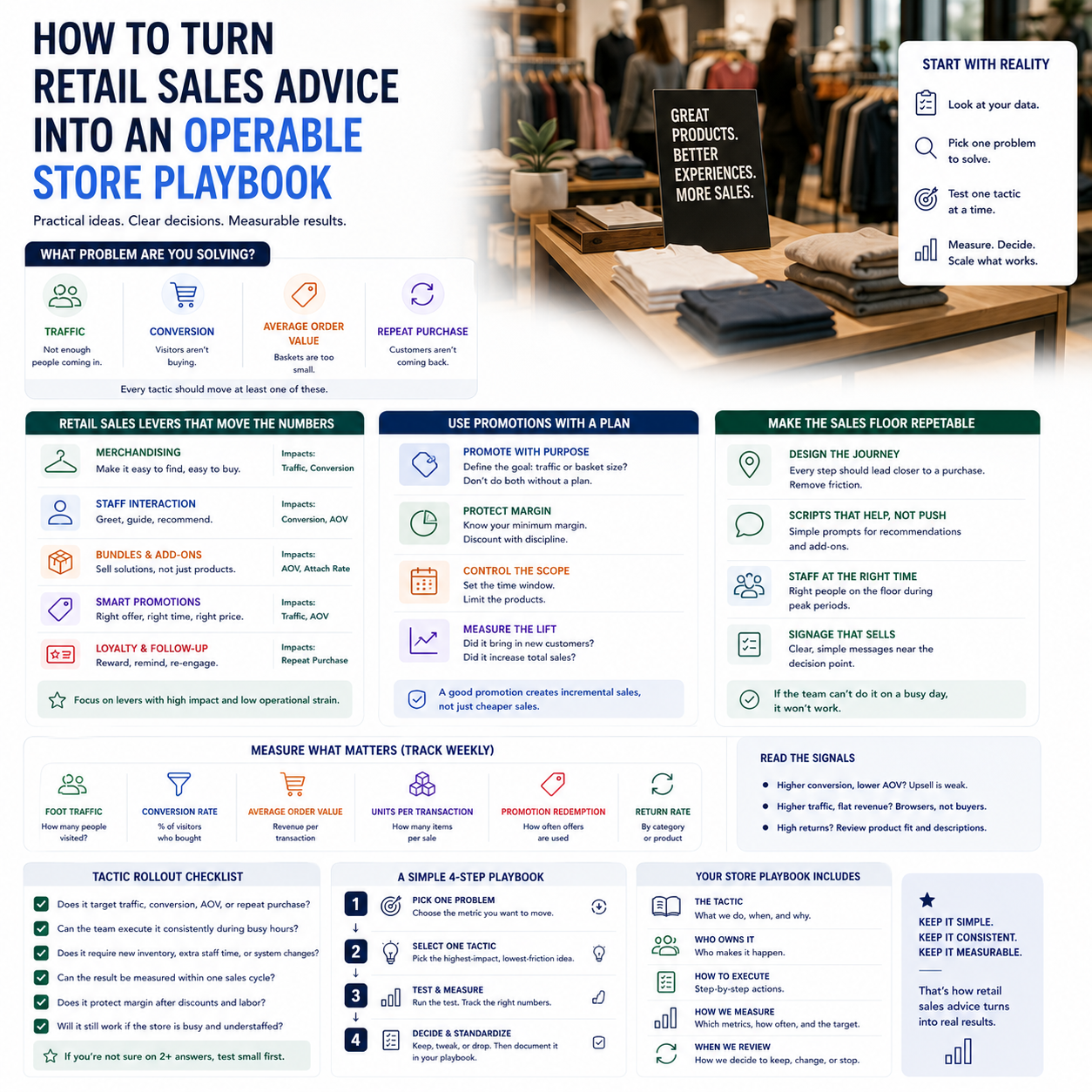
Retail sales advice is easy to find and hard to use. The real question for a founder or store operator is not which tactics sound good, but which ones change conversion, basket size, and repeat visits without adding chaos to the floor or the backend. This article turns broad retail sales ideas into decisions you can actually run.
Start with the sales problem you are trying to solve
Before changing promotions or training staff, define the operational issue. A store with weak traffic needs a different fix from a store with strong traffic but poor conversion. Likewise, a business with decent order volume but low margin should not chase the same tactics as one that needs more footfall.
The most useful way to read a retail sales article is to map each idea to one of four problems: traffic, conversion, average order value, or repeat purchase. If the idea does not affect at least one of those, it is probably noise.
The candidate on driving sales in retail is useful because it can be translated into specific store decisions: how you staff peak hours, how you bundle products, how you price promotions, and how you track whether the change actually worked.
Which retail sales levers are worth testing first
Not every sales tactic deserves equal attention. Some create more revenue but also more labor, more markdown risk, or more inventory complexity. For a small business, the right sequence is usually the one that changes buyer behavior with the least operational strain.
Start with levers that are easy to measure:
- Conversion rate at the point of sale: Are more visitors buying after you change merchandising or staff scripts?
- Average order value: Are bundles, add-ons, or threshold offers increasing basket size?
- Attach rate: Are accessories or complementary items being added to core purchases?
- Repeat purchase rate: Are customers coming back after a promotion or loyalty trigger?
If a tactic cannot be tied to one of those metrics, it becomes hard to judge whether it is helping or just keeping the team busy.
What most people miss
The common mistake is to treat sales growth as a marketing problem when it is often a floor execution problem. A store can spend more on promotions and still underperform if products are poorly placed, staff are not confident recommending add-ons, or peak hours are understaffed.
This matters because the same tactic can produce very different results depending on execution. A product bundle may work in one store because staff actively explain it at checkout. In another, the bundle sits unnoticed because no one is prompting it and the signage is weak. The tactic is not wrong; the operating system around it is.
That is why store owners should look at sales advice through the lens of workflow. Ask who will do the work, when they will do it, what it changes in the customer journey, and what happens if the team forgets to follow through.
Use promotions as a margin test, not a habit
Promotions are one of the fastest ways to lift revenue, but they can quietly damage margin if they are not controlled. The real decision is not whether to discount. It is whether the promotion creates incremental volume or merely trains customers to wait for deals.
For a small business, a better approach is to use promotions with a clear rule: protect gross margin, define the time window, and know the exact product set being discounted. That keeps promotions from spreading across the assortment and making inventory harder to manage.
Retailers should also separate traffic-driving offers from basket-building offers. A doorbuster may bring people in, but a bundle or threshold incentive is often better for average order value. Mixing the two without a plan can make reporting messy and results unclear.
Make the sales floor measurable
Retail sales advice becomes useful only when it changes what the team does every day. That means building a simple measurement rhythm. You do not need a complex dashboard to start; you need a few numbers that show whether the store is moving in the right direction.
At minimum, track these by week and by store if you have more than one location:
- Foot traffic or store visits
- Conversion rate
- Average order value
- Units per transaction
- Promotion redemption
- Return rate by category
If one metric improves while another falls, you have learned something important. For example, higher conversion with lower average order value may mean staff are closing sales but not upselling effectively. Higher traffic with flat revenue may mean the promotion is attracting browsers instead of buyers.
How to decide whether a tactic is worth rolling out
The best retail operators do not ask whether a tactic is popular. They ask whether it fits their model. A high-touch boutique, a convenience-focused store, and a seasonal retailer will not use the same sales approach even if they sell similar products.
Before rolling out a tactic across the business, test it against the following criteria:
- Does it target traffic, conversion, average order value, or repeat purchase?
- Can the team execute it consistently during busy hours?
- Does it require new inventory, extra staff time, or system changes?
- Can the result be measured within one sales cycle?
- Does it protect margin after discounting and labor are included?
- Will it still work if the store is busy and staff are under pressure?
If the answer is unclear on two or more of those points, keep the test small. If the answer is yes across the board, the tactic is worth formalizing in the store playbook.
The most useful retail sales idea is not the one that sounds persuasive in a summary. It is the one that can be repeated by your team, measured by your system, and sustained without creating extra operational drag.