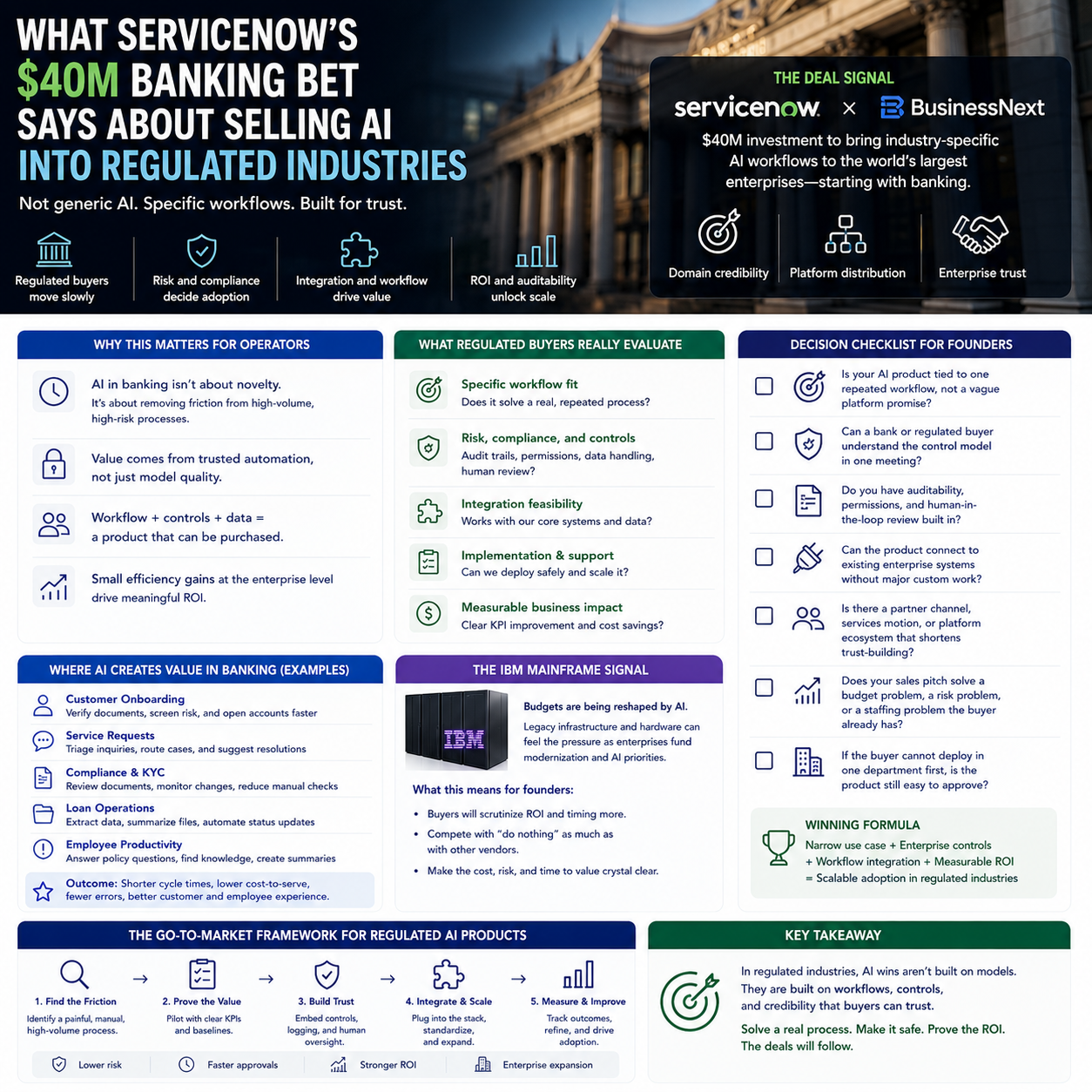
ServiceNow’s $40 million investment in BusinessNext is not just another AI funding story. It is a signal about how enterprise software is being packaged for regulated buyers: narrow use cases, domain credibility, and a route into distribution that can survive procurement, compliance, and long sales cycles.
For founders building in fintech, banking software, or other regulated verticals, the real question is not whether AI is useful. It is which problems are specific enough to buy, which workflows are safe enough to automate, and which partners can actually move the product through the enterprise buying process.
Why this deal matters to operators
The ServiceNow-BusinessNext move points to a familiar but often misunderstood pattern: large platform companies are not buying generic AI buzz. They are looking for products that fit a working workflow inside a regulated industry. Banking software is especially attractive because even small efficiency gains can be monetized across compliance, servicing, operations, and customer support, but only if the product can pass risk review.
That matters to founders because it changes where value sits. In consumer AI, the product may win through speed and novelty. In banking, the buyer usually wants confidence, auditability, integration depth, and a vendor that understands the vocabulary of the sector. A generic assistant rarely gets purchased. A workflow tool that reduces manual handling inside a bank’s existing stack has a much better chance.
The real buying criteria in regulated software
BusinessNext’s appeal is not just that it is AI-powered. It is that it can be positioned as an industry-specific layer on top of a broader enterprise platform. That combination gives enterprise buyers something they can evaluate: not a raw model, but a product tied to a business process.
Founders often overestimate how much AI matters in the sales conversation and underestimate how much the buyer cares about implementation. In banking, the question is usually:
- Does this fit a known process, such as onboarding, service requests, or case handling?
- Can it log actions, preserve audit trails, and support human review?
- Will it integrate with core systems without a major rewrite?
- Can security and legal teams evaluate it quickly?
If you cannot answer those questions clearly, the product may sound impressive but still fail in procurement.
What most people miss
The headline is not really “AI in banking.” The more useful reading is that strategic capital is flowing toward products that make AI legible to conservative buyers. That means packaging matters as much as model quality. A founder who builds a great AI capability but leaves it as a horizontal feature may struggle, while a smaller team with a focused workflow and strong compliance story can sell faster.
This also explains why partnerships matter so much. Distribution into regulated industries is expensive, and trust is hard to earn from scratch. A strategic backer can function as a signal to the market, but only if the product is already shaped for enterprise adoption. That is the hidden lesson here: in regulated software, a strong partner does not rescue a weak product. It amplifies a product that already fits the buyer’s operating reality.
How founders should frame a regulated AI product
If you are building for banks, insurers, healthcare groups, or government-adjacent buyers, the product narrative should be operational, not abstract. Avoid presenting AI as a broad productivity layer. Instead, show exactly where the workflow changes and what gets better:
- Manual steps removed from a specific case process
- Human review points that remain in place
- Controls for permissions, logging, and escalation
- Integration points with the systems the buyer already uses
That framing helps the buyer decide whether the tool is a pilot, a departmental rollout, or a platform purchase. It also helps the sales team avoid vague conversations about “transformation” that stall for months.
What the IBM mainframe story adds to the picture
The IBM result is a useful counterpoint. When corporate budgets get reshaped by AI spending, legacy hardware and older infrastructure can feel the pressure. IBM’s response suggests that AI is not simply replacing one category with another; it is changing how enterprises allocate budget across infrastructure, modernization, and software.
For operators, the practical implication is that selling into enterprise accounts now requires a sharper budget argument. You are no longer only competing against other software vendors. You may also be competing against the buyer’s decision to delay modernization, shift spend into AI pilots, or defend existing systems for another year. That makes ROI storytelling more about timing and less about feature lists.
Decision checklist for founders and operators
- Is your AI product tied to one repeated workflow, not a vague platform promise?
- Can a bank or regulated buyer understand the control model in one meeting?
- Do you have auditability, permissions, and human-in-the-loop review built in?
- Can the product connect to existing enterprise systems without major custom work?
- Is there a partner channel, services motion, or platform ecosystem that shortens trust-building?
- Does your sales pitch solve a budget problem, a risk problem, or a staffing problem the buyer already has?
- If the buyer cannot deploy in one department first, is the product still easy to approve?
For founders, the lesson from this deal is straightforward: in regulated AI, the winning product is rarely the most general one. It is the one that makes adoption feel safe, measurable, and easy to justify inside a complex organization.