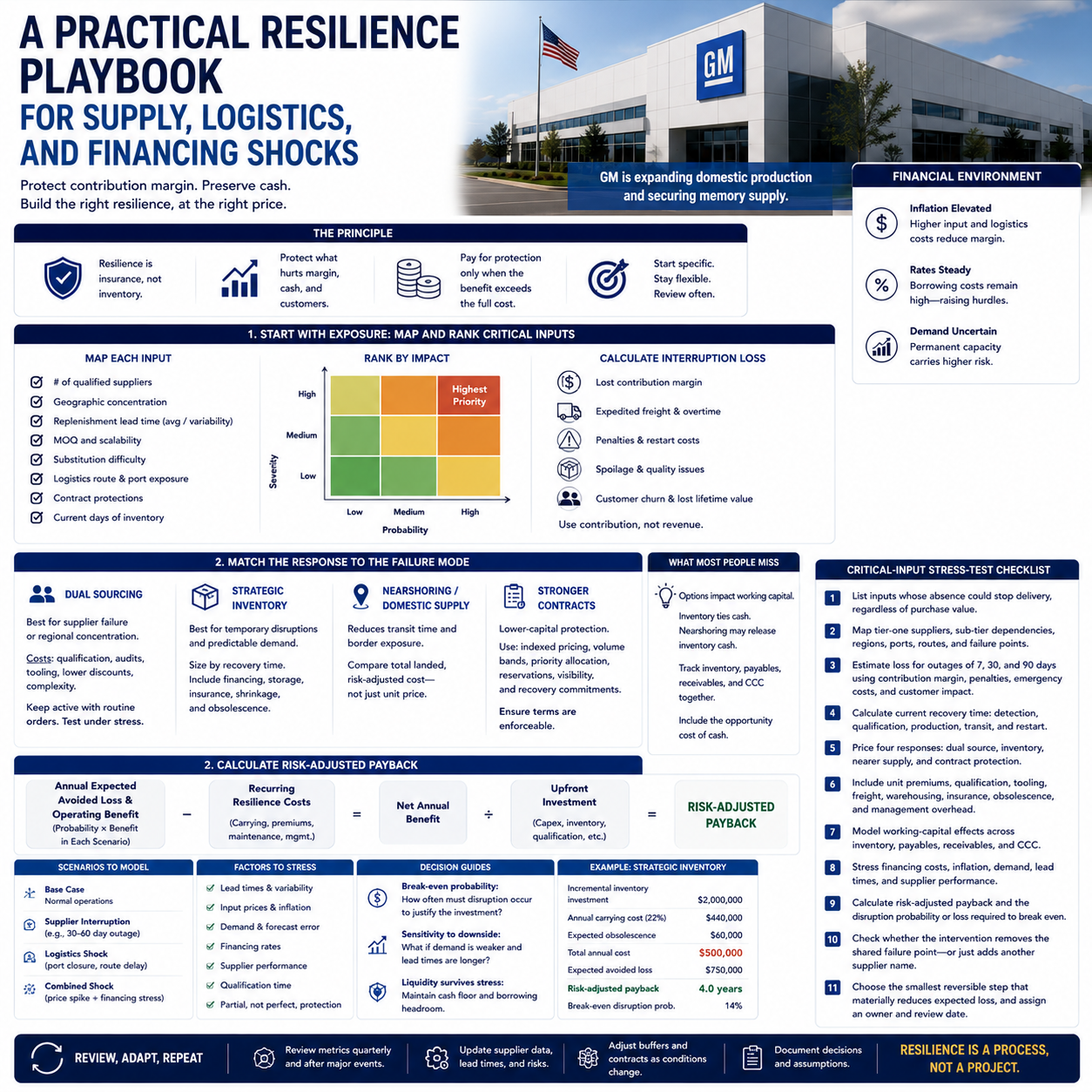
Supply-chain resilience is easy to support in principle and difficult to price in practice. Extra suppliers, buffer stock, domestic capacity, and stronger contract protections all consume cash before they prove their value. When inflation remains elevated and benchmark interest rates hold steady, the hurdle becomes higher: inventory costs more to carry, capital projects cost more to finance, and uncertain demand makes permanent capacity commitments riskier.
General Motors offers a useful starting point. Its efforts to expand domestic production and strengthen access to memory supply show how a large manufacturer can respond to commodity and logistics pressures by changing where it produces and how it secures critical inputs. But most operators cannot replicate GM’s purchasing power, capital budget, or supplier influence. The transferable lesson is not “build more factories.” It is to identify where disruption would damage contribution margin, cash flow, or customer retention enough to justify paying for protection.
Start with exposure, not a list of solutions
Map critical inputs by business impact rather than annual spend. A low-cost component can stop an expensive product line, while a costly material may be readily substitutable. For each input, record the number of qualified suppliers, geographic concentration, replenishment lead time, minimum order quantities, substitution difficulty, logistics route, contract protections, and days of inventory.
Then estimate the financial consequence of an interruption. Include lost contribution margin, overtime, expedited freight, production restart costs, penalties, spoilage, and probable customer losses. Avoid using revenue alone: delayed revenue may be recovered, whereas contribution margin lost to a cancelled order may not be.
Rank inputs using three dimensions: probability of disruption, severity of loss, and recovery time. Concentration can exist beyond the tier-one supplier. Two vendors may depend on the same semiconductor plant, port, sub-tier producer, or power grid. A nominally dual-sourced item is still single-sourced if both routes share the same failure point.
Match the intervention to the failure mode
Dual sourcing is appropriate when supplier failure or regional concentration is the main risk. The incremental cost includes qualification, audits, tooling, lower volume discounts, and operational complexity. It works only if the second source can deliver meaningful volume during stress. Use routine orders to keep that supplier active rather than treating it as an untested emergency contact.
Strategic inventory is better when disruption is temporary, demand is reasonably predictable, and the input does not become obsolete or deteriorate quickly. Set the buffer by expected recovery time, not by an arbitrary number of weeks. Count financing, warehousing, insurance, shrinkage, and obsolescence in the carrying cost.
Nearshoring or domestic sourcing can reduce transit time, border exposure, and dependence on fragile routes, but it does not automatically reduce risk. A nearby supplier could still rely on imported subcomponents. Compare total landed and risk-adjusted cost, including freight variability, duties, lead-time inventory, quality failures, and continuity—not just the quoted unit price.
Contract terms can provide lower-capital protection. Consider indexed pricing, volume-flexibility bands, priority-allocation provisions, capacity reservations, shared safety stock, disclosure of sub-tier dependencies, and recovery-time commitments. Test whether remedies are enforceable and operationally useful; compensation after a shutdown does not keep customers supplied.
What most people miss
Resilience options interact with working capital. Buying more inventory may reduce shutdown risk while weakening liquidity precisely when borrowing is expensive. A nearshore supplier may quote a higher unit price but require smaller orders and shorter lead times, releasing enough inventory cash to offset part of the premium. Conversely, a discounted annual commitment may look efficient while locking cash into stock and reducing flexibility.
Measure changes in inventory, payables, receivables, and cash-conversion-cycle days together. Include the opportunity cost of cash even when no loan is used. With benchmark rates steady and inflation elevated, yesterday’s financing assumption can understate the true cost of a buffer or capital project.
Calculate risk-adjusted payback
Build a base case and at least three stress cases: supplier interruption, logistics shock, and combined input-price and financing shock. For each, estimate annual disruption loss before and after the intervention. Multiply the avoided loss in each scenario by its probability, then add any recurring operating benefits, such as lower expedited freight or reduced lead-time inventory.
Compare that annual benefit with upfront spending and recurring costs. A simple measure is:
Risk-adjusted payback = upfront investment ÷ annual expected avoided loss and operating benefit, net of recurring resilience costs.
Do not let probability estimates create false precision. Use ranges and identify the break-even assumption: how frequently or severely must disruption occur for the investment to pay? Recalculate under a higher financing rate, weaker demand, longer qualification period, and partial—not perfect—protection.
For inventory, compare the expected avoided loss with annual carrying cost and expected write-downs. For dual sourcing, include duplicated qualification and the likely price premium. For equipment or domestic capacity, discount future benefits at a rate reflecting financing cost and execution risk. Management should see both the expected outcome and the downside if protection arrives late or delivers less capacity than planned.
Scale the GM lesson to smaller firms
GM-scale companies can influence production footprints, negotiate direct supply arrangements, reserve capacity, and spread investments across large purchasing volumes. Smaller firms should avoid copying those tactics without equivalent economics. Their advantage is often speed and specificity.
A smaller operator can qualify a second source for only the few inputs with the highest interruption loss, redesign a product around more available components, pool purchases with partners, negotiate vendor-managed stock, or reserve limited emergency capacity. It can also separate routine and crisis logistics providers, preapprove substitutes, and maintain technical documentation so switching does not begin from zero.
Use staged commitments. Start with supplier mapping and samples, move to qualification, then allocate a modest share of normal orders. For nearshoring, pilot one product family before changing the full network. For inventory, add coverage in increments linked to supplier recovery time and review it as demand changes. These options preserve reversibility when capital is costly.
A practical critical-input stress-test checklist
- List the inputs whose absence could stop delivery, regardless of their purchase value.
- Map tier-one suppliers, important sub-tier dependencies, production regions, ports, routes, and common failure points.
- Estimate loss for outages of 7, 30, and 90 days using contribution margin, penalties, emergency costs, and customer impact.
- Calculate current recovery time, including detection, qualification, production, transit, and restart.
- Price four responses: active second source, strategic inventory, nearer supply, and improved contract protection.
- Include unit premiums, qualification, tooling, freight, warehousing, insurance, obsolescence, and management overhead.
- Model working-capital effects across inventory, payables, receivables, and the cash-conversion cycle.
- Stress financing costs, inflation, demand, lead times, and supplier performance rather than relying on one forecast.
- Calculate risk-adjusted payback and the disruption probability or loss required to break even.
- Check whether the intervention removes the shared failure point or merely adds another supplier name.
- Choose the smallest reversible step that materially reduces expected loss, and assign an owner and review date.