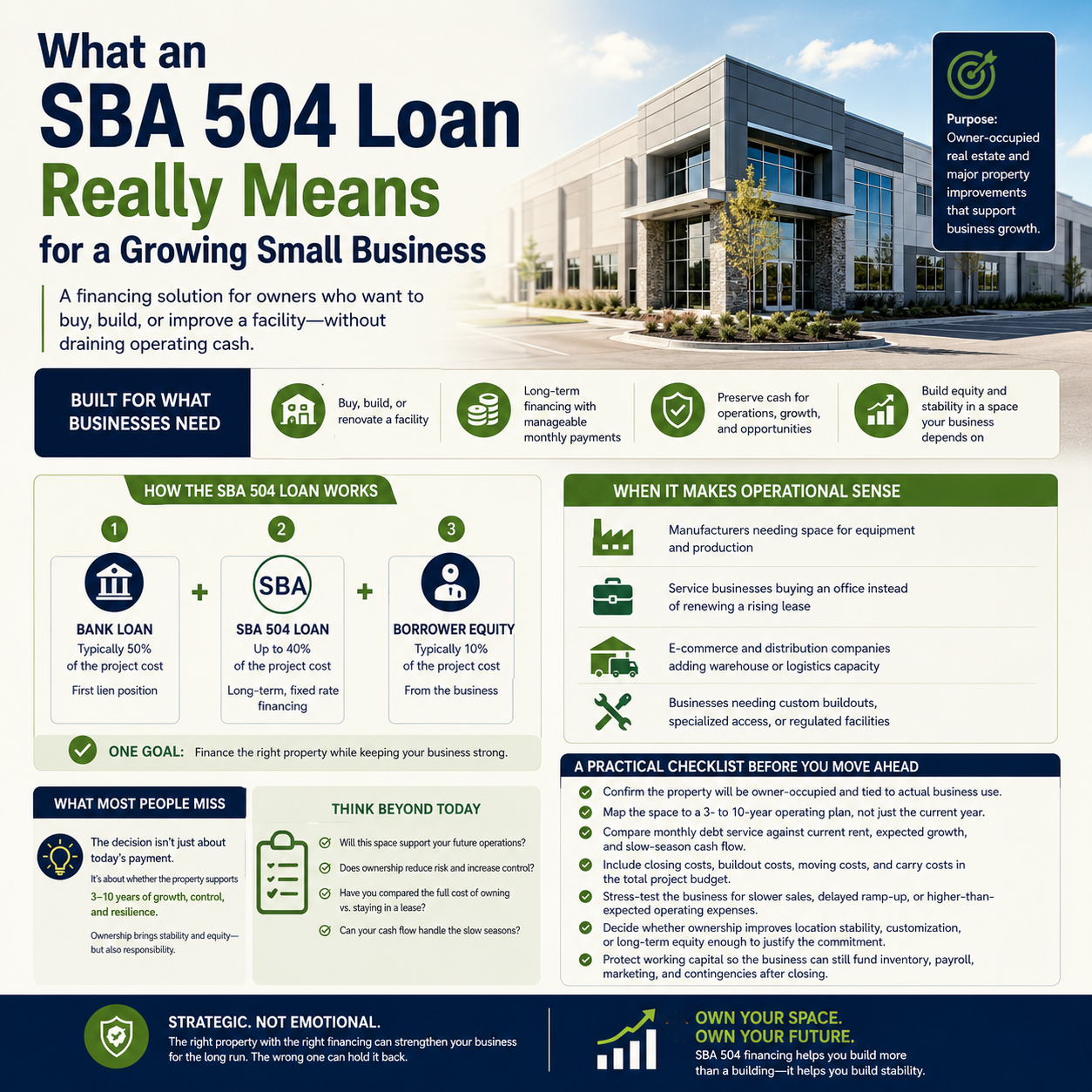
For many small businesses, the real estate decision arrives before the business feels “big enough” for real estate. That is exactly where an SBA 504 loan can change the math. It is not a general working-capital fix; it is a financing structure for owners who are trying to buy, build, or improve a facility without draining operating cash.
The practical question is not whether the program sounds helpful. It is whether the deal improves control, monthly cash flow, and long-term equity better than leasing or taking on a different loan structure.
What an SBA 504 loan is built to do
An SBA 504 loan is designed for owner-occupied commercial real estate and certain large fixed assets tied to business expansion. In plain terms, it helps a business secure property or make major property improvements while spreading the cost over a long horizon. That makes it especially relevant for operators who have outgrown a lease, want stability in a location, or need to commit to a facility they plan to use for years.
The structure typically involves more than one financing layer, which is why owners should think in terms of total project cost, not just the headline rate. A 504 deal is usually about aligning bank financing, SBA-backed financing, and equity from the business in a way that keeps the monthly burden manageable.
When this financing makes operational sense
The strongest use case is a business that can clearly connect the property to revenue stability or expansion. Examples include a manufacturer needing space for equipment, a professional service firm buying its office instead of renewing a rising lease, or an e-commerce business adding a warehouse to improve inventory control.
That last point matters. Real estate is not just an asset on the balance sheet; it can be an operational lever. Ownership may reduce exposure to rent increases, remove uncertainty around lease renewal, and make it easier to plan staffing, inventory, or equipment investments around a stable facility footprint.
What most people miss
Owners often compare the loan payment to today’s rent and stop there. The better question is whether the property supports the next three to ten years of operations. If the business will outgrow the space soon, or if demand is still uneven, the wrong property can become a drag even if the financing looks attractive.
The decision is not just about approval, but about control
One reason founders look at SBA 504 financing is control. A lease can expose a business to rent resets, relocation pressure, and limited customization. Ownership can solve those problems, but it also creates new responsibilities: maintenance planning, insurance, property taxes, and liquidity management.
That tradeoff matters most for businesses with predictable occupancy and a strong need for custom improvements. If the business relies on a specialized layout, cold storage, loading access, client parking, or regulated buildouts, ownership can reduce friction that is hard to quantify until it causes delays or extra expense.
For operators, the decision should be framed as: does this property increase the business’s operating resilience, or does it simply convert rent into debt? If the answer is only the second one, the case for 504 financing is weaker.
How to evaluate the cost structure before you commit
Before moving forward, owners should look beyond the interest rate and review the complete financing picture. That includes down payment expectations, closing costs, professional fees, and the way the project will affect monthly liquidity. A loan that looks affordable on paper can still create strain if the business needs cash for inventory, payroll, marketing, or seasonal volatility.
It is also worth comparing the financing against the likely cost of staying in a lease. A lease may appear cheaper in the short run, but it does not build equity and may leave the business exposed to rent escalation or a disruptive move. A 504 structure may have higher upfront complexity, but it can create a more predictable long-term ownership path.
Owners should also ask how sensitive the business is to interest rates and occupancy timing. If opening or moving into the building will take months, carrying costs during the transition should be included in the analysis. If the business is highly seasonal, the repayment schedule should be tested against the weakest revenue months, not the best ones.
Who should slow down before using a 504 loan
This is not the right financing for every growing company. Businesses with unstable revenue, unclear space requirements, or a near-term chance of relocating again should be cautious. The same is true for firms that need most of their capital for inventory, hiring, software, or acquisition opportunities rather than bricks and mortar.
Owners should also be careful not to use property ownership as a substitute for operational discipline. Buying a building does not fix poor margin management, slow collections, or weak demand. In some cases, it can make those problems harder to absorb because more capital is locked into a long-term asset.
That is why the real decision is strategic, not emotional. The right answer depends on whether property ownership strengthens the business model or simply satisfies a milestone mindset.
A practical checklist before you move ahead
- Confirm the property will be owner-occupied and tied to actual business use.
- Map the space to a 3- to 10-year operating plan, not just the current year.
- Compare monthly debt service against current rent, expected growth, and slow-season cash flow.
- Include closing costs, buildout costs, moving costs, and carry costs in the total project budget.
- Stress-test the business for slower sales, delayed ramp-up, or higher-than-expected operating expenses.
- Decide whether ownership improves location stability, customization, or long-term equity enough to justify the commitment.
- Protect working capital so the business can still fund inventory, payroll, marketing, and contingencies after closing.


