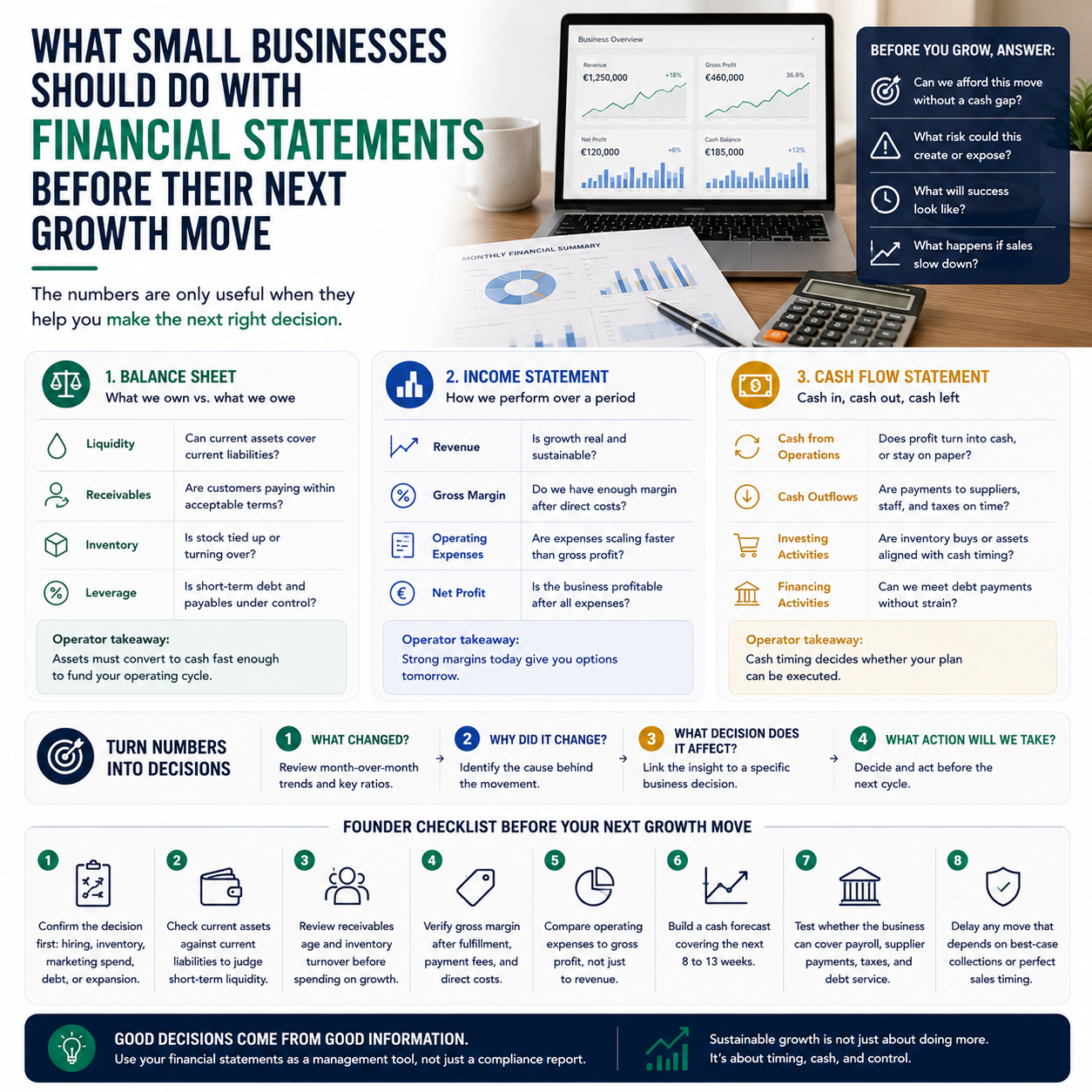
Most small businesses already have the numbers. The problem is not access to financial statements; it is using them to make a specific decision. Before a hiring plan, inventory order, ad spend increase, or new location, founders should read the balance sheet, income statement, and cash flow statement as one operating system.
The practical question is simple: what decision can these statements support right now, and what risk do they reveal before cash gets tight?
Why financial statements matter before growth decisions
Many owners look at revenue first and assume growth is healthy. Revenue can rise while margins shrink, receivables drag cash down, or inventory ties up working capital. Financial statements help separate activity from stability. That matters because growth often fails at the point where a business can no longer fund its own operations.
The balance sheet shows what the business owns and owes at a point in time. The income statement shows whether the core model produces profit after expenses. The cash flow statement shows whether profits are actually turning into spendable cash. Used together, they answer a founder-level question: can the business support the next move without straining operations?
Start with the decision, not the report
Before opening the books, define the decision. A small business owner should not ask, “How do these statements look?” A better question is, “Can I hire one person, add inventory, or expand marketing without creating a cash gap?” That framing changes how the numbers are read.
If the decision is hiring, the owner needs to know whether current gross margin can absorb payroll plus overhead. If the decision is inventory expansion, the issue is not only profitability but how much working capital will be tied up before sales convert back to cash. If the decision is borrowing, the owner needs a realistic picture of repayment capacity, not just top-line growth.
What most people miss
The three statements often tell different stories. A business can look profitable on paper and still be cash-poor because customers pay late, inventory moves slowly, or loan payments are scheduled before receipts arrive. That mismatch is where many small business growth plans break.
How to read the balance sheet like an operator
The balance sheet is most useful when you focus on liquidity and leverage. For a small business, that means checking whether current assets can cover current liabilities without depending on a best-case sales month.
Look at receivables first. If customers owe too much relative to monthly sales, the business is financing its buyers. Then examine inventory. Excess stock may hide in the warehouse while cash sits trapped on the shelf. After that, review short-term debt and payables. If near-term obligations exceed what the business can realistically collect, growth may be creating strain instead of value.
A practical reading of the balance sheet is this: do assets convert to cash quickly enough to support the operating cycle? If not, the issue is not just accounting. It is a working-capital problem.
How the income statement should guide margin decisions
The income statement is where owners should test unit economics and expense discipline. Revenue alone does not tell you if a new customer is worth acquiring or if a discount is quietly eroding margin. For e-commerce operators and service businesses alike, gross margin is the first filter. If gross margin is weak, every growth decision becomes more expensive.
Owners should also review operating expenses in categories that scale with growth. Fulfillment, payroll, software subscriptions, payment processing, and ad spend can all rise faster than expected. The question is not whether expenses are high in absolute terms. The question is whether each euro or dollar spent produces enough contribution margin to justify expansion.
If net profit exists but operating expenses are climbing faster than gross profit, the business may be scaling activity without improving economics. That is a warning sign before committing to more inventory, more headcount, or a larger marketing budget.
Cash flow is the real gatekeeper
Cash flow is the statement that determines whether the business can execute its plan. A founder may approve a profitable order, but if supplier terms, customer payment timing, and payroll timing do not line up, the company can still run into trouble.
For operators, the most useful cash flow question is not “Are we profitable?” It is “When does cash actually enter and leave the business?” That means reviewing collections from customers, timing of supplier payments, tax obligations, debt service, and one-off purchases such as equipment or stock build.
This is also where forecasting becomes practical. A simple 8- to 13-week cash forecast can reveal whether a hire, campaign, or inventory buy will force the business to draw on reserves or credit. If the forecast shows a gap, the decision should be delayed, resized, or paired with improved collection terms.
Turn the statements into an operating routine
Small businesses do not need a complicated finance function to use financial statements well. They need a short routine tied to decisions. That routine should be monthly at minimum, and weekly for cash-sensitive businesses such as e-commerce, retail, and service firms with upfront inventory or payroll commitments.
Use the statements to answer the same four questions each cycle: What changed since last month? Why did it change? What decision does it affect? What action will we take before the next cycle?
That approach turns accounting from a backward-looking record into a management tool. It also helps owners spot when a promising growth opportunity is actually a financing problem in disguise.
Checklist for the next founder decision
- Confirm the decision first: hiring, inventory, marketing spend, debt, or expansion.
- Check current assets against current liabilities to judge short-term liquidity.
- Review receivables age and inventory turnover before spending on growth.
- Verify gross margin after fulfillment, payment fees, and direct costs.
- Compare operating expenses to gross profit, not just to revenue.
- Build a simple cash forecast covering the next 8 to 13 weeks.
- Test whether the business can cover payroll, supplier payments, taxes, and debt service during a slower month.
- Delay any move that depends on best-case collections or perfect sales timing.