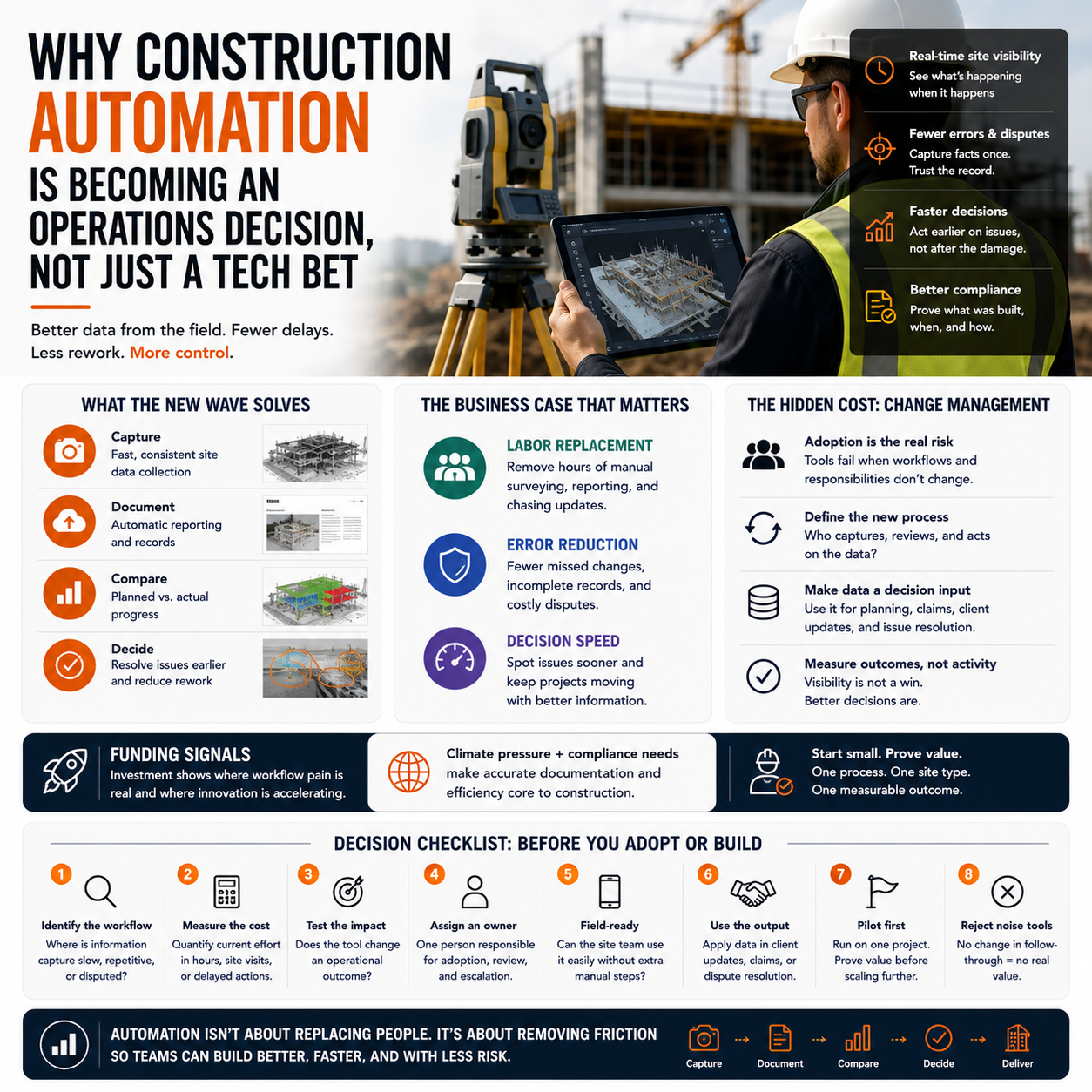
Construction technology is moving away from “nice-to-have innovation” and toward something operators have to evaluate like any other process investment. The latest funding news around automated surveying and documentation tools, alongside broader climate-tech pressure on the built environment, shows where the market is heading: less manual reporting, faster site visibility, and tighter control over rework and compliance.
For founders, contractors, and property operators, the real question is not whether the category is interesting. It is whether a specific tool reduces site friction enough to justify switching workflows, training teams, and paying for it.
What the new wave of construction automation actually solves
The most practical use case in this group is not a flashy “AI for construction” story. It is the removal of slow, error-prone manual steps in surveying, documentation, and site reporting. A system that captures site conditions more consistently can reduce time spent chasing updates, comparing photos, and reconciling what happened on site with what was planned.
That matters because the cost of bad information in construction is rarely just software spend. It shows up as delayed decisions, change orders, missed dependencies, and duplicated site visits. If a tool shortens the gap between work performed and work recorded, it can improve project control without changing the core business model.
Why this matters for small operators and not only large contractors
Smaller construction businesses often assume automation only makes sense once they have many sites or a dedicated tech team. That is not always true. A lean operation can benefit sooner if it spends a disproportionate amount of time on manual surveys, progress checks, or back-and-forth documentation with clients and subcontractors.
The key is to think in terms of operator time and error reduction rather than abstract innovation. If one project manager is spending hours each week assembling site evidence, validating progress, or answering disputes with incomplete documentation, automation can free capacity immediately. That does not require enterprise scale. It requires a workflow with enough repetition to be worth standardizing.
How to judge whether a surveying tool is worth adopting
For founders and operations leads, the first decision is not vendor selection. It is deciding where automation belongs in the current workflow. A tool should fit into a specific process: site capture, progress comparison, documentation handoff, or client reporting. If it only creates another dashboard to check, it is adding noise rather than control.
Look at the business case in three layers:
1. Labor replacement. How much manual effort does the tool remove from surveyors, engineers, or project managers?
2. Error reduction. Does it lower the risk of missing site changes, incomplete records, or disputes over progress?
3. Decision speed. Does it let you act earlier on delays, defects, or scope drift?
A useful system does at least two of those well. If it only improves visibility without changing decisions, the ROI may be weak.
What most people miss
The hidden cost is rarely the software license. It is the operational change required to make the system useful. A surveying platform only works if site teams upload consistently, project managers trust the output, and the company defines who is responsible for review and follow-up.
In other words, the main risk is not buying the tool. The main risk is buying it without redesigning the process around it. That leads to partial adoption, duplicated work, and a tool that looks impressive in demos but does not change project execution.
How funding signals can help operators make better buying decisions
When a startup in this space raises capital, that does not automatically mean buyers should rush in. It does suggest where investors believe the workflow pain is strongest and where product development is likely to accelerate. In this case, automated surveying and documentation is a category with a clear operational logic: it sits close to the job site, touches daily work, and can be measured against time saved and errors avoided.
That makes the category easier to assess than many software trends. Buyers do not need to speculate about customer engagement or brand lift. They can run a pilot on one project and compare current effort against the new process. If the tool reduces manual reporting, improves visibility, and shortens issue resolution time, it has a case. If not, it is still early.
The climate-tech angle is also relevant. Construction and infrastructure are under growing pressure to document activity more efficiently and reduce waste in delivery. Automation tools that help teams prove what was built, when it was built, and how the site changed are becoming part of operational compliance, not just productivity tooling.
What this means for buying, not admiring, the category
Most operators should avoid buying construction automation as a broad platform rollout. A narrower approach works better: choose one process, one site type, and one internal owner. Then measure whether the tool actually changes how decisions are made.
For example, a company might use automated surveying only for recurring progress checks on active sites. Another might deploy it for dispute-proof documentation on subcontractor-heavy projects. The point is to connect the software to a cost center or risk area, not to a vague innovation goal.
If you are a founder building in this category, the buyer message should also stay specific. Construction teams do not want another generic digital transformation promise. They want proof that your system fits into field reality, reduces admin, and survives imperfect site conditions.
Decision checklist before you adopt or build in this space
- Identify one workflow where information capture is slow, repetitive, or disputed.
- Measure the current cost in hours, site visits, or delayed decisions.
- Test whether the tool changes an operational outcome, not just reporting quality.
- Assign one internal owner for adoption, review, and escalation.
- Confirm the field team can use it without adding extra manual steps.
- Check whether output can be used in client updates, progress claims, or dispute resolution.
- Start with one pilot project before any wider rollout.
- Reject tools that create visibility without changing follow-through.