Synthesia’s move from video generation into AI roleplay is more than a product update. For operators, it signals a shift in how companies will buy, run, and measure employee training: less one-way content, more interactive practice with analytics attached.
The practical question for founders and operations leaders is not whether AI training looks impressive. It is whether it reduces manager time, standardizes coaching, and produces measurable skill signals that justify the spend.
What Synthesia is actually changing
According to the company’s launch, AI Roleplay Sessions lets employees practice workplace conversations with AI avatars that can score responses and provide feedback. That changes the training unit from a video asset to a repeatable practice workflow.
For a small business or growing team, that matters because training is often broken in the same places: managers coach inconsistently, onboarding takes too much live time, and nobody can tell which employees actually absorbed the material. A system that can simulate sales calls, support scenarios, or internal processes offers a way to standardize those interactions.
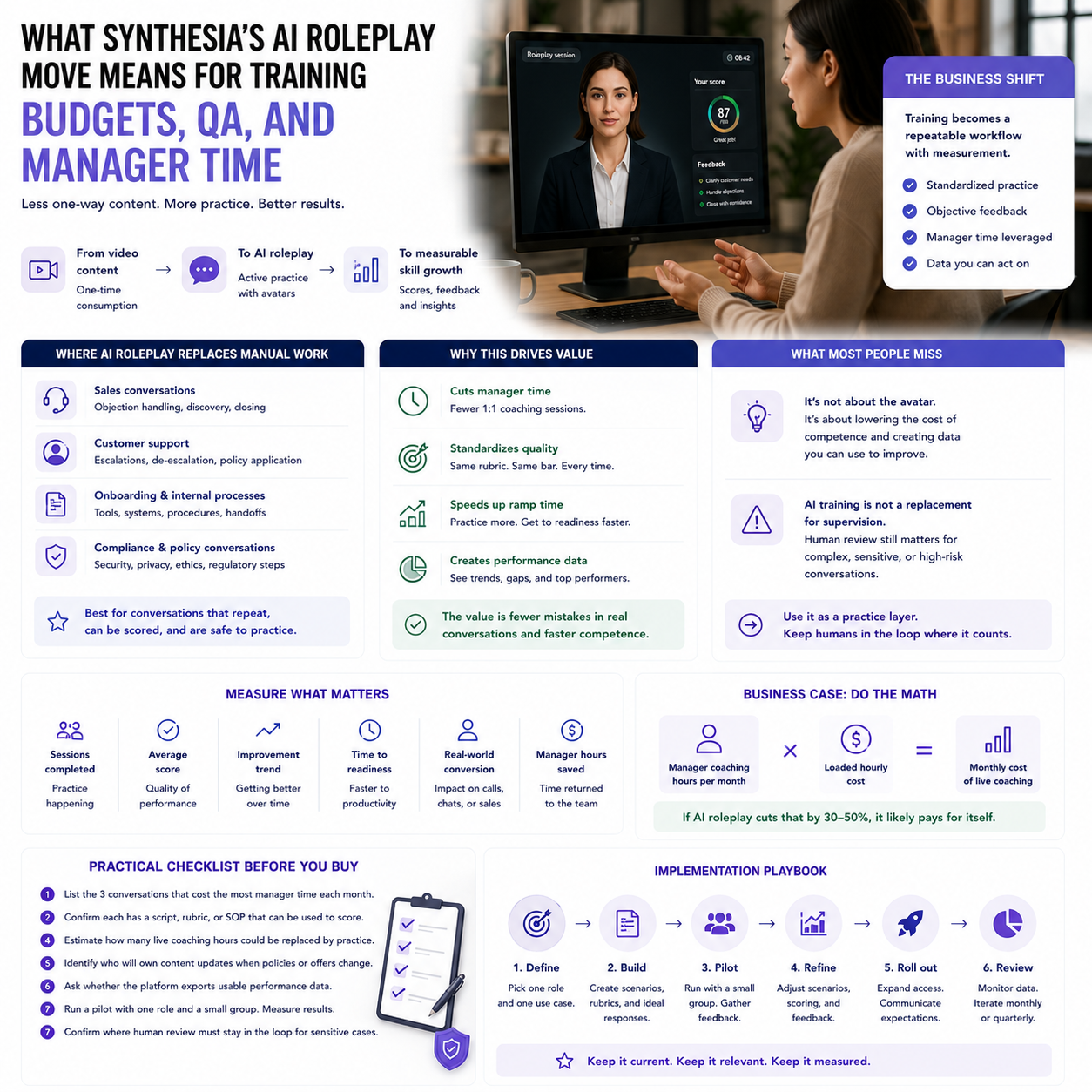
The key business shift is not the avatar. It is the measurement layer. If a training tool can produce session data, completion patterns, and scoring trends, it becomes easier to decide where humans still need to step in and where automated practice is good enough.
Where this can replace manual work
Most companies do not need AI training for everything. They need it for repeated conversations that managers currently coach one by one.
Good candidates include onboarding scripts, objection handling, customer support escalations, compliance conversations, and internal process walkthroughs. These are the kinds of interactions where inconsistency creates cost: slow ramp time, uneven customer experience, and repeated manager interruptions.
For operators, the decision is whether the task has three traits:
- It repeats often enough to justify a reusable system.
- It can be evaluated against a clear rubric.
- Practice errors are cheaper than real-world errors.
If all three are true, AI roleplay can move part of the training load away from managers without eliminating human oversight.
What most people miss
Most discussions about AI training focus on engagement. That is the wrong unit. The real question is whether the system lowers the cost of competence.
If an employee can practice ten times in private before a live customer call, the value is not the avatar itself. The value is fewer manager-led repetitions, fewer mistakes in real conversations, and a clearer benchmark for readiness. That is especially useful in businesses where managers are already overloaded and training quality depends on who happened to be available that week.
The other overlooked point is that AI training creates operational data. If a team uses the same rubric across hires, departments, or locations, leaders can compare who is ready faster, which scripts work, and where the process needs simplification. That turns training from a soft HR activity into something closer to an operations system.
How founders should evaluate the business case
Before adopting any AI training platform, founders should compare it against the current cost of live coaching. That includes manager time, ramp delays, rework, and the hidden cost of inconsistent performance across employees.
The most useful test is simple: does the platform reduce live coaching hours enough to justify subscription cost and setup time? For a small company, even a modest reduction in recurring manager interruptions can matter more than polished content.
There is also a workflow question. If your training process already exists in scripts, scorecards, and standard operating procedures, AI roleplay can plug in quickly. If your training is undocumented and informal, the first cost is not software. It is creating the criteria the software will score against.
That makes this category more relevant to operationally disciplined businesses than to teams that rely on tribal knowledge. The more structured your process, the easier it is to automate practice and measurement.
Risk, quality control, and where human review still matters
AI roleplay is useful only if it reflects the real job. If the scenarios are too generic, the scoring may create false confidence. That is a risk in sales, support, compliance, and any role with nuanced judgment.
Businesses should treat the system as a training layer, not a replacement for supervision. Human review still matters when the conversation involves legal risk, sensitive customer issues, escalation judgment, or brand-specific tone.
Another operational risk is training drift. If scripts, policies, or product details change but the roleplay content does not, the system can teach outdated behavior. That means someone inside the business has to own updates the same way they would own SOP maintenance.
For that reason, the best use case is not “train everyone once.” It is “create a repeatable practice loop that stays current.”
What this means for small businesses and operators
For smaller teams, the advantage is not enterprise-scale transformation. It is leverage. A tool like this can help one manager train more people, more consistently, with less live repetition.
It also gives founders a new way to think about training spend. Instead of viewing training as an overhead line item, they can evaluate it like a system with input costs, throughput, and measurable output. If employees reach competence faster, the return shows up in shorter ramp time and fewer preventable mistakes.
That makes AI training relevant to companies that care about staffing efficiency, customer handling quality, and process standardization. It is especially useful where the cost of a bad conversation is high and the conversation itself is repeatable.
Practical checklist before buying an AI training platform
- List the three employee conversations that cost the most manager time each month.
- Check whether each one has a script, rubric, or SOP that can be used as a scoring standard.
- Estimate how many live coaching hours could be replaced by repeated practice sessions.
- Decide who will own content updates when policies, offers, or scripts change.
- Ask whether the platform exports usable performance data or only completion status.
- Test one role with a small group before rolling it out across departments.
- Review whether the system is suitable for low-risk practice, or whether human review must remain in the loop for sensitive scenarios.