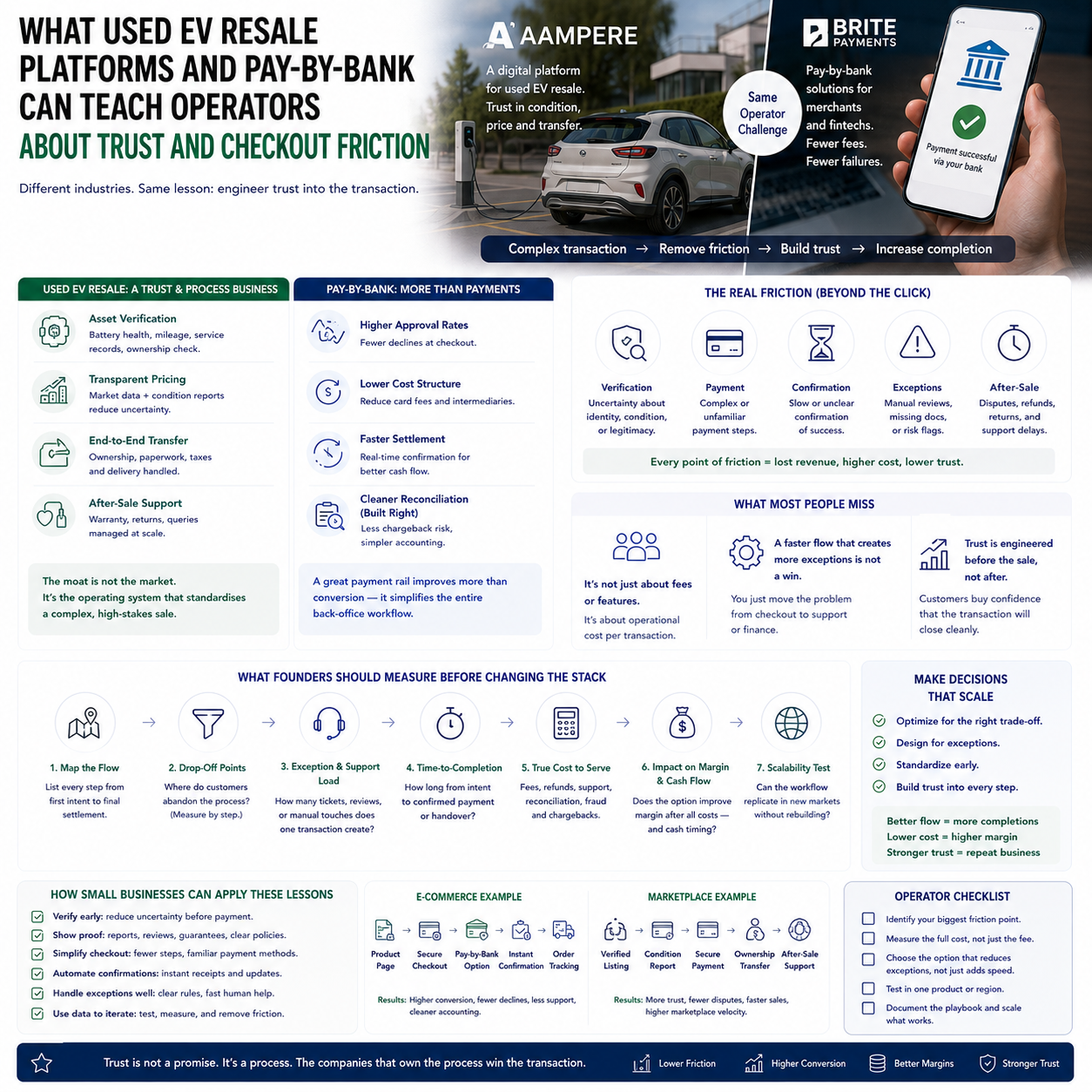
Two European startup signals point to the same operator problem: trust has to be engineered into the transaction, not added afterward. One is about used electric car resale, where the buyer needs confidence in condition, pricing and transfer. The other is about pay-by-bank, where the payment method can remove card fees and failed checkout steps if the flow is designed well.
For founders and operators, the lesson is not “build in EV” or “switch to open banking.” It is to look at where your own revenue gets stuck: verification, payment confirmation, dispute handling, or manual follow-up. Those are the places where revenue leaks, conversion drops, and service costs pile up.
Why these two signals belong in the same business conversation
Aampere’s model is a fully digital resale platform for used electric cars. That means the company is not just matching buyers and sellers; it is trying to make a high-trust transaction feel standardised enough to scale across markets. Brite Payments sits on the other side of the funnel, helping merchants and fintechs move customers from intent to completed payment through pay-by-bank rails.
These are different industries, but the operational pattern is the same. Both businesses are selling flow: one flow for asset transfer, one flow for money movement. The value is created where complexity disappears for the customer, but the real work happens inside the system design, partner network, checks, and exception handling.
That is why founders should read these announcements less as fundraising news and more as proof that “friction removal” can be a product category when it solves a specific operational bottleneck.
Used EV resale is really a trust-and-process business
Used electric cars are not a normal marketplace item. Buyers worry about battery condition, range degradation, warranty transfer, charging history, service records and delivery logistics. Sellers worry about valuation, time to sale and whether they will be pulled into endless questions before a deal closes.
A digital resale platform can only scale if it reduces those concerns into a repeatable transaction. That usually means a tighter internal checklist than a generic marketplace would need. Asset verification, pricing logic, inspection rules, ownership transfer and post-sale support all become part of the product. The platform is not just listing cars; it is standardising a complicated sale.
For operators, this matters because many businesses assume the market is the moat. In reality, the moat is often the operating system around the transaction. If the workflow is messy, customers demand more reassurance and staff spend more time on manual exceptions. If the workflow is standardised, the business can handle more volume without adding the same amount of headcount.
Pay-by-bank is not about payments alone
Pay-by-bank providers are often described as alternatives to cards, but that undersells the operational decision. The merchant is choosing how quickly a customer can complete payment, how many intermediaries sit in the flow, and how much reconciliation work happens later in finance operations.
For some businesses, pay-by-bank can be attractive because it may reduce card dependency and simplify certain settlement steps. But it also changes the checkout experience, customer support logic, refund handling and accounting workflow. If the payment method is fast but reconciliation is hard, the business only moves the problem from checkout into finance.
This is the key decision point for founders: do you want the cheapest payment rail, the highest approval rate, the cleanest bookkeeping flow, or the best customer experience? You often cannot optimise all four at once. The right answer depends on your margin structure, average order value and how much operational complexity your team can absorb.
What most people miss
Payment innovation is usually sold as a conversion story, but for operators it is often a support and finance story. The real question is not whether a new rail is modern. It is whether your team can handle exceptions, refunds, dispute resolution and reconciliation without creating hidden costs.
What founders should measure before changing the stack
When a company considers a marketplace workflow, a payment rail, or another transaction layer, the first task is to define where friction sits. Many teams only measure top-line conversion. That is too shallow.
Instead, measure the full transaction path:
First, look at drop-off points. Where do customers abandon the process: before verification, at payment, during document upload, or while waiting for confirmation? Then look at the cost of handling exceptions. How many support tickets does one failed transaction create? How many manual touches are required before revenue is recognised?
Also track time-to-completion. In asset-heavy categories like used cars, delays can kill intent even when buyers are serious. In payments, delays can trigger cart abandonment or failed settlement. Speed matters, but only when it is tied to certainty. A faster flow that increases error rates is not a win.
Finally, connect the workflow to margin. If a cleaner checkout method reduces payment fees but increases refund complexity, the margin gain may vanish. If a resale workflow makes pricing more accurate but requires more verification labor, the business may gain trust but lose throughput. The right decision is operational, not ideological.
How to think about market expansion without adding chaos
Both companies in these announcements are also expanding across Europe, which is where many founders underestimate the operational burden. Cross-border growth is not just a sales question. It brings local payment preferences, legal differences, customer support expectations and partner dependencies.
For a used EV platform, expansion may require market-specific transfer processes, vehicle data standards and logistics coordination. For a pay-by-bank provider, expansion means broader bank coverage, local payment behaviour and merchant onboarding support. In both cases, a product that works in one market can fail if the back office cannot adapt cleanly.
That is why expansion should be sequenced around operational readiness, not just demand. A founder should ask whether the team can replicate the core workflow in a new market without rebuilding the whole process. If the answer is no, the growth plan may be too early.
What small businesses can copy from these models
You do not need to sell cars or build fintech infrastructure to use the lesson. Any business that depends on a transaction can improve economics by reducing uncertainty earlier in the flow.
If you run e-commerce, that may mean better pre-purchase verification, clearer payment options, or fewer manual reviews on high-risk orders. If you run a service business, it may mean upfront qualification and a cleaner deposit workflow. If you run a marketplace, it may mean standardised listing rules and stricter seller identity checks.
The point is to treat trust as part of the product architecture. Customers are not just buying the item or the service. They are buying confidence that the transaction will close cleanly, with fewer surprises and fewer support interactions.
- Map the full transaction path and mark every step that creates manual work.
- Measure where customers abandon the flow, not just where they click.
- Count support tickets, refund requests and reconciliation issues tied to one transaction type.
- Compare payment or checkout options by total operational cost, not only by fee rate.
- For cross-border expansion, test whether the workflow can be copied with local changes rather than rebuilt from scratch.
- Prioritise systems that reduce exception handling, because that is where scaling breaks first.