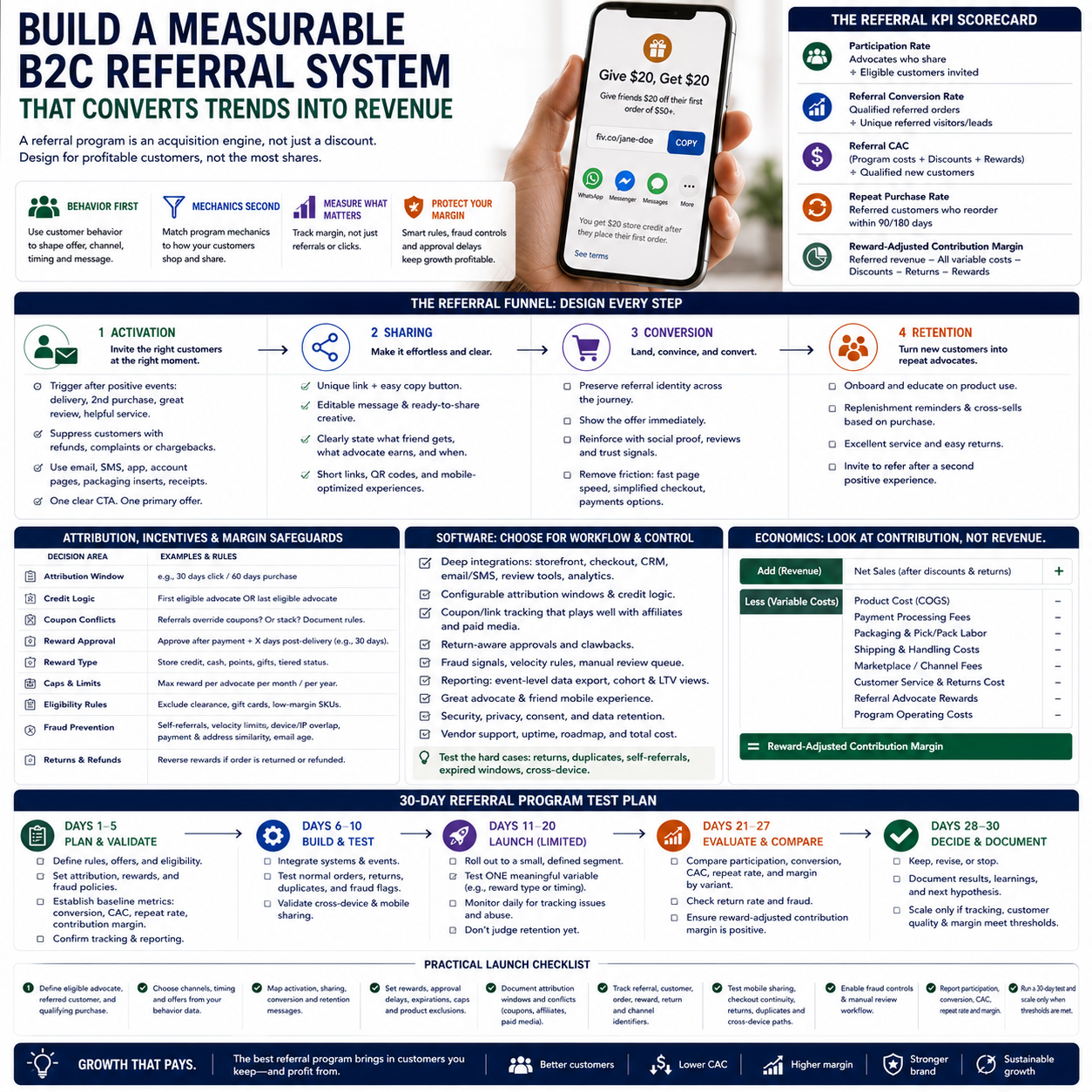
A referral program is not simply a discount attached to a sharing button. For an e-commerce or retail operator, it is an acquisition system: customer behavior determines the offer and channel, sales tactics move prospects through the funnel, and referral-management software records the commercial result.
The objective is not to generate the most shares. It is to acquire customers whose orders remain profitable after discounts, rewards, returns, fulfillment, and fraud. That requires explicit rules before launch and disciplined measurement afterward.
Start with customer behavior, not the reward
Consumer shopping behavior should shape four decisions: where referrals happen, what customers receive, how the message is framed, and when the invitation appears. Review your own order, device, channel, and repeat-purchase data alongside the shopping patterns described in the source material. Trends provide hypotheses; first-party data decides whether they fit your buyers.
Match the program mechanics to observable behavior. Mobile-heavy shoppers need short links, fast landing pages, and easy sharing through messaging apps. Social discovery supports creator-style assets and product imagery. Price-sensitive segments may respond to a fixed discount, while loyal or premium customers may value store credit, early access, gifts, or status more than another coupon.
Timing matters as much as reward value. Ask after a positive event: delivery confirmation, a strong review, a repeat purchase, or a helpful service interaction. Avoid asking before the customer has experienced the product. For replenishable goods, test invitations near the expected reorder window, when product relevance is naturally higher.
What most people miss
A trend is not permission to copy a popular mechanic. It is a signal to test a specific behavioral hypothesis. Write each hypothesis plainly: “Customers who make a second purchase will refer at a higher rate than first-time buyers when offered store credit.” This makes segmentation, reporting, and decisions far clearer than launching one universal offer.
Map sales tactics to the referral funnel
Referral acquisition has four operational stages. At activation, identify satisfied customers and present one clear action. Use post-purchase email, account pages, packaging inserts, receipts, and service follow-ups, but suppress customers with unresolved complaints or recent returns.
At sharing, reduce effort. Provide a unique link, concise benefit statement, and editable message. Explain what the friend receives, what the advocate earns, and when the reward becomes valid. Ambiguity reduces trust.
At conversion, align the landing page with the shared promise. Show the referred offer immediately, preserve referral identity across the journey, add relevant social proof, and remove unnecessary checkout friction. If the friend already knows the product category, the page should confirm value rather than force a long educational sequence.
At retention, treat the referred buyer as a customer rather than a completed referral. Use onboarding, replenishment reminders, cross-sells, and service messages based on the product purchased. Invite that buyer to refer only after a qualifying positive experience. This creates a loop instead of a one-off promotion.
Design attribution, incentives, and margin safeguards
Define attribution before selecting software. Set the referral window, decide whether the first or last eligible advocate receives credit, and document how coupon codes interact with referral links, paid media, affiliates, and existing-customer purchases. Capture referral ID, advocate ID, click time, order ID, customer status, discount, reward liability, return status, and channel.
Use a pending period before issuing rewards. A conversion should qualify only after payment clears and the return or cancellation window passes. Establish rules for partial refunds, exchanges, subscriptions, and split shipments. Decide whether rewards are cash, credit, points, gifts, or tiered benefits—and when they expire.
Protect contribution margin with minimum order values, reward caps, eligible-product rules, and exclusions for low-margin or heavily discounted items. A double-sided incentive can improve conversion, but it also creates two costs. Model both before launch.
Fraud controls should flag self-referrals, repeated payment instruments or addresses, disposable emails, unusual device or IP overlap, rapid account creation, and abnormal referral velocity. Do not rely on automatic blocking alone: route uncertain cases to review and publish clear program terms.
Select software around the workflow
Referral-program management tools should support your operating rules rather than dictate them. Begin with integration quality: the platform must connect reliably to your storefront, checkout, customer records, email or SMS tools, analytics stack, and reward system.
Then evaluate configurable attribution windows, first- versus last-touch logic, coupon and link tracking, customer-status checks, return-aware reward approval, fraud signals, and manual review. Reporting should export event-level data, not only dashboard totals. You need cohort, channel, segment, reward, and product views to diagnose performance.
Also test advocate and friend experiences on mobile, branding controls, consent capture, data retention, permissions, support, and total cost. Ask vendors to demonstrate a returned order, suspected self-referral, duplicate claim, and expired attribution window. Exception handling reveals more than a polished campaign builder.
Measure economics, then run a 30-day test
Track participation rate: advocates who share divided by eligible customers invited. Track referral conversion rate: qualified referred orders divided by unique referred visitors or leads, using one definition consistently. Referral customer acquisition cost equals program operating costs, discounts, and issued rewards divided by qualified new customers.
Measure repeat purchase rate for referred cohorts over a defined period and compare it with comparable non-referred customers. Most importantly, calculate reward-adjusted contribution margin: referred revenue minus cost of goods, variable fulfillment, payment fees, discounts, returns, advocate rewards, and other variable program costs. Review it per order and per acquired customer.
In days 1–5, document eligibility, attribution, reward approval, fraud, and margin rules; establish baseline conversion, acquisition cost, repeat purchase, and contribution margin. In days 6–10, integrate systems, validate events, and test normal orders, returns, duplicates, and cross-device journeys.
In days 11–20, launch to a limited segment. Test one meaningful variable—such as reward type or invitation timing—while keeping audience and landing experience stable. Monitor daily for tracking failures and abuse, but avoid judging retention too early. In days 21–27, compare participation, conversion, acquisition cost, and reward-adjusted margin by variant. In days 28–30, keep, revise, or stop the test; document the result and select the next hypothesis. Do not scale a variant merely because it generated more referrals.
Practical launch checklist
- Define the eligible customer, referred customer, and qualifying purchase.
- Choose channels and timing from first-party behavior, using trends as test hypotheses.
- Map activation, sharing, conversion, and retention messages.
- Set reward values, approval delays, expirations, caps, and product exclusions.
- Document attribution windows and conflicts with coupons, affiliates, and paid media.
- Track referral, customer, order, reward, return, and channel identifiers.
- Test mobile sharing, checkout continuity, returns, duplicate claims, and cross-device paths.
- Enable self-referral, velocity, identity-overlap, and manual-review controls.
- Report participation, conversion, acquisition cost, repeat purchase, and reward-adjusted contribution margin.
- Run a limited 30-day test and scale only when tracking, customer quality, and margin meet preset thresholds.