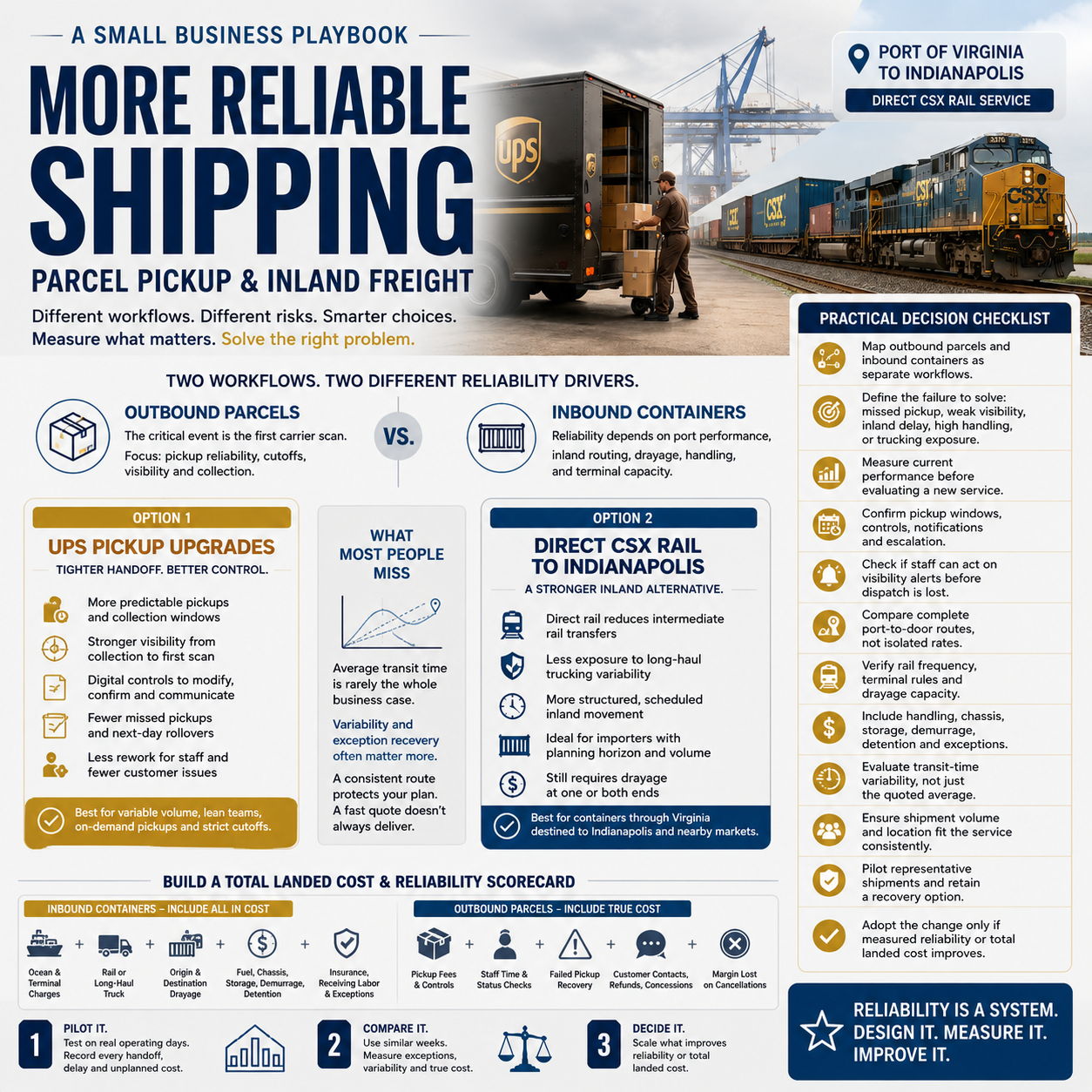
Shipping reliability is often treated as one carrier problem, but small businesses usually face two very different workflows. Outbound parcel orders depend on predictable pickups, accurate cutoffs and timely tracking. Inbound imports depend on port performance, inland routing, drayage capacity and the number of times a container is handled.
Two recent developments illustrate how operators can improve those separate ends of the chain. UPS has rolled out pickup upgrades aimed at small-business shippers, while the Port of Virginia has added direct CSX rail service to Indianapolis. Neither option is automatically faster or cheaper. Their value depends on shipment profile, geography, volume and the operational failure being addressed.
The right question is therefore not “Which service costs less?” It is “Which source of variability costs us most, and does this option remove it without moving the risk elsewhere?”
Start by separating outbound and inbound reliability
For outbound e-commerce, the critical event is the first carrier scan. A parcel packed on time but collected late can miss its planned network movement, weaken delivery estimates and generate customer-service work. Pickup reliability should be measured from order cutoff through collection and initial visibility—not merely from the moment the carrier possesses the package.
Inbound containers operate on a different scale. After arriving at a seaport, freight must reach a warehouse, factory or distribution point. The operator may use truck service for most of that journey or transfer the container to rail before arranging destination drayage. Here, reliability depends on terminal availability, rail schedules, transfers, chassis and driver access, free-time limits and receiving appointments.
Do not combine these workflows into one vague “on-time shipping” metric. Track outbound pickup exceptions and inbound container exceptions separately. Otherwise, a strong parcel delivery rate can conceal repeated pickup failures, while an acceptable ocean transit average can conceal expensive inland delays.
Evaluate pickup upgrades as operational controls
The UPS upgrades should be assessed as controls over the handoff between your operation and the parcel network. Begin by documenting how pickups are scheduled, changed and confirmed. Identify who can modify a request, when the daily cutoff becomes firm, how staff know a driver has collected everything and what happens when expected visibility does not appear.
Useful pickup metrics include the percentage collected within the promised window, time from collection to first scan, missed-pickup frequency and the share of parcels rolled into the next operating day. Also track labor spent checking status, contacting the carrier, moving packages to a drop-off point and responding to customers whose orders have not entered the network.
Better digital controls and visibility are most valuable for businesses with variable daily volume, limited loading space, lean staffing or strict order cutoffs. They may also help merchants that schedule pickups on demand rather than maintaining a stable routine. A business shipping predictable volumes from a staffed dock under an established pickup arrangement may see less incremental value.
Test any upgrade against real operating days. Compare similar weeks and record whether it reduces exceptions rather than simply making them easier to observe. Visibility has value, but an alert that arrives too late to save the day’s dispatch is not the same as reliable collection.
Assess direct rail against the actual inland alternative
The Port of Virginia’s direct CSX service to Indianapolis gives importers serving that market another inland-routing option. The relevant comparison is not “rail versus truck” in the abstract. Model the complete routes: port-to-destination trucking versus terminal handling, rail movement and destination drayage.
Direct rail may be attractive for businesses receiving containers through Virginia and delivering into Indianapolis or a practical surrounding radius. Potential benefits include less exposure to long-haul trucking, fewer intermediate rail transfers and a more structured inland movement. Consolidated import programs and businesses able to plan receiving around scheduled service are more plausible candidates than occasional importers needing immediate, highly flexible delivery.
However, rail does not eliminate trucking. Drayage is still needed at one or both ends, depending on the operating arrangement. Confirm terminal rules, appointment requirements, container availability, free time, storage exposure, chassis access and the distance from the Indianapolis ramp to the final facility. A direct service can simplify the line-haul leg while leaving costly local bottlenecks intact.
What most people miss
Average transit time is rarely the whole business case. Variability and exception recovery often matter more. A route averaging one day longer may be preferable if it consistently protects production or receiving plans. Conversely, a fast quoted transit can be expensive when missed connections, late availability or limited drayage capacity create storage, demurrage, detention or emergency-trucking charges.
The same principle applies to parcel pickup. More tracking events do not automatically improve reliability. The operational benefit comes from having enough warning—and enough authority—to intervene before the cutoff is lost.
Build a total landed cost and reliability scorecard
Compare options per shipment, per container and per order where appropriate. For inbound freight, include ocean charges that vary by routing, port and terminal fees, rail or long-haul truck cost, origin and destination drayage, fuel surcharges, chassis costs, storage, demurrage, detention, cargo insurance and warehouse receiving labor. Add a realistic exception allowance based on your records rather than assuming perfect execution.
For outbound parcels, include pickup fees, staff time, failed-collection recovery, mileage and labor for emergency drop-offs, delayed-order contacts, refunds or concessions and the margin lost through cancellations. Some of these costs are indirect, but excluding them favors the status quo.
Score reliability alongside cost using on-time percentage, variability around the promised time, visibility milestones, cutoff success and recovery options. Weight each measure according to the business. A subscription merchant may prioritize consistent dispatch; an importer feeding production may place more value on predictable container availability than on the lowest line-haul quote.
Run a controlled pilot before redesigning the network. Test pickup features on representative shipping days. For rail, start with suitable containers and compare actual door-to-door results against the incumbent route. Record every handoff, delay and unplanned charge. Seasonal peaks should be analyzed separately from normal operations.
Practical decision checklist
- Map outbound parcels and inbound containers as separate workflows.
- Define the failure to solve: missed pickup, weak first-scan visibility, unreliable cutoff, inland delay, excessive handling or high trucking exposure.
- Measure current performance before evaluating a new service.
- Confirm pickup windows, modification controls, notifications and escalation procedures.
- Check whether staff can act on visibility alerts before dispatch is lost.
- Compare complete port-to-door routes, not isolated rail and truck rates.
- Verify rail frequency, terminal availability rules and destination drayage capacity.
- Include handling, chassis, storage, demurrage, detention and exception costs.
- Evaluate transit-time variability as well as the quoted average.
- Identify whether shipment volume and location fit the service consistently.
- Pilot representative shipments and retain a recovery option.
- Adopt the change only if measured reliability or total landed cost improves.