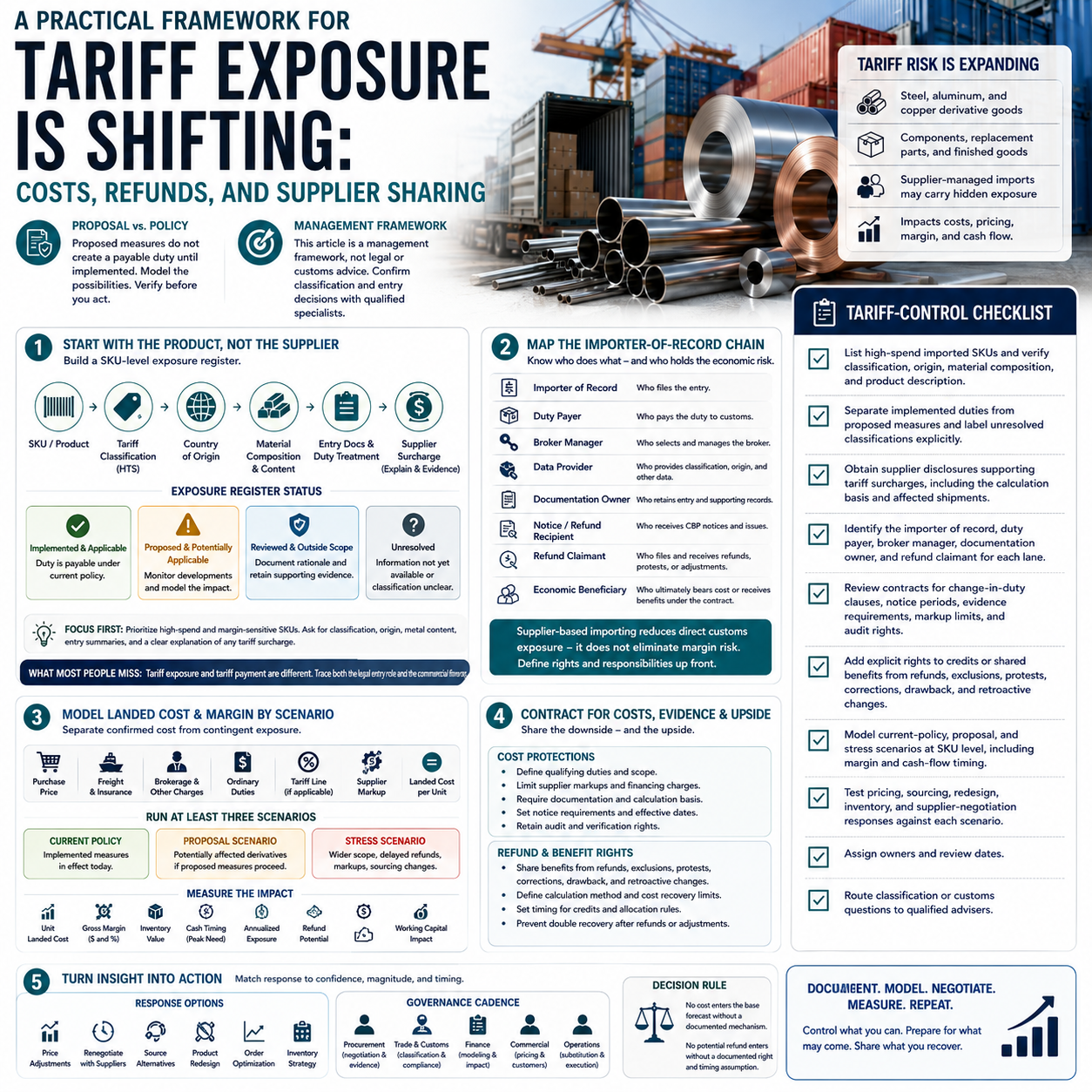
Tariff risk is no longer confined to businesses importing obvious metal inputs. Proposed expansion of U.S. duties to additional steel, aluminum, and copper derivative goods could move exposure deeper into finished products, components, replacement parts, and supplier-managed imports. That makes tariff control an operational problem spanning procurement, customs data, contracts, pricing, and finance.
The essential distinction is between a proposal and implemented policy. Proposed additions do not create a payable duty until the relevant process is completed and the measure takes effect. Operators should therefore model possible exposure without treating every proposed product as already subject to a new charge. This article offers a management framework, not legal or customs advice; classification and entry decisions should be validated with qualified specialists.
Start with the product, not the supplier
A supplier’s country or a product’s broad description is not enough to establish exposure. Begin at SKU level and connect each item to its tariff classification, material composition, country of origin, entry documentation, and applicable duty treatment. For assemblies, identify whether the potential measure applies to the complete article, its metal content, or a specifically described derivative product.
Build a working exposure register with four statuses: implemented and applicable; proposed and potentially applicable; reviewed and outside scope; and unresolved. The unresolved category matters because false precision can lead to premature price increases or missed liabilities.
Prioritize high-spend and high-margin-sensitive SKUs rather than attempting to perfect the entire catalog immediately. Ask suppliers for classification codes, origin information, metal-content details, entry summaries where appropriate, and an explanation of any tariff surcharge. A surcharge presented as a percentage of the invoice is not proof that the same percentage was paid to customs.
What most people miss
Tariff exposure and tariff payment are different questions. A buyer may bear the economic cost even when a supplier or intermediary pays the duty as importer of record. Conversely, a company importing directly may owe the duty but recover part of the impact through supplier concessions, customer pricing, refunds, drawback, or sourcing changes. The control model must therefore trace both the legal entry role and the commercial flow of money.
Map the importer-of-record chain
For every material import lane, document who serves as importer of record, who selects the customs broker, who supplies classification and origin data, and who receives notices, protests, refunds, or other adjustments. Incoterms and purchase terms can help explain responsibilities, but operators should verify how transactions work in practice.
Supplier-based importing can reduce a buyer’s direct customs exposure, but it does not eliminate margin risk. O’Reilly Automotive’s supplier-based sourcing model illustrates the distinction: suppliers handle much of the importing, while the retailer manages tariff effects through commercial arrangements, including sharing benefits when tariff refunds occur. The lesson is not to copy one formula. It is to define the information and economic rights before duties, exclusions, or refunds change.
Create a one-page responsibility map for each supplier relationship. It should name the importer, duty payer, initial cost bearer, documentation owner, surcharge calculator, refund claimant, and beneficiary under the contract. If any field is unknown, the forecast contains an unmanaged assumption.
Model landed cost and margin by scenario
A useful model separates confirmed cost from contingent exposure. At SKU level, start with purchase price, freight, insurance, brokerage, ordinary duties, and other established import charges. Add a tariff line calculated on the appropriate customs value or other applicable basis only after that basis has been verified. Keep supplier administrative markups separate so teams can challenge them independently.
Run at least three scenarios: current implemented policy; a proposed-policy case covering potentially affected derivatives; and a stress case that includes wider scope, delayed refunds, supplier markups, or adverse sourcing changes. For each scenario, calculate unit landed cost, gross-margin dollars, gross-margin percentage, inventory value, cash timing, and annualized exposure based on realistic volumes.
Do not model every dollar as permanent. Use timing assumptions for inventory already in transit, supplier notice periods, contract reopening dates, customer price changes, and possible refunds. A duty paid today and refunded later still creates working-capital pressure. Finance should show both the income-statement effect and the peak cash requirement.
Contract for costs, evidence, and upside
Tariff clauses often describe who pays a new charge but remain silent on evidence and later recoveries. Effective language should address both. Define which government-imposed duties qualify for adjustment, whether supplier overhead or financing costs may be added, and what documentation supports a surcharge. Establish notice requirements, audit or verification rights, effective dates, and treatment of inventory purchased before a change.
Refund rights deserve equal attention. Specify whether benefits from refunds, exclusions, protests, corrections, drawback, or retroactive policy changes must be passed through. State how the benefit is calculated, whether reasonable recovery costs are deducted, when credits are issued, and how benefits are allocated if a claim covers goods sold to multiple customers.
O’Reilly Automotive’s reported refund-sharing approach is operationally useful because it recognizes symmetry: if buyers share tariff costs, they should negotiate access to corresponding recoveries. Without that symmetry, a supplier can pass through the downside while retaining the upside. Procurement should also prevent double recovery—for example, a supplier retaining a surcharge after its underlying duty has been refunded.
Turn the model into operating decisions
The response should reflect confidence, magnitude, and timing. For implemented exposure with reliable documentation, options include targeted price changes, revised order quantities, alternative origins, product redesign, supplier negotiation, or direct-import changes. For proposed exposure, reversible actions are usually preferable: quote-validity limits, conditional pricing, supplier data requests, dual-source qualification, and scenario reserves.
A governance cadence prevents contradictory decisions. Procurement owns supplier evidence and negotiations; trade specialists validate classifications and entry assumptions; finance controls the model; commercial teams assess pricing; and operations evaluate substitutions. Review high-exposure SKUs whenever policy scope changes, a supplier introduces a surcharge, or refund information becomes available.
Use one decision rule throughout: no cost should enter the base forecast without a documented mechanism, and no potential refund should enter it without a documented right and realistic timing assumption.
Tariff-control checklist
- List high-spend imported SKUs and verify classification, origin, material composition, and product description.
- Separate implemented duties from proposed measures and label unresolved classifications explicitly.
- Obtain supplier disclosures supporting tariff surcharges, including the calculation basis and affected shipments.
- Identify the importer of record, duty payer, broker manager, documentation owner, and refund claimant for each lane.
- Review contracts for change-in-duty clauses, notice periods, evidence requirements, markup limits, and audit rights.
- Add explicit rights to credits or shared benefits from refunds, exclusions, protests, corrections, drawback, and retroactive changes.
- Model current-policy, proposal, and stress scenarios at SKU level, including margin and cash-flow timing.
- Test pricing, sourcing, redesign, inventory, and supplier-negotiation responses against each scenario.
- Assign owners and review dates, and route classification or customs questions to qualified advisers.