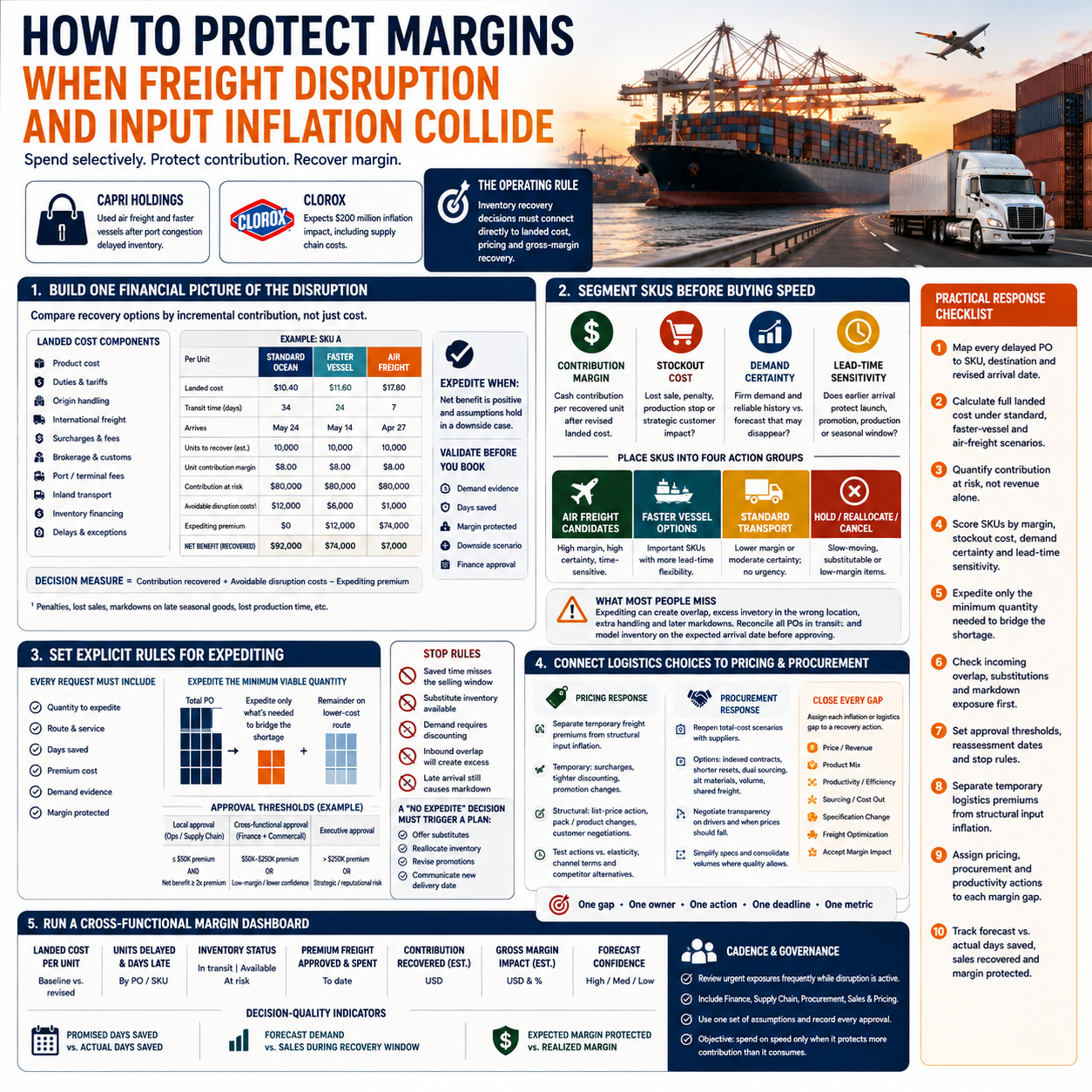
When freight disruption and supplier inflation arrive together, the instinctive response is often to treat them as separate problems. Operations tries to recover delayed inventory, procurement negotiates input costs, and finance revises the margin forecast. That separation creates expensive decisions: a team may approve premium freight to protect sales without calculating whether the recovered contribution covers the logistics premium.
Capri Holdings illustrates the service-versus-cost dilemma. After port congestion contributed to inventory delays, the owner of Michael Kors, Versace and Jimmy Choo used measures including air freight and faster vessels. Clorox, meanwhile, expected a $200 million inflation impact, with supply-chain costs among the factors. Together, the cases point to one operating rule: inventory recovery decisions must be connected directly to landed cost, pricing and gross-margin recovery.
Build one financial picture of the disruption
Start by replacing separate freight, inventory and inflation reports with a single scenario model. For each affected SKU, calculate the current landed cost and at least three recovery options: remain with the original route, move to a faster ocean service, or use air freight. Include product cost, duties, handling, transport, surcharges and the cost of financing inventory. Then add the commercial consequences of each arrival date.
The comparison should not be “air versus ocean cost.” It should be “incremental recovery cost versus contribution at risk.” Estimate the units likely to sell during the time saved, multiply them by unit contribution margin, and adjust for demand confidence. Add avoidable costs such as customer penalties, markdowns on late seasonal goods or lost production time. Deduct the premium freight cost and any extra handling.
A simple decision measure is: expected contribution recovered plus avoidable disruption costs, minus the expediting premium. Expedite only when that value is positive and the assumptions withstand a downside scenario. Finance should validate the margin logic before operations books capacity.
Segment SKUs before buying speed
Blanket expediting is rarely defensible. Score each SKU against four factors: contribution margin, stockout cost, demand certainty and lead-time sensitivity. Use a consistent scale, such as one to five, but keep the underlying measures visible so that a subjective score does not obscure the economics.
- Contribution margin: How much cash contribution can each recovered unit generate after the revised landed cost?
- Stockout cost: Would a shortage lose a sale, trigger a penalty, stop production or weaken a strategic customer relationship?
- Demand certainty: Is there firm demand, reliable replenishment history or only a forecast that may disappear?
- Lead-time sensitivity: Does arriving several days earlier protect a launch, promotion, production schedule or seasonal window?
Place SKUs into four action groups. High-margin, high-certainty and time-sensitive products are candidates for air freight. Important products with more lead-time flexibility may justify faster vessels. Lower-margin items with uncertain demand should normally remain on standard transport. Slow-moving or substitutable products should be held, reallocated or cancelled where contract terms permit.
This method also prevents revenue size from dominating the decision. A high-revenue SKU can still destroy margin if its unit economics are weak, while a smaller item may deserve priority because it protects a production line or a valuable account.
What most people miss
Expediting changes more than freight expense. It can pull inventory into the wrong location, create excess stock after delayed shipments arrive, increase handling, and reduce the time available to detect a demand slowdown. Before approving a premium route, reconcile every purchase order already in transit and model inventory at the destination on the expected arrival date. Otherwise, the business may pay for speed only to create a later markdown problem.
Set explicit rules for expediting
Require every request to state the quantity, route, days saved, premium cost, demand evidence and margin protected. Avoid shipping an entire purchase order when only part of it is needed. Split the order: expedite enough units to bridge the shortage, then leave the balance on the lower-cost route. This “minimum viable expedite” limits downside if demand weakens.
Set approval thresholds based on economics and risk. Local teams may approve smaller actions when expected contribution recovered comfortably exceeds the premium. Larger commitments, uncertain forecasts or low-margin products should require finance and commercial approval. Reassess open expedites frequently because port conditions, vessel schedules and demand can change before departure.
Also define stop rules. Do not expedite when the saved time misses the selling window, substitute stock is available, demand depends on discounting, or delayed inventory will create an overlap. A decision not to expedite should trigger a commercial plan rather than passive acceptance: offer substitutes, reallocate inventory, revise promotions or communicate a new delivery date.
Connect logistics choices to pricing and procurement
Premium freight is a bridge, not a complete margin strategy. When inflation affects materials, manufacturing and transport simultaneously—as Clorox’s projected $200 million impact demonstrates—the response must cover both revenue and the cost base.
Pricing teams should distinguish temporary freight premiums from structural input inflation. Temporary costs may be recovered through surcharges, tighter discounting or promotion changes. Structural increases may require list-price action, pack or product architecture changes, and customer negotiations. Test price actions against elasticity, channel terms and competitor alternatives rather than applying a uniform percentage.
Procurement should reopen total-cost scenarios with suppliers. Options include indexed contracts, shorter price-reset periods, alternative materials, dual sourcing, revised order quantities and shared freight arrangements. Negotiate transparency around the drivers of increases and define when prices should fall if those drivers reverse. Operations can support this work by reducing specification complexity or consolidating volumes, but substitutions must be assessed for quality and customer impact.
Assign every inflation or logistics gap to a recovery action: price, mix, productivity, sourcing, specification, freight optimization or an accepted margin reduction. This converts a broad cost warning into accountable measures and reduces the risk of counting the same savings twice.
Run a cross-functional margin dashboard
The dashboard should operate at SKU, purchase-order and business-unit levels. Track baseline and revised landed cost per unit; units delayed and days late; inventory in transit, available and at risk; premium freight approved and spent; expected contribution recovered; projected gross-margin impact; forecast confidence; and the owner, timing and status of each recovery action.
Add decision-quality indicators. Compare promised days saved with actual days saved, forecast demand with sales during the recovery window, and expected margin protected with realized margin. These measures reveal whether premium freight is genuinely effective or merely transferring cost into the logistics budget.
Review urgent exposures frequently while disruption is active, with finance, supply chain, procurement, sales and pricing present. Use one set of assumptions and record every approval. The objective is not to eliminate all disruption costs. It is to spend selectively where speed protects more contribution than it consumes, while structural inflation is recovered through coordinated commercial and procurement action.
Practical response checklist
- Map every delayed purchase order to its SKU, destination and revised arrival date.
- Calculate full landed cost under standard, faster-vessel and air-freight scenarios.
- Quantify contribution at risk rather than using revenue alone.
- Score SKUs by margin, stockout cost, demand certainty and lead-time sensitivity.
- Expedite only the minimum quantity needed to bridge the shortage.
- Check incoming inventory overlap, substitutions and markdown exposure first.
- Set approval thresholds, reassessment dates and stop rules.
- Separate temporary logistics premiums from structural input inflation.
- Assign pricing, procurement and productivity actions to each margin gap.
- Track forecast versus actual days saved, sales recovered and margin protected.