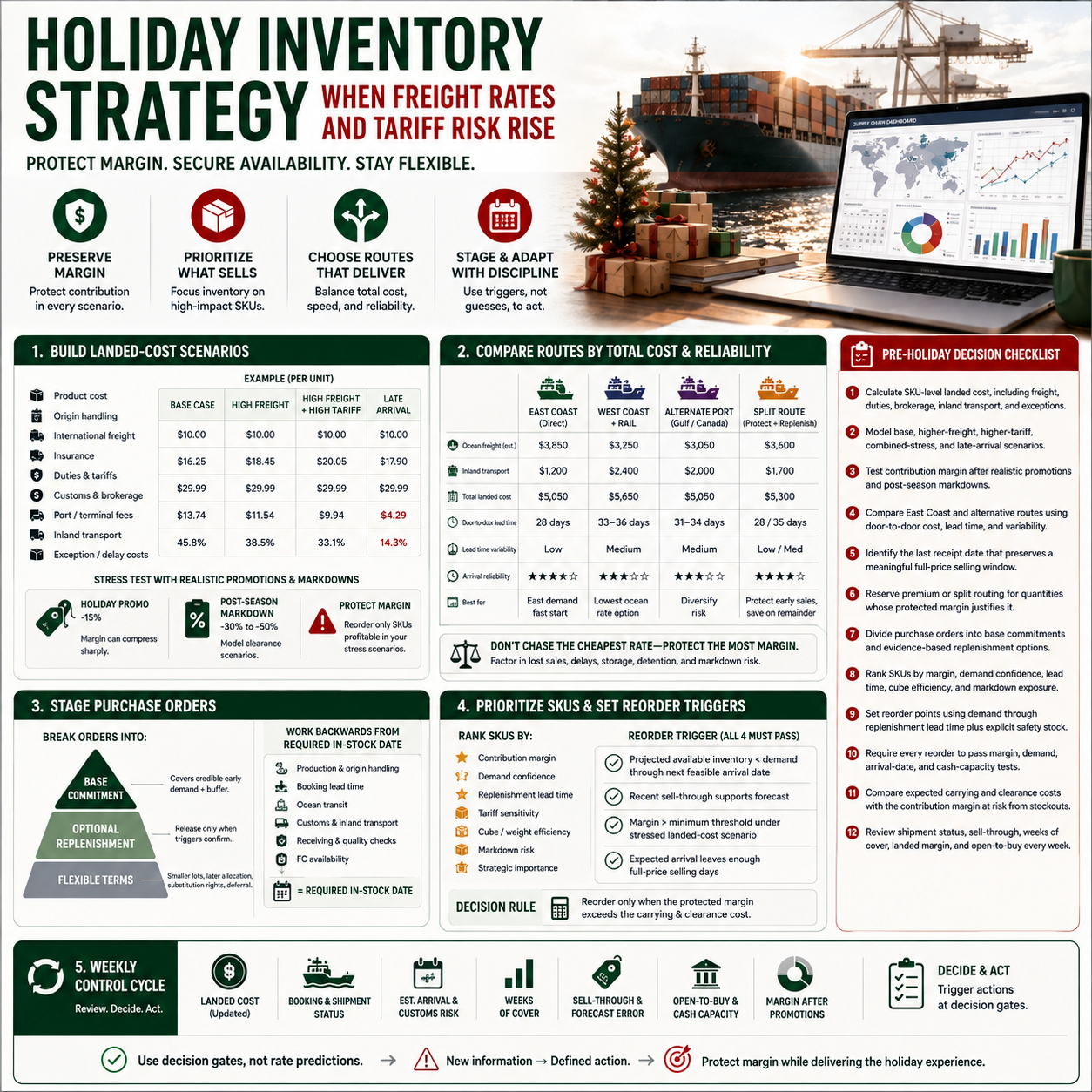
Holiday inventory planning becomes harder when several risks arrive together: retailers have already pulled imports forward, Asia-to-US East Coast ocean rates are rising, and tariff exposure remains uncertain. Importers cannot solve that combination by making a single forecast. They need a decision system that remains useful across multiple outcomes.
The objective is not simply to secure the lowest freight quote or import the most stock before a possible tariff change. It is to preserve contribution margin while maintaining enough availability for the products that matter. That requires SKU-level landed-cost scenarios, deliberate routing choices, staged purchase orders, and explicit rules for balancing stockouts against post-holiday markdowns.
Build landed-cost scenarios before changing purchase orders
Begin with unit economics rather than container rates. For each important SKU, calculate landed cost as product cost plus origin handling, international freight, insurance, duties and tariffs, customs and brokerage charges, port or terminal fees, inland transport, and an allowance for delays or exceptions. Divide shared shipment costs using the factor that actually drives expense—usually volume, weight, or container space—not merely unit count.
Create at least three scenarios: a base case using current assumptions, a higher-freight case, and a combined higher-freight and higher-tariff case. Add a delay case when late arrival would materially reduce the product’s selling window. This is particularly important for seasonal merchandise whose value falls sharply after a specific date.
For each scenario, calculate contribution margin in dollars and as a percentage of net selling price. Then stress-test the expected selling price with realistic promotional and markdown assumptions. A shipment can appear profitable at full price but destroy margin if congestion or weak demand leaves stock to be cleared after the holidays.
Use ranges instead of one blended average. A tariff-sensitive SKU with thin gross margin should not inherit the same purchasing rule as an evergreen, high-margin product. The output should show management which SKUs remain profitable in every scenario, which require repricing or cost changes, and which should not be reordered without stronger demand evidence.
Compare routes by total cost and arrival reliability
Rising Asia-to-US East Coast rates make alternative gateways worth testing, but the ocean quote is only one line in the comparison. Model each feasible route from factory release to the inventory’s final destination. Include sailing time, transshipment exposure, port dwell, rail or truck cost, drayage, storage, transfer handling, and the cost of inventory tied up for additional days.
An East Coast service may still be economical for stock serving eastern customers because it avoids a long domestic move. A West Coast gateway may offer a different capacity or transit profile but add rail or trucking expense. Other ports can diversify disruption risk, although they may introduce smaller carrier networks, extra handling, or longer final-mile distances.
Evaluate routes on expected landed cost, plausible high-case cost, door-to-door lead time, lead-time variability, and the commercial cost of missing the selling window. Split-routing can be sensible for priority SKUs: move the minimum quantity needed to protect early sales through the route with the best arrival confidence, while sending replenishment through the lower-total-cost option. Avoid splitting merely for appearance; additional shipments can reduce container utilization and multiply fixed charges.
What most people miss
The cheapest route is not necessarily the route with the lowest expected business cost. A small freight saving can be overwhelmed by lost full-price sales, emergency transport, detention, or markdowns caused by a late arrival. Conversely, paying a premium for every unit can also be wasteful when only part of the order is needed early. The correct unit of analysis is the margin protected by each routing decision, not the freight rate alone.
Stage purchase orders instead of making one large bet
Front-loading can reduce exposure to later disruption or tariff changes, but it transfers risk into working capital, storage, obsolescence, and markdowns. Replace an all-at-once commitment with staged purchase orders where supplier terms and production constraints permit.
Separate each order into a base quantity and optional replenishment. The base should cover credible early-season demand plus a targeted buffer for supply variability. Release later quantities only when predefined signals support them, such as sell-through, available-to-promise inventory, inbound shipment status, supplier lead time, and updated landed margin.
PO timing should work backward from the required in-stock date, not the holiday itself. Include production, origin consolidation, booking lead time, sailing, customs clearance, inland transport, receiving, quality checks, and fulfillment-center availability. Add a variability buffer explicitly rather than hiding it inside an inflated forecast.
Negotiate flexibility as well as price. Useful terms can include smaller production lots, later assortment allocation, controlled release windows, substitution rights, and the ability to postpone part of a shipment. Even when flexibility raises unit cost slightly, it may be cheaper than financing surplus seasonal inventory.
Prioritize SKUs and set measurable reorder triggers
Classify holiday products using contribution margin, demand confidence, strategic importance, replenishment lead time, tariff sensitivity, cube efficiency, and markdown risk. High-margin products with dependable demand and long replenishment cycles deserve stronger availability protection. Low-margin, bulky, trend-driven, or highly tariff-sensitive items should face stricter purchase thresholds.
Set a reorder point for each priority SKU based on expected demand during the full replenishment lead time plus safety stock. Safety stock should reflect both demand volatility and lead-time variability. If neither can be estimated precisely, use operational ranges and review them frequently rather than choosing an arbitrary percentage of forecast sales.
A practical trigger can require four conditions: projected available inventory will fall below demand through the next feasible arrival date; recent sell-through supports the forecast; the replenishment remains above a minimum contribution-margin threshold under the stressed landed-cost case; and the expected arrival still leaves enough full-price selling days. This prevents teams from reordering solely because sales are strong while ignoring deteriorating economics or timing.
Measure the tradeoff directly. Carrying cost includes financing, storage, insurance, handling, shrinkage, and obsolescence or markdown risk. Stockout cost includes lost contribution margin, potential customer-acquisition waste, marketplace ranking effects, and substitution to competitors. Buy additional safety stock only when its expected protection value exceeds its expected carrying and clearance cost.
Run a weekly control cycle
During the pre-holiday period, review the plan weekly at SKU and shipment level. Track updated landed cost, booking status, estimated arrival, customs exposure, weeks of cover, sell-through, forecast error, open-to-buy, and margin after expected promotions. Assign one owner to approve exceptions so urgent logistics choices do not bypass profitability checks.
Use decision gates rather than rate predictions. If freight moves above the stress threshold, recalculate margin and test alternative routes. If tariff treatment changes, rerun the duty component before releasing open POs. If a shipment’s likely arrival crosses the last profitable receipt date, reduce, defer, redirect, or cancel it where contracts allow. If demand exceeds plan, replenish only SKUs that pass both the margin and arrival-window tests.
This process preserves optionality. It accepts that operators cannot reliably predict freight or trade policy while ensuring that each new piece of information leads to a defined action.
Pre-holiday decision checklist
- Calculate SKU-level landed cost, including freight, duties, brokerage, inland transport, and exception costs.
- Model base, higher-freight, higher-tariff, combined-stress, and late-arrival scenarios.
- Test contribution margin after realistic promotions and post-season markdowns.
- Compare East Coast and alternative routes using door-to-door cost, lead time, and variability.
- Identify the last receipt date that preserves a meaningful full-price selling window.
- Reserve premium or split routing for quantities whose protected margin justifies it.
- Divide purchase orders into base commitments and evidence-based replenishment options.
- Rank SKUs by margin, demand confidence, lead time, cube efficiency, and markdown exposure.
- Set reorder points using demand through replenishment lead time plus explicit safety stock.
- Require every reorder to pass margin, demand, arrival-date, and cash-capacity tests.
- Compare expected carrying and clearance costs with the contribution margin at risk from stockouts.
- Review shipment status, sell-through, weeks of cover, landed margin, and open-to-buy every week.