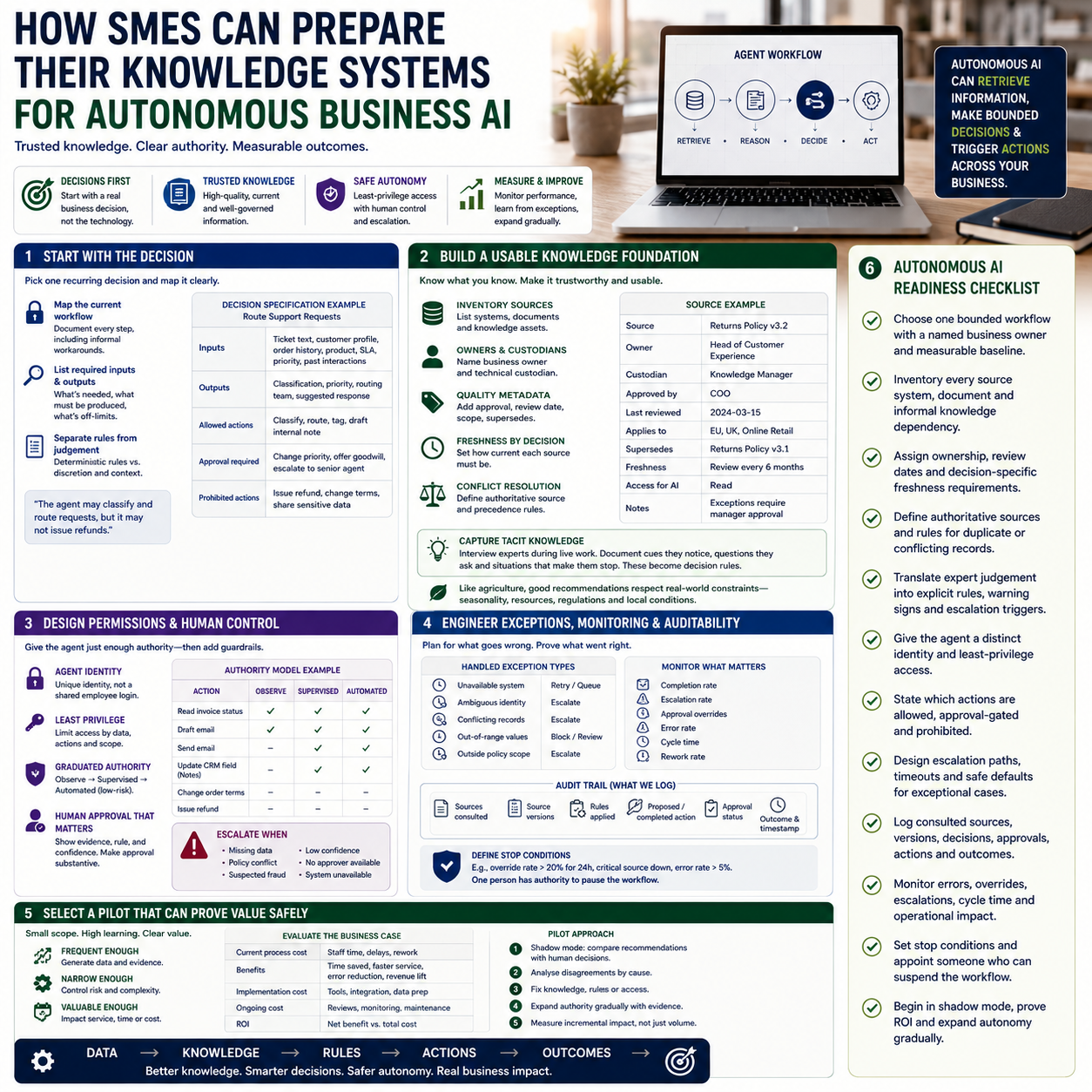
Autonomous business AI promises more than answering questions. It can retrieve information, make bounded decisions and trigger actions across operational systems. For an SME, however, the main obstacle is rarely the model itself. It is the condition of the organisation’s knowledge: scattered documents, undocumented judgement, inconsistent records and permissions designed for people rather than software agents.
The practical lesson from emerging business-AI infrastructure is straightforward: an AI system cannot operate reliably if it lacks trusted context and explicit authority. The same principle appears in agriculture, where recommendations must account for biology, local conditions and operational constraints. SMEs should therefore treat autonomy as a knowledge and workflow redesign project—not a chatbot deployment.
Start with the decisions, not the AI
Before selecting technology, identify a recurring operational decision that consumes time or causes avoidable delay. Examples include routing support requests, checking order exceptions, preparing renewal files or identifying invoices that need review. Describe the workflow as it works today, including informal steps performed in email, spreadsheets and employees’ heads.
For every decision, document the required inputs, acceptable outputs and actions that must remain prohibited. Separate deterministic rules—such as contractual thresholds—from judgement calls. Record who can approve an exception, what evidence they need and how quickly they must respond. This turns institutional knowledge into an executable operating specification.
Do not begin with a broad objective such as “automate customer service.” Choose a bounded workflow with a clear start, finish and owner. Autonomy is safer when the system’s authority can be stated in one sentence: “The agent may classify and route requests, but it may not issue refunds.”
Build a usable knowledge foundation
Create an inventory of every source the workflow uses: CRM fields, ERP records, policies, contracts, ticket histories, shared drives and specialist databases. For each source, name a business owner and a technical custodian. Record how frequently it changes, how the AI will access it and which system wins when records conflict.
Knowledge quality involves more than completeness. A document can be accurate yet unusable because it has no effective date, owner or customer scope. Add metadata that answers: Who approved this? When was it last reviewed? Which products, jurisdictions or teams does it cover? What supersedes it?
Resolve duplicate and conflicting records before granting an agent permission to act. Where immediate cleanup is unrealistic, define precedence rules and force escalation when confidence is low. Freshness also needs an operational standard. A shipping status may become stale within hours, while an annual policy can remain valid for months. Set freshness requirements by decision, not through one company-wide rule.
What most people miss
The hardest knowledge to capture is often not written down. Experienced employees know which customer promises override standard policy, when a supplier estimate is unreliable and which anomalies indicate a genuine risk. Interview operators while they process real cases. Capture the cues they notice, questions they ask and circumstances that make them stop. These are domain-aware decision rules, not incidental anecdotes.
A sponsored EU-Startups interview concerning Greenda offers a useful sector-specific counterpoint: agriculture’s data-and-decision layer must adapt to biological and ecosystem conditions rather than impose generic recommendations. The broader lesson for SMEs is not a claim about any product. It is that operational reality constrains AI. A technically consistent recommendation may still be wrong if it ignores seasonality, machinery availability, customer commitments or local regulation.
Design permissions and human control together
Give an AI agent its own identity rather than allowing it to operate through a shared employee account. Apply least-privilege access at the level of data, action and scope. An agent may need to read invoice status without seeing payroll, draft an email without sending it, or update one CRM field without changing commercial terms.
Use graduated authority. In an observation phase, the agent recommends actions but executes nothing. In a supervised phase, a person approves each action. Later, low-risk cases can proceed automatically while high-value, unusual or low-confidence cases remain gated.
Human approval must be substantive. Show the reviewer the proposed action, supporting evidence, applicable rule and uncertainty or conflict. Define escalation routes for missing data, policy conflicts, suspected fraud and unavailable approvers. Include timeouts and a safe default—usually pausing rather than guessing.
Engineer exceptions, monitoring and auditability
Normal cases make demonstrations look impressive; exceptions determine whether a system survives production. List known failure modes before launch: unavailable systems, ambiguous identities, contradictory records, out-of-range values and requests outside policy. Specify whether each case should be retried, queued, reassigned or blocked.
Keep an audit trail containing the input sources consulted, relevant versions, rule applied, proposed or completed action, approval status and outcome. Avoid storing unnecessary sensitive data, but retain enough evidence to reconstruct why an action occurred. Logging supports compliance, debugging and continuous improvement.
Monitor operations rather than model output alone. Useful measures include completion rate, escalation rate, approval overrides, error rate, processing time and rework. Establish stop conditions, such as a spike in overrides or failures to retrieve a critical source. Assign one person authority to suspend automation.
Select a pilot that can prove value safely
A strong pilot is frequent enough to generate evidence, narrow enough to control and valuable enough to matter. Prefer workflows with stable inputs, reversible actions and an existing performance baseline. Avoid starting with employee discipline, large payments, legal commitments or decisions where errors could materially harm customers.
Calculate ROI against the current process: staff time, queue delay, error correction and missed opportunities. Include implementation, integration, review and maintenance costs. Measure whether capacity is released or service improves—not merely how many tasks the agent touches.
Run the pilot first in shadow mode and compare recommendations with actual decisions. Analyse disagreements by cause: stale data, missing knowledge, unclear policy, access failure or weak reasoning. Expand authority only when the evidence supports it.
Autonomous AI readiness checklist
- Choose one bounded workflow with a named business owner and measurable baseline.
- Inventory every source system, document and informal knowledge dependency.
- Assign ownership, review dates and decision-specific freshness requirements.
- Define authoritative sources and rules for duplicate or conflicting records.
- Translate expert judgement into explicit rules, warning signs and escalation triggers.
- Give the agent a distinct identity and least-privilege access.
- State which actions are allowed, approval-gated and prohibited.
- Design escalation paths, timeouts and safe defaults for exceptional cases.
- Log consulted sources, versions, decisions, approvals, actions and outcomes.
- Monitor errors, overrides, escalations, cycle time and operational impact.
- Set stop conditions and appoint someone who can suspend the workflow.
- Begin in shadow mode, prove ROI and expand autonomy gradually.