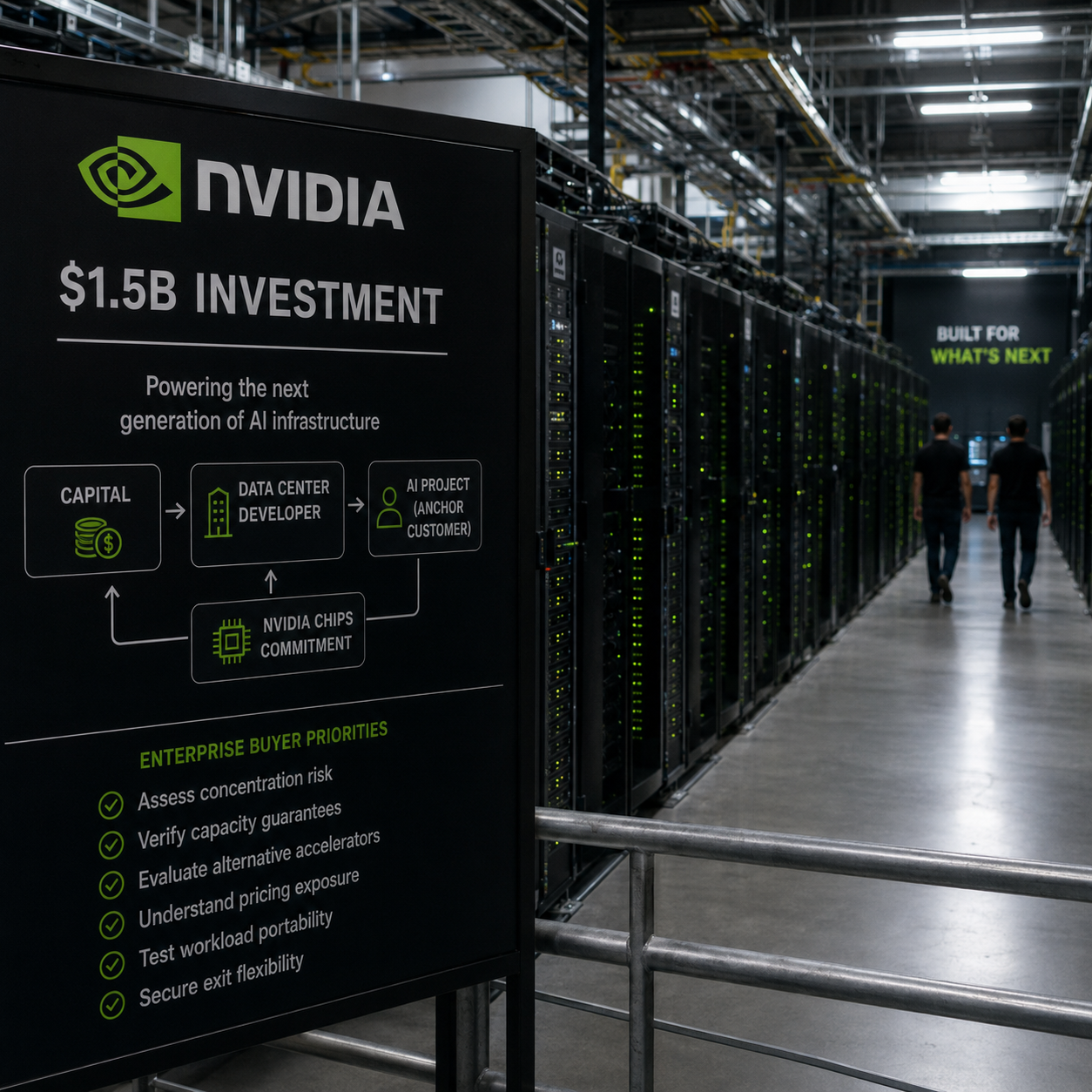
Nvidia’s reported $1.5 billion investment in a SoftBank data-center developer behind an OpenAI project is more than a financing story. According to TechCrunch, the investment is accompanied by a commitment to use Nvidia chips for the project. It therefore provides a concrete example of an AI-chip supplier helping finance downstream data-center capacity while reinforcing demand for its own hardware.
For CIOs and AI operators, the relevant question is not whether this particular project will change their next cloud bill. It is what happens to procurement when capital, physical capacity, accelerators, and large anchor customers become more tightly linked. Infrastructure partners may arrive with stronger access to scarce resources, but also with commercial and technical dependencies that are difficult to unwind. Buyers should evaluate the whole supply chain behind an AI service—not merely the accelerator model or quoted hourly rate.
Capital and compute are becoming part of the same supply decision
Large AI facilities require substantial funding, suitable sites, power, cooling, networking, and accelerator supply. The reported Nvidia investment illustrates how one participant can influence several parts of that chain: capital supports downstream development, the developer creates capacity, a major AI project supplies demand, and a chip commitment supports hardware sales.
The source report establishes the investment and associated hardware commitment; it does not justify assumptions about undisclosed pricing, exclusivity, delivery volumes, capacity allocations, or contract terms. Those details should remain unknown unless the parties disclose them. Even so, the structure offers an important procurement lesson: a provider’s financial backing and hardware relationships can affect which capacity gets built, which accelerators are available, and which customers receive priority.
This alignment can benefit enterprise buyers. A well-capitalized infrastructure partner with credible hardware access may execute faster and reduce the risk of promising capacity it cannot obtain. However, alignment can also narrow choice. When financing, equipment selection, and anchor-customer demand reinforce one another, alternatives may be technically supported but commercially unattractive, delayed, or unavailable at meaningful scale.
Hardware concentration is a business-continuity issue
An enterprise should map concentration at three levels. First is the accelerator installed in the facility. Second is the infrastructure provider operating or leasing that facility. Third is the upstream ecosystem supplying networking, software, replacement parts, and specialized operational knowledge. Apparent diversification across two service providers may offer little protection if both depend on the same hardware supply chain or serve workloads from the same constrained region.
Concentration is not automatically a reason to avoid Nvidia-based infrastructure. Standardizing on a mature accelerator ecosystem can simplify recruitment, tooling, performance optimization, and application deployment. The decision becomes risky when the enterprise cannot quantify its dependency or execute an alternative.
Buyers should identify which workloads genuinely require a particular accelerator and which could run elsewhere. Training, fine-tuning, batch inference, real-time inference, and data preparation have different performance and portability requirements. A team may reasonably accept concentration for a highly optimized training workload while retaining alternatives for routine inference. That is more defensible than making one hardware choice the unexamined default for every pipeline.
Alternative-accelerator claims also require testing. Ask for benchmark results using representative models, sequence lengths, batch sizes, precision levels, latency targets, and data-transfer patterns. A nominally supported accelerator is not a useful fallback if migration requires rebuilding kernels, replacing orchestration components, or accepting economics that invalidate the application.
Capacity access needs contractual evidence
Investment announcements can signal ambition, but enterprises buy deliverable service. Procurement teams should translate claims about scale and strategic relationships into contractual answers: when capacity becomes available, where it is located, what configuration is guaranteed, and what remedy applies if delivery slips.
For reserved capacity, distinguish a forecast from a binding commitment. Clarify whether the provider guarantees a number of functioning accelerators, an entire cluster, a power envelope, or only access subject to availability. Define acceptance testing, network performance, maintenance allowances, replacement timelines, and the treatment of degraded hardware. If capacity is being developed rather than already operational, contracts should address construction, energization, commissioning, and hardware-delivery dependencies without assuming that any one milestone guarantees the next.
Pricing exposure deserves the same scrutiny. Determine which charges are fixed and which can change with electricity, cooling, networking, software licensing, support, or hardware refreshes. Ask whether unused reservations can be reduced, transferred, or resold; whether burst capacity uses a different rate; and whether minimum commitments continue during provider-caused outages. A low headline compute price can be offset by data movement, storage, inter-region networking, or inflexible take-or-pay terms.
Cloud customers and dedicated-infrastructure lessees face different risks
Enterprises buying cloud services
Cloud customers usually gain abstraction and operational convenience. They can choose managed AI services, instances, or APIs without operating the data center. Their main risks are service-level capacity, regional availability, opaque underlying dependencies, pricing changes, and application lock-in at the platform layer.
These buyers should ask whether reserved instances provide firm access during demand spikes, whether equivalent configurations exist in multiple regions, and how quickly workloads can move to another service or accelerator. Portability tests should cover model artifacts, containers, orchestration, observability, identity controls, data formats, and managed-service interfaces. An application packaged in containers may still be locked in through proprietary model endpoints, security services, or data pipelines.
Enterprises leasing dedicated infrastructure
Dedicated clusters or data-hall leases give buyers more control but expose them directly to site and asset risks. Power availability, cooling design, network diversity, hardware maintenance, spare inventory, physical security, and facility commissioning become central procurement questions. Location also affects latency, data residency, energy availability, disaster recovery, and the cost of moving large datasets.
Dedicated buyers should establish who owns the equipment, who carries performance and obsolescence risk, and who pays for upgrades. They also need operational rights: access to telemetry, maintenance records, security evidence, and incident reports. If the provider relies on a strategic hardware relationship, determine whether that relationship gives the enterprise enforceable delivery protection or merely supports the provider’s general purchasing plans.
A due-diligence checklist for choosing an AI infrastructure partner
- Supplier concentration: Map accelerator, networking, facility, cloud, software, and geographic dependencies. Test whether supposedly separate providers share critical upstream suppliers.
- Alternative accelerators: Request workload-specific benchmarks and a documented migration path. Identify unsupported libraries, custom kernels, performance losses, and retraining requirements.
- Workload portability: Run an actual portability exercise before signing a long commitment. Measure migration time, engineering effort, data-transfer cost, and service interruption.
- Capacity guarantees: Define configuration, location, delivery date, acceptance criteria, availability, maintenance treatment, scaling rights, and remedies for shortfalls.
- Pricing exposure: Separate compute from power, networking, storage, support, software, and egress charges. Limit unilateral repricing and clarify take-or-pay obligations.
- Energy and location constraints: Review power readiness, cooling limits, network paths, regional regulation, data residency, latency, and disaster-recovery options.
- Customer-priority risk: Ask how capacity is allocated during shortages and whether larger anchor customers can affect delivery or expansion schedules.
- Exit provisions: Secure data-export assistance, model and configuration retrieval, deletion verification, transition support, termination rights, and predictable exit fees.
The practical implication of Nvidia’s reported investment is not that enterprises should avoid closely integrated infrastructure ecosystems. It is that financial strength, hardware access, and customer demand must be assessed together. Before committing, buyers should require evidence that strategic alignment improves deliverability while preserving enough contractual flexibility and technical portability to keep today’s capacity solution from becoming tomorrow’s unmanageable dependency.