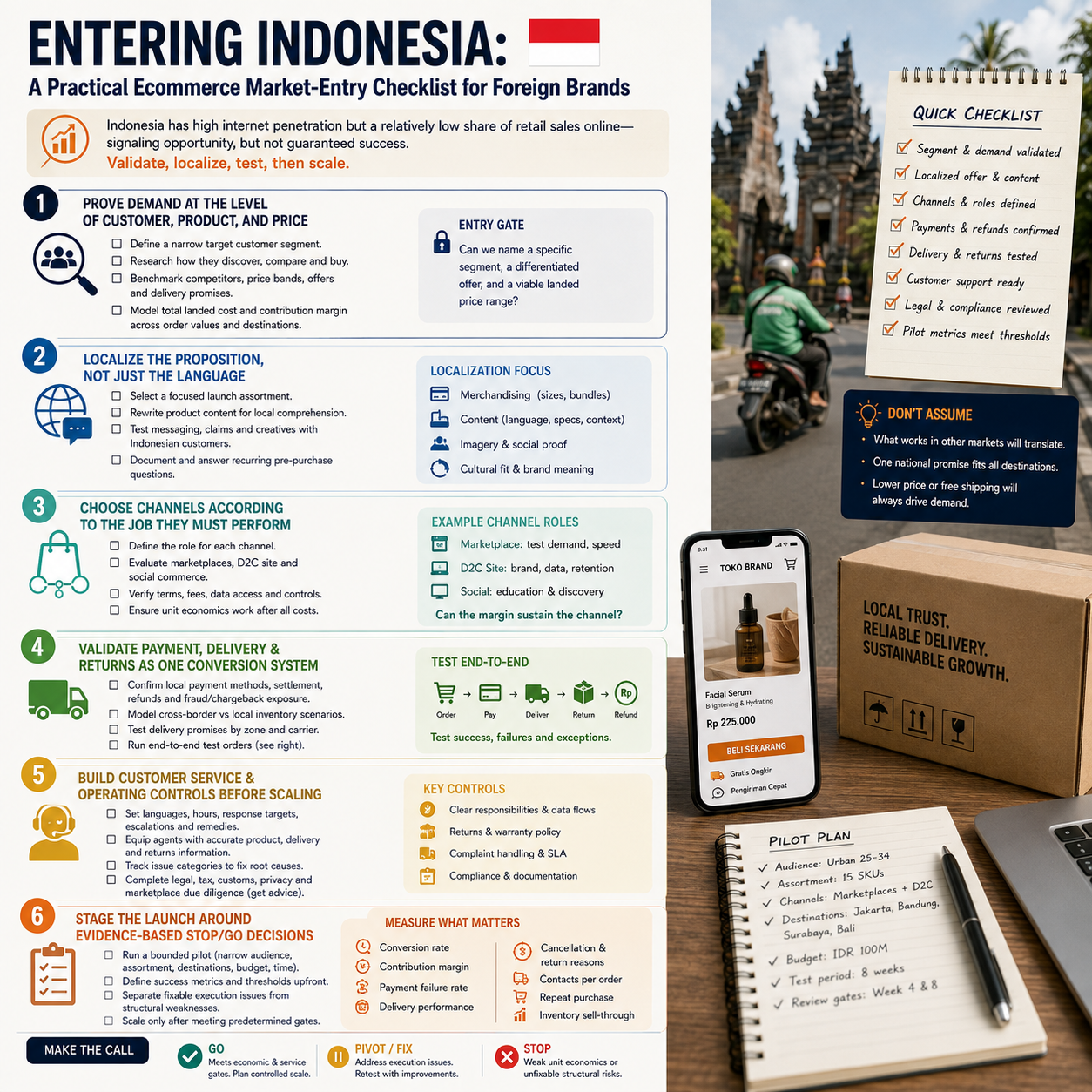
Indonesia presents foreign brands with an attractive but easily misread ecommerce opportunity. Practical Ecommerce highlights a gap between the country’s high internet penetration and the comparatively low share of retail sales conducted online. That gap can indicate room for growth, but it does not prove that a particular product, price point, or operating model will succeed.
For ecommerce operators, the central question is therefore not simply whether Indonesia is a promising market. It is whether the brand can acquire suitable customers, offer locally credible buying experiences, and fulfill orders reliably without allowing complexity to overwhelm margins. The checklist below turns the opportunity identified by the source into a staged entry decision. Unless explicitly attributed to Practical Ecommerce, the questions and recommendations are an operator framework rather than claims about Indonesian law or market size.
1. Prove demand at the level of customer, product, and price
National internet adoption is a useful signal, but an entry case must be built from addressable demand. Define the customer narrowly: location, age or life stage, purchasing power, use case, and current alternatives. “Digitally connected consumers” is too broad to guide assortment, pricing, or acquisition.
Start by examining how Indonesians discover and compare products in the relevant category. Review marketplace listings, local and international competitors, customer comments, search behavior, creator content, and recurring objections. Look beyond visible sales signals. Identify common pack sizes, product claims, promotional patterns, delivery promises, and the price bands in which credible competitors cluster.
Test the total customer proposition, not only the base price. A product that looks competitive before shipping, duties, platform charges, returns, and promotions may become unattractive at checkout—or unprofitable after delivery. Build contribution-margin scenarios for several order values and destinations without assuming that demand will compensate for weak unit economics.
Entry gate: Can the team name a specific customer segment, explain why its offer is preferable to existing choices, and identify a viable landed selling-price range? If not, Indonesia remains an interesting macro opportunity rather than a validated market.
2. Localize the proposition, not just the language
Localization should begin with merchandising. Decide which products deserve introduction, which need different bundles or sizes, and which may require too much explanation. Launching the global catalog can dilute marketing spend and complicate inventory before the brand knows what resonates.
Product pages and campaigns should communicate in language that target customers understand naturally. Translation quality matters, but so do local context, imagery, dimensions, care instructions, compatibility information, and expectations about what is included. Social proof imported from another country may establish legitimacy, yet it cannot fully answer local concerns about fit, authenticity, delivery, or after-sales support.
Operators should also review whether the brand name, claims, visual identity, and campaign concepts carry unintended meanings. This is best tested with Indonesian customers or qualified local partners rather than inferred from machine translation. The goal is not to erase the brand’s origin; foreign provenance may be valuable. The goal is to remove uncertainty from the purchase decision.
- Choose a focused launch assortment tied to one or two clear use cases.
- Rewrite high-intent product content for local comprehension rather than translating word for word.
- Test creative and product claims with people from the intended segment.
- Document recurring pre-purchase questions and incorporate the answers into merchandising.
3. Choose channels according to the job they must perform
Foreign brands typically need to evaluate marketplaces, a localized direct-to-consumer site, social commerce, or some combination. The correct choice depends on what the initial stage must learn.
A marketplace can provide access to existing shopping behavior and tools, while also making price comparison immediate and limiting control over customer relationships. A brand-owned site offers greater control over presentation, data collection, and retention, but requires the operator to generate trust and traffic. Social channels may be effective for education and discovery, although engagement is not evidence of profitable demand.
Rather than treating these channels as interchangeable storefronts, assign each a role. A marketplace might test product-market fit and transactional demand. The owned site might carry richer education, bundles, or retention programs. Social activity might demonstrate use cases and route prospects to the channel where conversion is easiest.
Before selecting a partner or platform, verify onboarding eligibility, commercial terms, data access, counterfeit and unauthorized-seller controls, advertising requirements, settlement arrangements, and responsibility for returns. These are due-diligence questions, not assertions about any particular Indonesian platform.
Entry gate: Does each proposed channel have a measurable purpose, and can the expected gross profit absorb its fees, promotions, advertising, and operational workload?
4. Validate payment, delivery, and returns as one conversion system
Payment expectations must be researched directly for the target segment and chosen channels. Do not assume that methods performing well in the brand’s home market will cover Indonesian buyers. Ask prospective payment providers or platforms which options are available to a foreign merchant, how customers authenticate, when funds settle, how refunds work, and who bears fraud or chargeback exposure.
Fulfillment deserves the same level of scrutiny. Indonesia’s geography means that a promise viable for one destination may not be viable nationwide. Model service by delivery zone instead of advertising one undifferentiated national experience. Compare cross-border fulfillment with locally held inventory using realistic assumptions for transit time, customs handling, stock ownership, storage, failed deliveries, reverse logistics, and inventory replenishment.
A cross-border pilot may reduce initial inventory exposure, but longer or less predictable delivery can weaken conversion and increase support contacts. Local inventory may improve service and enable faster replenishment of customer expectations, while adding forecasting commitments and partner dependencies. Neither model is automatically superior.
Run complete test orders before launch: successful payment, declined payment, address correction, tracking, delivery, cancellation, return request, refund, damaged parcel, and lost shipment. A checkout that accepts an order is not proof that the end-to-end system works.
5. Build customer service and operating controls before scaling
Customer service is part of localization. Establish supported languages, operating hours, response targets, escalation paths, and approved remedies before paid acquisition begins. Agents need accurate information about products, deliveries, returns, warranties, and payment problems. Where a marketplace or logistics partner owns part of the interaction, define handoffs so customers are not sent repeatedly between parties.
Track issue categories, not merely ticket volume. Repeated questions about sizing suggest a merchandising defect; “where is my order?” contacts indicate a delivery or communication problem; refund delays may expose a payment workflow failure. These signals should change the operating model.
Foreign brands should obtain current professional advice on corporate structure, tax, customs, product rules, consumer obligations, privacy, and marketplace eligibility before accepting orders. This article does not infer specific legal requirements from the source. Record which entity imports, sells, invoices, holds inventory, processes personal data, and bears return costs. Ambiguity in those responsibilities is itself a launch risk.
6. Stage the launch around evidence-based stop/go decisions
Begin with a bounded pilot: a narrow audience, limited assortment, selected destinations, controlled acquisition budget, and explicit test period. Define success before the first campaign. Useful measures include conversion rate by channel, contribution margin after variable costs, payment failure, delivery performance, cancellation and return reasons, support contacts per order, repeat purchase, and inventory sell-through. Set thresholds from the brand’s economics rather than borrowing generic benchmarks.
At the pilot review, separate fixable execution problems from structural weaknesses. Poor product-page clarity can be repaired. Demand that appears only under margin-destroying discounts is a more serious warning. Expansion should follow evidence that customers buy at sustainable prices and that operations remain reliable as order volume rises.
Final checklist: validate a defined customer and price proposition; localize the assortment and communication; assign clear roles to each channel; confirm payment and refund workflows; test delivery and returns by destination; prepare local customer support; complete legal and commercial due diligence; and scale only after the pilot meets predetermined economic and service gates. Indonesia’s ecommerce gap may justify investigation, but disciplined validation determines whether it justifies investment.