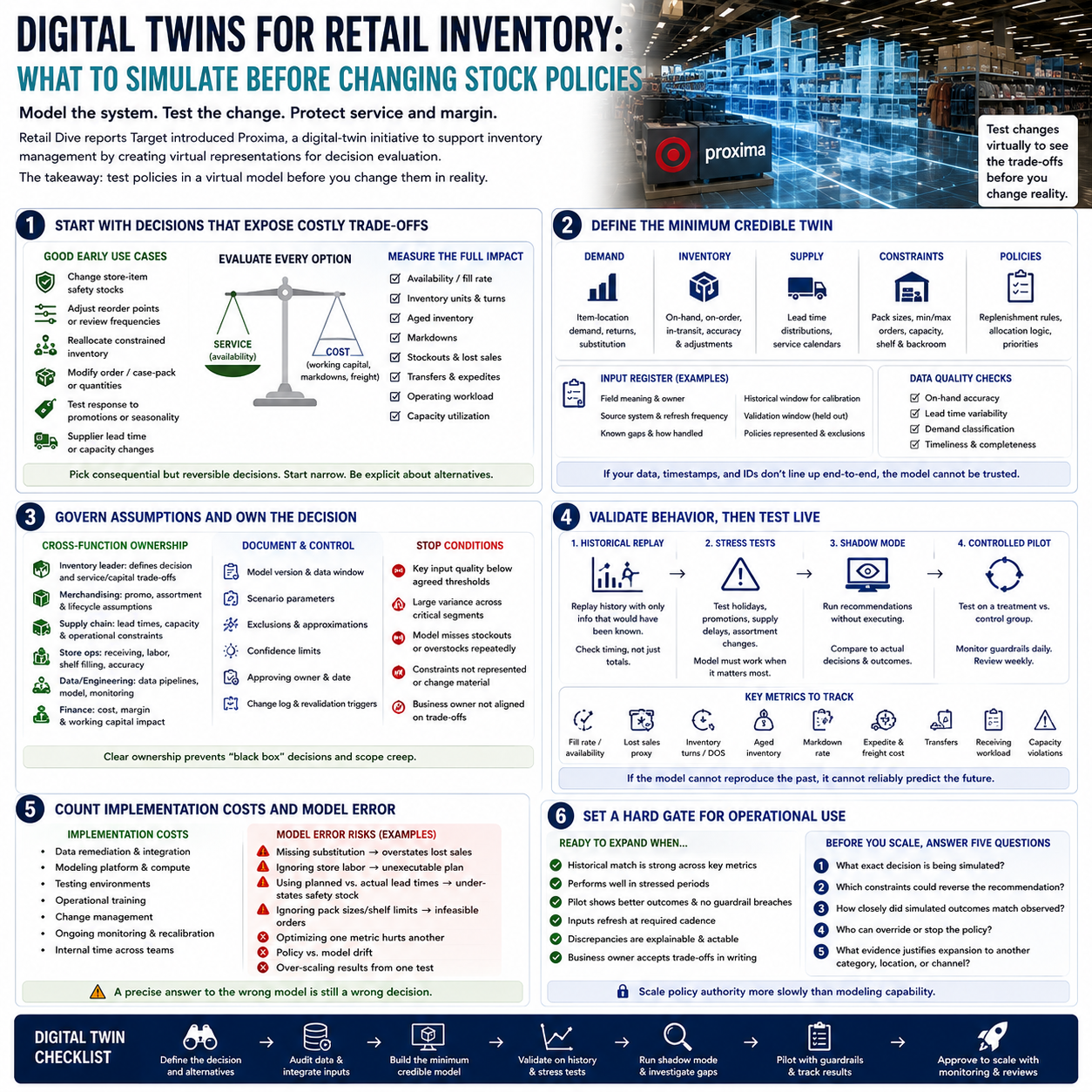
Changing an inventory policy is rarely a contained decision. A higher safety-stock target may improve availability but increase markdown exposure. A different replenishment rule may help one store format while creating capacity problems elsewhere. Digital twins promise a safer way to examine such trade-offs: model the relevant operating system, simulate a proposed change, and compare likely outcomes before deploying it.
Retail Dive reports that Target introduced Proxima, a digital-twin initiative intended to support inventory management by creating virtual representations that can be used to evaluate decisions. For retail operators, the important lesson is not that every network needs a replica of Target’s program. It is that stock-policy changes should be tested against operational interactions—not judged from a single forecast or aggregate inventory target.
The source establishes the direction of Target’s initiative, but it does not provide a complete technical blueprint for other retailers. The framework below is therefore practical synthesis: a disciplined way to decide what to simulate, which inputs must be trustworthy, and when model results are strong enough to influence live inventory.
Start with decisions that expose costly trade-offs
A digital twin should begin with a decision, not with an ambition to model the entire retail network. The best early use cases combine meaningful financial or service consequences with measurable outcomes and enough historical variation to test the model.
Candidate decisions include changing store-item safety stocks, adjusting reorder points or review frequencies, reallocating constrained inventory among locations, modifying case-pack or order quantities, and testing replenishment responses to promotions or seasonal peaks. Operators can also examine how a policy behaves when supplier lead times lengthen, demand shifts between channels, or receiving capacity becomes constrained.
Each use case needs explicit alternatives. “Improve replenishment” is not testable; “compare the current reorder rule with two proposed rules for a defined product-location group” is. The simulation should expose both intended and unintended effects, including availability, inventory units, aged stock, markdown risk, transfers, emergency orders, workload, and capacity utilization.
Prioritize decisions that are consequential but reversible during a pilot. Avoid starting with products dominated by exceptional events, very sparse demand, or unresolved data defects. Likewise, do not make a network-wide policy change the first test. A narrower category, store cluster, or fulfillment path makes discrepancies easier to diagnose.
Define the minimum credible twin
A useful inventory twin does not need to reproduce every physical detail. It does need to represent the constraints capable of changing the decision. For a store-replenishment policy, that may include item-location demand, on-hand and on-order inventory, lead-time distributions, delivery calendars, pack sizes, shelf or backroom limits, minimum orders, receiving schedules, substitution effects, and rules governing replenishment.
Data quality should be assessed according to the proposed decision. An inaccurate on-hand balance may invalidate a store-level stock simulation even when aggregate inventory reports look reasonable. A model of supplier-policy changes needs actual lead-time variability, not merely contractual lead times. Promotion simulations require dependable event dates and a way to distinguish promotional demand from the baseline.
Before development, create an input register covering:
- the operational meaning, owner, source system, and update frequency of each field;
- known gaps, corrections, and treatment of missing or late records;
- the historical period used for calibration and the period reserved for validation;
- which policies and constraints are represented explicitly;
- which effects are omitted or approximated.
Integration is equally important. The model may need feeds from merchandising, order management, warehouse management, transportation, point-of-sale, forecasting, and supplier systems. Identifiers and timestamps must align across them. If the team cannot reliably connect an order, shipment, receipt, sale, return, and inventory adjustment, adding model complexity will not repair the underlying evidence.
Give operational owners authority over assumptions
A digital twin can produce precise-looking results from incomplete assumptions. Governance must therefore separate model construction from decision accountability.
An inventory or replenishment leader should own the policy question and define acceptable service and working-capital trade-offs. Merchandising should review promotion, assortment, lifecycle, and markdown assumptions. Supply-chain teams should validate lead times and capacity constraints. Store operations should challenge assumptions about receiving, shelf filling, and inventory accuracy. Data and engineering teams should own pipelines and monitoring, while finance should verify how operational outputs translate into cost or margin consequences.
For every simulation, record the model version, data window, scenario parameters, exclusions, confidence limits, and approving owner. Material changes to logic or source data should trigger revalidation. The decision record should also state whether the output is advisory, requires human approval, or can activate a policy automatically.
Teams should define stop conditions before seeing results. A simulation should not drive deployment if key inputs fall below agreed quality thresholds, if performance varies sharply across important segments, or if the model repeatedly understates stockouts, excess inventory, or operational bottlenecks.
Validate behavior, then test a live policy
Validation should occur in layers. First, replay historical periods using information that would have been available at the time. Check whether the twin reproduces not only total demand and inventory, but also the timing and location of shortages, receipts, overstocks, and constraint breaches.
Second, test difficult periods separately: promotions, holidays, supply delays, assortment transitions, and unusual channel shifts. A model that performs acceptably on average may fail exactly when policy decisions carry the greatest risk.
Third, run the proposed policy in shadow mode. Generate recommendations without executing them and compare those recommendations with actual decisions and outcomes. Investigate disagreements rather than averaging them away.
Finally, conduct a controlled live pilot using comparable treatment and control groups where feasible. Keep the scope narrow enough to reverse quickly, but long enough to capture replenishment cycles and demand variability. Monitor guardrails daily even when the formal assessment is weekly or monthly.
Measures should reflect the policy’s full consequence set: item-location availability, lost-sales proxies, inventory turns or days of supply, aged inventory, markdowns, order volatility, transfers, expedited freight, cancellations, receiving workload, and constraint violations. Compare results by product velocity, lifecycle stage, store format, geography, and fulfillment role. Aggregate improvement can conceal damaging outcomes in strategically important segments.
Count implementation costs—and the cost of model error
The business case should include data remediation, system connectors, modeling and compute, testing environments, operational training, change management, monitoring, and ongoing recalibration. Internal time is a real cost: merchants, planners, store operators, finance teams, and engineers must define rules and investigate mismatches.
Model error can be more expensive than the platform. Missing substitution behavior could overstate lost sales. Ignoring store labor may recommend delivery patterns that cannot be executed. Using planned rather than actual lead times may understate safety-stock requirements. Failing to represent pack sizes or shelf constraints can yield policies that appear efficient but are operationally impossible.
Other risks include optimizing one metric at the expense of another, allowing policy logic to drift away from the model, and scaling results from one category to unlike categories. Scenario outputs should therefore be treated as conditional estimates, not forecasts guaranteed to occur.
Set a hard gate for operational use
Move beyond experimentation only when the twin reproduces relevant historical behavior, remains reliable during stressed periods, and improves pilot outcomes without breaching agreed guardrails. Inputs must refresh at the cadence the decision requires, discrepancies must be explainable, and an accountable business owner must accept the trade-offs.
Before changing a stock policy, operators should be able to answer five questions: What exact decision is being simulated? Which constraints could reverse the recommendation? How closely did simulated outcomes match observed outcomes? Who can override or stop the policy? What evidence justifies expansion to another category, location, or channel?
Target’s Proxima initiative signals the potential value of testing inventory decisions in a virtual representation before applying them in operations. The transferable discipline is more modest and more important: model only what is needed for a defined decision, make omissions visible, validate against reality, and scale policy authority more slowly than modeling capability.