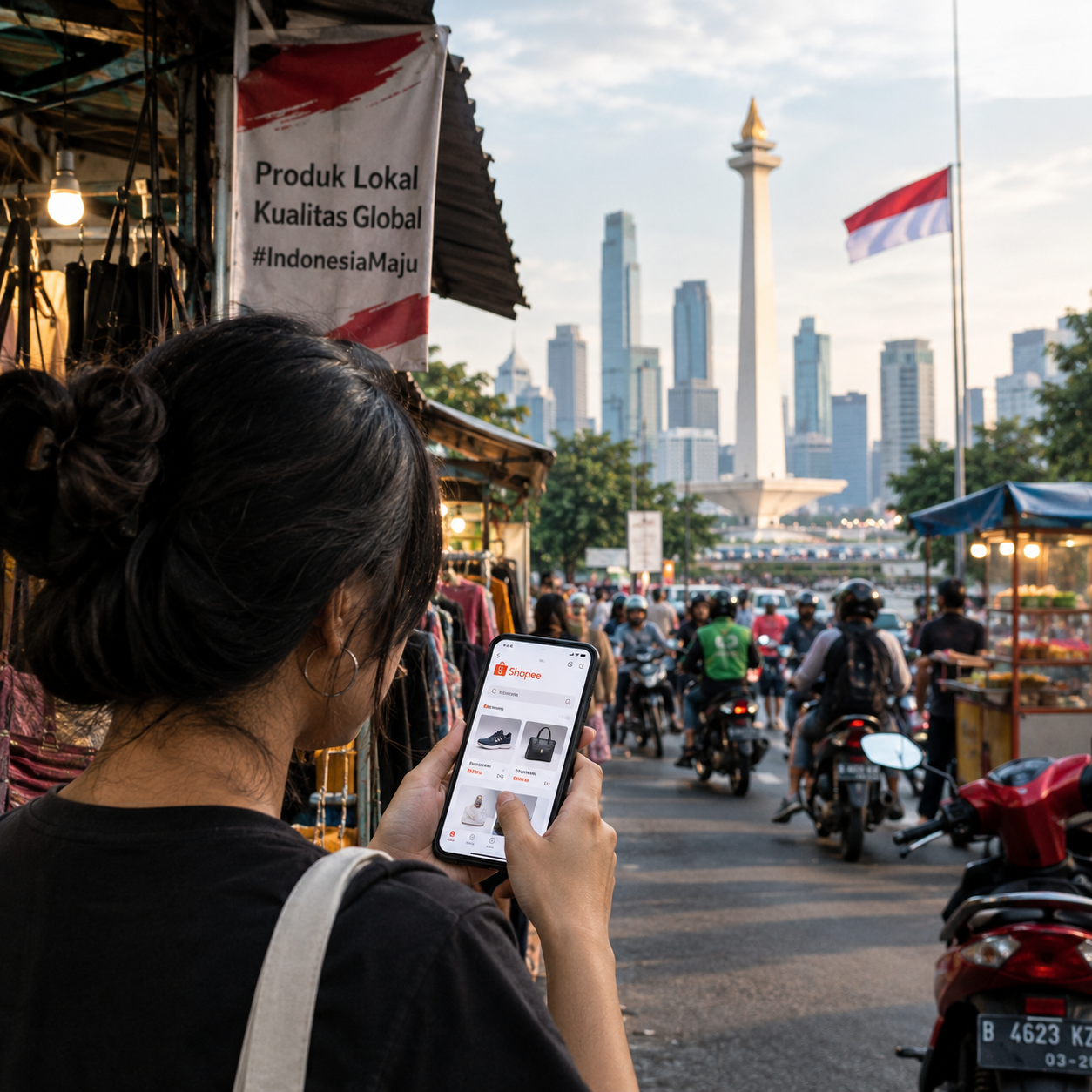
Indonesia can look unusually attractive to an international ecommerce brand: widespread internet use creates a large digitally reachable audience, while comparatively low retail ecommerce sales suggest room for growth. But that gap is not proof that any particular foreign product will sell profitably. It may reflect barriers involving purchasing power, payments, logistics, regulation, trust, or product-market fit.
The practical question is therefore not “Is Indonesia a promising ecommerce market?” It is “Can this brand acquire and serve a defined Indonesian customer segment at a sustainable contribution margin?” The market overview published by Practical Ecommerce provides the factual starting point for this framework. The evaluation steps, pilot design, and decision thresholds below are an operator-focused synthesis rather than claims drawn directly from that source.
Convert headline potential into a testable customer thesis
Start with a narrow proposition instead of treating Indonesia as one homogeneous market. Define the customer, use case, product range, price position, and geographic service area that the pilot will test. “Urban consumers interested in premium skincare” is still too broad. A useful thesis identifies the buyer’s problem, the products most likely to solve it, competing alternatives, and the reason a foreign brand might earn trust.
Validate the thesis before making substantial inventory or localization commitments. Examine search behavior, marketplace listings, customer reviews, competitor pricing, promotional intensity, shipping promises, and recurring complaints. Interviews with potential customers, distributors, marketplace specialists, and local operators can reveal whether apparent demand survives scrutiny.
Demand evidence should distinguish interest from purchasing intent. Social engagement or website traffic may indicate curiosity, but orders at realistic prices are stronger evidence. Test a small number of products and avoid introductory discounts so deep that the results say nothing about normal-price demand. Track conversion by product, price, location, and acquisition source.
The initial research should answer four questions:
- Which specific customer segment has a problem the brand can credibly solve?
- What local and imported alternatives already satisfy that need?
- Can the product remain attractive after duties, taxes, delivery charges, and marketplace fees?
- Does demand persist without unsustainable promotions or influencer spending?
Choose a channel that matches what you need to learn
Marketplaces and owned ecommerce channels serve different purposes. A marketplace can provide access to existing traffic, familiar payment methods, platform trust, and established shopping behavior. It may therefore be the faster environment for testing whether unfamiliar customers will buy. The trade-offs can include fees, promotional pressure, limited customer ownership, direct price comparison, and dependence on platform rules.
An owned site gives the brand more control over presentation, customer data, merchandising, and retention. However, the operator must create trust and traffic, integrate locally suitable payments, provide responsive support, and arrange reliable delivery. Launching an owned store first can confuse weak distribution with weak demand: customers may want the product but hesitate to purchase through an unfamiliar checkout.
Channel choice should follow the experiment. Use a marketplace-led pilot if the primary uncertainty is basic demand or transaction trust. Consider an owned channel when the brand already has meaningful local awareness, needs richer product education, or expects repeat purchasing to support the economics. A hybrid approach may use marketplaces for discovery and validation while an owned site develops gradually for brand storytelling and retention.
Do not assume customers can simply be moved from a marketplace to the brand’s website. Compare each channel separately using conversion, acquisition cost, fee burden, average order value, cancellation rate, repeat behavior, and contribution margin. The channel with the highest revenue is not necessarily the one that creates the most durable value.
Price localization, payments, and fulfillment as one system
Localization is more than translating product descriptions. A foreign brand should test whether its value proposition, imagery, sizing, usage instructions, assortment, bundles, and service standards make sense to Indonesian buyers. Customer questions and return reasons are especially useful: repeated confusion indicates that localization is incomplete.
Payment design must reflect the methods customers expect and trust. Before launch, confirm which methods are available to the proposed business structure, what they cost, settlement timing, refund processes, fraud exposure, and failure rates. A checkout that technically accepts payments but excludes preferred local options can suppress conversion.
Fulfillment decisions should be modeled alongside payment and pricing. Cross-border shipping may limit fixed investment during an early test, but longer delivery times, uncertain landed costs, and difficult returns can undermine the customer experience. Local inventory can improve delivery speed and predictability, yet introduces inventory exposure, warehousing requirements, and more operational complexity.
For each proposed setup, map the complete order journey: product availability, checkout, payment authorization, import handling where applicable, final-mile delivery, customer communication, returns, refunds, and damaged or missing parcels. Test the journey personally before buying substantial traffic. Operational defects can otherwise be mistaken for a lack of market demand.
Establish legal and tax feasibility before committing inventory
Regulatory diligence is an entry gate, not a task to postpone until sales grow. The relevant obligations may depend on product category, sales channel, transaction structure, inventory location, importer arrangements, and whether the seller establishes a local presence. Product registration, labeling, consumer protection, data handling, customs, tax, and marketplace requirements may all need examination.
This article does not provide legal or tax advice. Rules and platform requirements can change, so the brand should obtain current advice from qualified Indonesian legal, tax, customs, and product-compliance professionals. Ask advisers to assess the proposed operating model rather than offering only a general market summary.
At minimum, determine who will act as seller, importer, inventory owner, and customer-service counterparty; which registrations or approvals apply to the products; what taxes and duties affect landed cost; and how returns, warranties, privacy, and consumer complaints must be handled. Document these answers before signing long-term contracts or shipping commercial inventory.
Model contribution margin before celebrating revenue
A pilot needs a unit-economics model that links customer acquisition to the full cost of serving an order. Begin with net revenue after discounts and refunds. Deduct product cost, international freight, duties and taxes where applicable, payment charges, marketplace commissions, local fulfillment, packaging, final-mile delivery, returns, customer support, and expected loss from failed or fraudulent transactions.
The remainder is the amount available to pay for customer acquisition and overhead. This establishes a maximum tolerable acquisition cost rather than relying on an arbitrary marketing target. Build scenarios for normal pricing, promotional pricing, higher return rates, costlier delivery regions, and lower-than-expected average order values.
Repeat purchases should not rescue an otherwise weak model unless the pilot demonstrates retention. Measure repurchase by cohort and channel, using contribution rather than revenue. If the first order loses money, specify how many subsequent purchases are required to recover that loss and whether observed behavior supports the assumption.
Inventory economics matter too. A product can show a positive per-order margin while tying up cash in slow-moving stock. Track sell-through, stock cover, expiry or obsolescence risk, replenishment lead time, and the concentration of sales in a few products.
Run a limited pilot with explicit decision gates
Set a defined pilot period, capped inventory, controlled marketing budget, narrow assortment, and limited service geography. Before launch, record the thresholds that would trigger scaling, revision, or exit. This prevents attractive gross sales from overriding poor economics.
Signals to scale
- Customers convert at viable prices without excessive discounting.
- Contribution margin remains positive after realistic acquisition and fulfillment costs.
- Delivery, payment, cancellation, return, and support performance are operationally manageable.
- Demand appears across repeatable segments or channels rather than one short-lived campaign.
- Compliance advisers confirm that the scaled operating model is feasible.
Signals to change strategy
- Demand exists, but the channel fee structure or acquisition cost destroys margin.
- Customers repeatedly request different sizes, bundles, instructions, payment methods, or delivery promises.
- A small group of products performs strongly while the broader imported assortment stalls.
- Cross-border fulfillment limits conversion, suggesting that local inventory deserves a controlled test.
Signals to exit or pause
- Orders depend on discounts that eliminate contribution margin.
- Acquisition costs do not improve despite better targeting and creative tests.
- Regulatory requirements make the chosen products or model impractical.
- Returns, failed deliveries, payment problems, or service costs remain structurally high.
Indonesia’s digital reach creates a reason to investigate, not a reason to overcommit. The strongest entry plan treats the country as a sequence of falsifiable decisions: validate a precise customer need, select the channel best suited to the current uncertainty, prove operational feasibility, obtain current professional compliance advice, and scale only when repeatable demand and full-cost margins support it.


