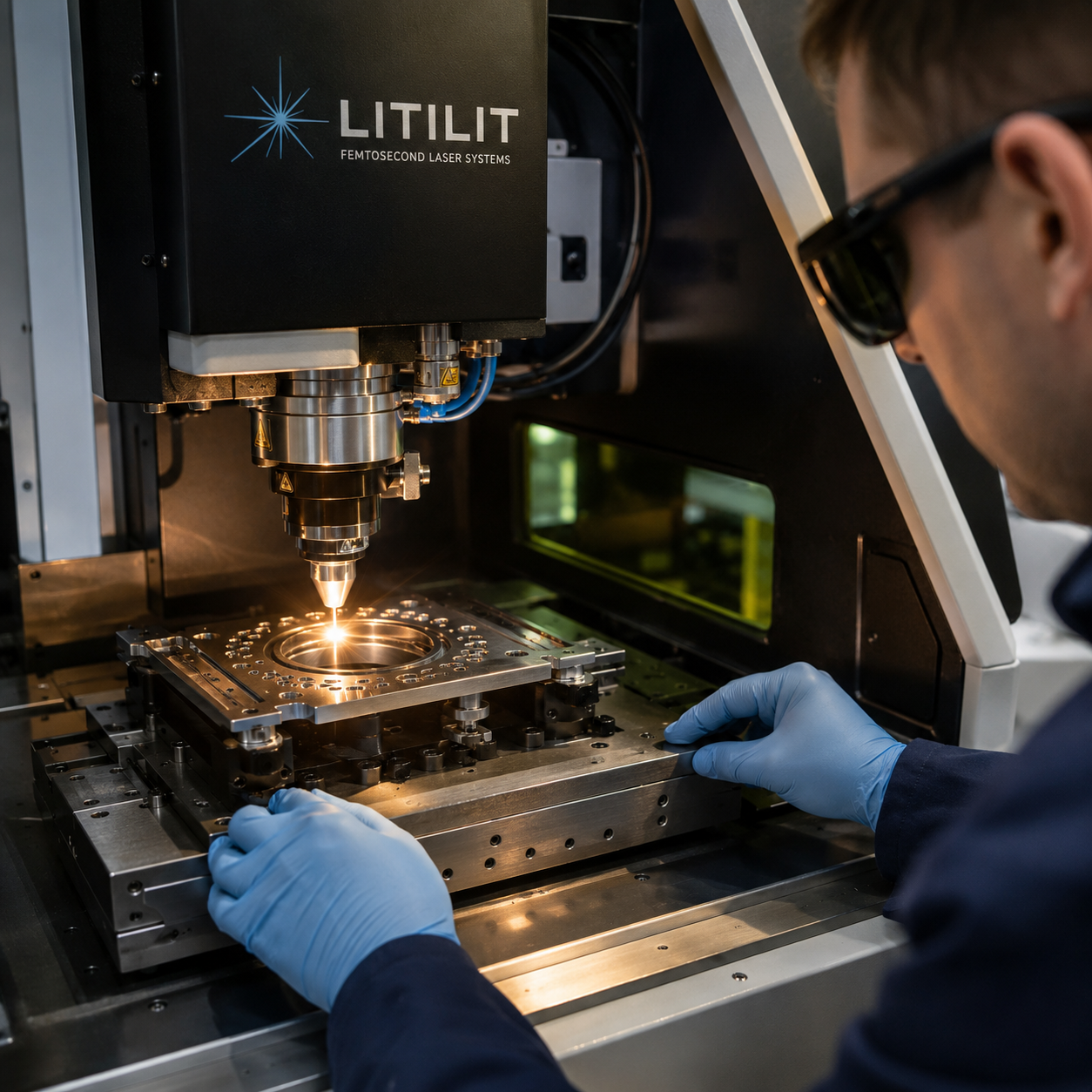
Bringing femtosecond laser processing in-house is not simply an equipment purchase. It can change how a manufacturer develops processes, qualifies parts, schedules production, controls quality and maintains specialist expertise. The central question is therefore not whether ultrafast lasers are technically impressive, but whether ownership solves a defined production problem better than outsourcing does.
LITILIT’s FEMODA project makes this decision especially relevant. EU-Startups reports that the Vilnius-based company received an €8 million loan toward a €10 million project intended to develop modular femtosecond laser systems, accelerate adoption and enable new applications. Modularity could reduce some implementation barriers, but buyers should treat those prospective advantages as claims to validate in their own operating environment. A modular architecture does not eliminate the need to prove process capability, throughput, integration, safety and economics.
Start with the production constraint, not the laser
A credible investment case begins with a part, material and specification. Define the operation that is currently too slow, inconsistent, costly or technically constrained. Record the material composition and condition, feature geometry, tolerance, acceptable heat-affected region, surface-quality requirement, inspection method and annual volume. Include upstream variation and downstream consequences: a process that produces an acceptable feature but creates difficult cleaning or inspection requirements may not improve the overall workflow.
Separate a true production requirement from an exploratory application. A recurring, qualified part family can support an ownership analysis. A speculative application with uncertain demand usually calls for laboratory trials or outsourced processing first. The manufacturer should also establish what “success” means before asking vendors to demonstrate equipment: measurable acceptance criteria are more useful than a sample that merely looks promising.
Femtosecond processing should be compared with the actual alternatives, including existing laser processes, mechanical methods, chemical processes, redesigning the component or continuing to use a specialist supplier. The right question is whether the complete femtosecond process delivers the required outcome at an acceptable cost and risk—not whether it can interact with the material.
Does modularity lower the barriers that matter?
The FEMODA project is intended to make femtosecond systems scalable through modularity, according to the reported financing announcement. For a buyer, however, “modular” needs to be translated into operational details. Ask which elements can be configured, replaced or upgraded: laser source, pulse characteristics, beam delivery, scanning equipment, motion platform, optics, controls, enclosure, extraction or process-monitoring components.
A modular design could be valuable when it allows a manufacturer to configure a system around a validated application, expand capacity without replacing the whole platform, or service one subsystem with less disruption. These are evaluation hypotheses, not guaranteed outcomes. Interfaces between modules can introduce their own qualification, calibration and support requirements.
Buyers should request a documented compatibility matrix and clarity on who warrants system-level performance. If modules come from different suppliers, responsibility for faults can become ambiguous. Establish whether future upgrades preserve process recipes and validation status, whether replaced modules require requalification, and how long each component will be supported. Modularity lowers adoption barriers only if it reduces lifecycle risk rather than transferring integration work to the customer.
Prove the process with representative tests
A vendor demonstration should use production-representative material, including relevant coatings, thicknesses, batches and surface conditions. Testing ideal laboratory coupons is useful for feasibility but insufficient for an investment decision. Include difficult geometries and expected material variation, then evaluate results with the inspection method used in production.
The test plan should cover feature accuracy and repeatability, surface condition, evidence of thermal or structural effects, debris and cleaning needs, tool-path or recipe stability, scrap behaviour and sensitivity to fixture variation. Manufacturers should test sustained operation rather than relying only on the best individual sample. Record setup time, processing time, loading and unloading, inspection, cleaning, changeovers and any manual intervention.
Throughput must be measured at the system boundary. A fast laser cycle does not create a fast production cell if alignment, fixturing or inspection dominates elapsed time. Run enough consecutive parts to expose drift, contamination, thermal stability issues and operator-dependent variation. Where traceability matters, verify whether the system can store recipes, identify users, record process parameters and export data to existing quality systems.
Before purchase, agree a factory acceptance test and a site acceptance test tied to the same requirements. Define sampling, measurement methods, allowable failures and corrective-action responsibilities. If the application remains uncertain, a paid feasibility study or pilot programme may be cheaper than committing to production equipment prematurely.
Compare outsourcing and ownership on total economics
Outsourcing is often the more defensible choice when volumes are low or volatile, designs are changing, specialist knowledge is scarce, or several competing processes still need evaluation. It converts much of the technical and maintenance burden into a per-job cost. Its disadvantages may include supplier lead times, minimum charges, logistics, intellectual-property exposure and less immediate control over process development.
Ownership becomes more plausible when demand is recurring, response time is commercially important, process knowledge is strategic, or internal experimentation has continuing value. Even then, utilisation is critical. An advanced system that is busy during qualification but underused afterward can have unattractive unit economics.
Build total cost of ownership around more than the quoted machine price. Include financing, facility modifications, enclosure and safety measures, extraction, utilities, fixtures, automation, metrology, software, installation, validation, training, consumables, replacement optics, planned service, unplanned downtime and internal engineering time. Account for yield and rework, plus the opportunity cost of floor space and staff.
Model conservative, expected and high-utilisation cases. Compare their cost per accepted part with an outsourced quotation on equivalent quality and lead-time assumptions. Also test the cost of demand arriving later than planned, a critical component failing, or a process requiring more engineering support than expected. Avoid counting unproven applications as guaranteed capacity utilisation.
Plan integration, safety and ownership of expertise
The laser source is only one element of a production capability. Map part presentation, fixturing, motion, beam delivery, guarding, extraction, inspection, data collection and material flow. Determine whether the equipment will operate as a stand-alone workstation or connect to automation and manufacturing systems. Clarify control interfaces and who is responsible for integrating them.
Laser safety must be designed into the installation and operating model. The buyer should conduct a site-specific risk assessment with qualified specialists and address enclosure, interlocks, access control, protective measures, extraction, signage, procedures and applicable regulatory obligations. Maintenance activities may create different exposure conditions from normal enclosed operation, so they require explicit controls and training.
Assign named owners for process engineering, daily operation, quality, safety and maintenance. Training should cover more than starting recipes: personnel need to recognise degraded output, contamination, alignment or fixture problems and know when to stop production. Document recipe control, calibration, preventive maintenance and escalation procedures.
Service terms deserve the same scrutiny as technical specifications. Ask about response times, remote diagnostics, spare-part availability, preventive-maintenance intervals, software support and the work customers may perform themselves. For modular systems, establish whether a failed module can be exchanged on-site, how calibration is restored and what evidence is required before production resumes.
A staged decision before capital commitment
LITILIT’s reported €8 million financing toward the €10 million FEMODA project signals an effort to make modular femtosecond systems more scalable and accessible. It does not remove the buyer’s obligation to validate a specific use case. Manufacturers should proceed through controlled gates: document the production problem; compare alternative processes and outsourcing; test representative materials and sustained throughput; calculate lifecycle economics under uncertain utilisation; audit integration, safety, skills and service requirements; and bind acceptance criteria into the purchase agreement.
The strongest reason to bring the capability in-house is a repeatable combination of technical fit, sufficient demand and strategic value that survives conservative assumptions. If feasibility is established but utilisation, staffing or integration remains uncertain, outsourced production or a structured pilot preserves flexibility. Modularity is valuable when it creates a clearer, serviceable path from one proven application to the next—not when it becomes a substitute for proving the first application.