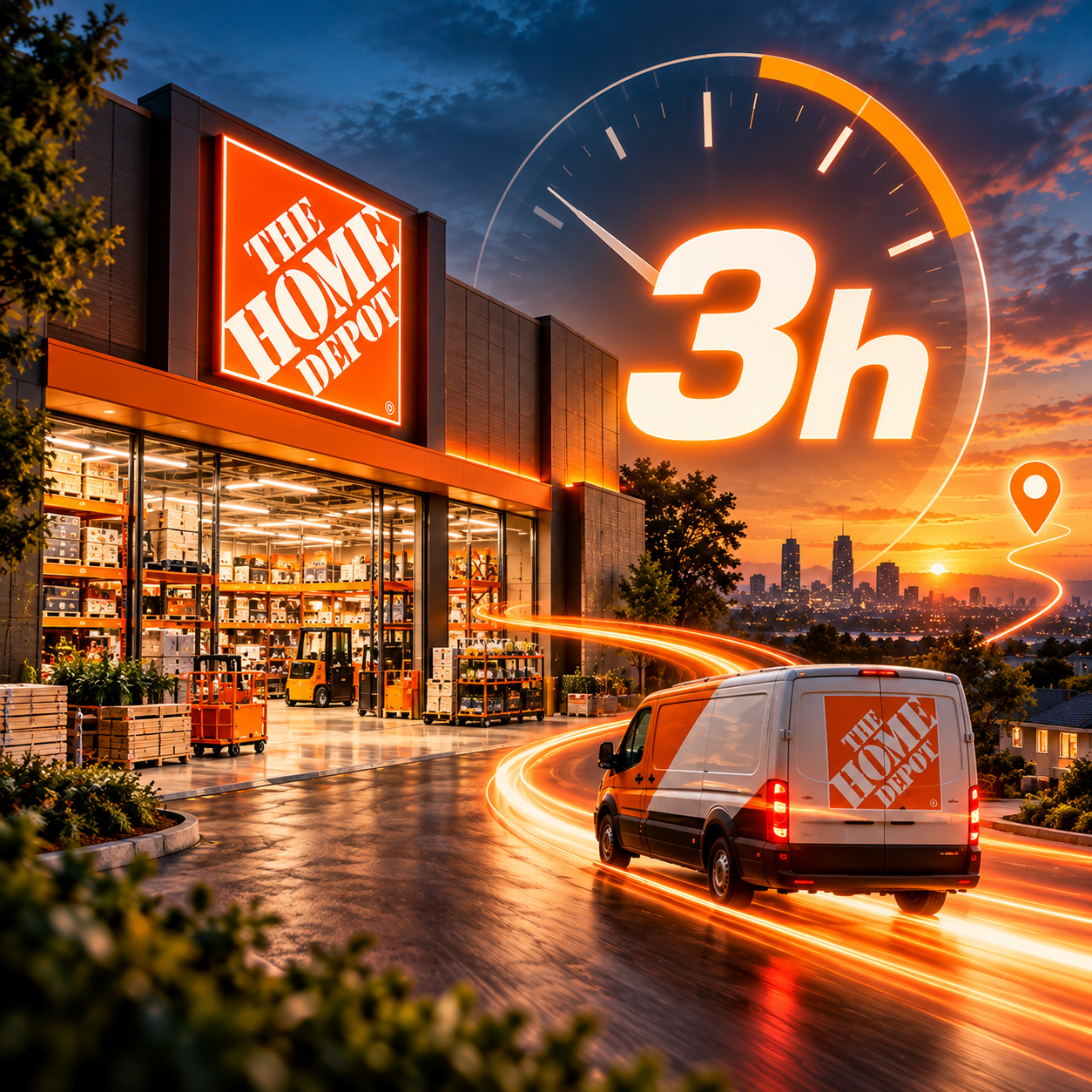
Home Depot’s nationwide express-delivery rollout illustrates a potentially powerful role for physical stores: serving nearby customers as both shopping locations and fulfillment hubs. According to Supply Chain Dive, the retailer introduced delivery in three hours or less across the United States for thousands of eligible products, drawing on more than 2,000 stores.
For other retailers, the important question is not simply whether stores can dispatch orders quickly. It is whether they can do so consistently, without disappointing customers, overloading employees or turning convenient orders into unprofitable ones. The answer depends on which products qualify, how accurately inventory is represented, what picking work the store can absorb and how tightly delivery areas are designed.
Start with the use case, not the speed claim
Three-hour delivery is most compelling when the customer’s problem is genuinely time-sensitive. A contractor may need a replacement component to continue a job. A homeowner may discover a missing tool halfway through a repair. In these situations, a nearby store holds an advantage over a distant distribution center: proximity can convert existing inventory into rapid availability.
That advantage weakens for purchases customers are willing to plan days ahead, especially if the order is costly to pick or transport. Retailers should therefore identify specific urgent missions rather than applying an express promise indiscriminately.
Good candidates generally combine local availability, straightforward picking and manageable delivery characteristics. Examples may include common tools, repair parts, consumables and packaged products that one person can handle. More difficult candidates include fragile goods, unusually heavy or bulky items, products needing specialist handling, regulated merchandise and orders assembled from many store locations.
Home Depot’s use of thousands of eligible SKUs—not necessarily every item—underlines the importance of selection. Eligibility should be a controlled operating rule based on product and order characteristics, not merely an option displayed across the entire online catalogue.
Make inventory accuracy the admission test
A three-hour promise leaves little time to recover from an inventory error. If the system says an item is available but an employee cannot find it, sourcing a substitute from another location may make the delivery window impossible. Frequent cancellations also undermine the value of speed.
Before enabling a SKU, retailers should compare recorded inventory with observed pick success at each store. Risk tends to be higher for products that are small, frequently misplaced, vulnerable to theft, stored in multiple areas or sold rapidly. Display units, damaged stock and inventory already reserved for another order must not appear as available supply.
A prudent availability rule includes a buffer rather than offering the last recorded unit. The appropriate buffer can vary by SKU and location. High-confidence inventory may require only a modest safeguard, while inaccurate categories should be excluded until their records improve.
Order routing must also evaluate inventory confidence, not just geographic distance. The nearest store is not the best fulfillment point if its stock record is unreliable, its pick queue is full or it lacks staging capacity. A useful routing hierarchy weighs confirmed availability, likely completion time, store workload, courier coverage and delivery distance.
Protect store operations from the fulfillment queue
Turning a store into a hub introduces warehouse-like tasks into an environment built primarily for shoppers. Employees must receive the order, locate products, verify them, package or label them, stage them securely and complete a courier handoff. Each step consumes labor and physical space.
Retailers should map this workflow before launch and assign ownership. If orders simply appear in a general task list, urgent picks may compete unpredictably with shelf replenishment and customer assistance. Defined response times, escalation rules and maximum queue sizes make the promise operational rather than aspirational.
Picking capacity should be managed by store and time period. A location that can handle express orders on a quiet weekday may be unable to absorb the same volume during a weekend peak. Dynamic capacity limits can stop new express orders when labor, staging space or courier availability becomes constrained.
Staging design deserves particular attention. Completed orders need a clearly marked, access-controlled area close enough to the handoff point to avoid delay. Chilled, fragile, valuable or oversized products may require separate treatment—or exclusion. Courier collection should not block checkout lanes, loading areas or customer parking.
The handoff process should record the order identifier, courier, time and package count. Staff also need a clear procedure for a late courier, a missing package or a driver unable to accommodate the item. Without chain-of-custody controls, faster fulfillment can create more disputes.
Design delivery zones around reliability and cost
A simple radius on a map does not represent a consistent three-hour journey. Congestion, road layouts, bridges, parking constraints and courier supply can make two addresses at the same distance operationally different. Service areas should be based on achievable travel times and dispatch performance, with different boundaries by store or time of day where necessary.
Retailers also need rules for overlapping territories. Routing every order to the closest store may ignore workload and inventory confidence; routing to a lightly loaded store may add excessive courier distance. The routing engine should balance fulfillment probability against total delivery effort.
The customer promise must explain what “three hours or less” means. The checkout experience should show whether the window begins at order placement, payment authorization or another defined point, alongside the applicable cutoff and eligible address. Retailers should avoid offering the service until stock, capacity and courier coverage have been checked.
Product exclusions should account for courier vehicle limitations and handling risks. Weight, dimensions, fragility, hazardous-material rules, age restrictions and installation requirements can all affect suitability. Basket-level logic is essential: one ineligible item should not silently make the full order impossible to deliver within the advertised window.
Test whether convenience protects the order margin
Store inventory may already be positioned close to the customer, but proximity does not make fulfillment free. The economic test should include incremental picking and packing labor, packaging materials, staging overhead, courier charges, payment costs, failed-delivery exposure, refunds and customer-service work. It should also account for any disruption to in-store selling and replenishment.
Revenue should be assessed just as carefully. The relevant question is whether the delivery fee and incremental gross profit attributable to convenience cover the additional cost and risk. Retailers should not assume that demand for speed implies willingness to pay enough for it.
Unit economics will differ sharply by basket. A single low-margin item with a long courier trip may be unattractive, while a larger basket of easy-to-pick goods delivered nearby may be viable. Useful controls include a minimum order value, distance-based fees, a restricted express assortment and limits on unusually complex baskets. These are evaluation options, not claims about Home Depot’s commercial terms.
A pilot should track contribution after fulfillment, not only order volume. Other practical measures include inventory-related cancellation rate, pick completion time, labor minutes per order, courier wait time, on-time delivery rate, substitutions, failed handoffs and effects on store service. Results should be segmented by store, SKU group, basket profile, distance and daypart.
A controlled pilot checklist
- Choose urgent customer missions: Identify purchases for which a three-hour window solves a meaningful problem.
- Create an eligible SKU list: Screen products for inventory confidence, pick complexity, dimensions, weight, fragility and handling restrictions.
- Validate store inventory: Audit candidate SKUs and set safety buffers before displaying express availability.
- Set routing rules: Consider stock confidence, store workload, staging capacity, courier coverage and travel time.
- Cap order intake: Establish hourly or daypart limits so express demand cannot overwhelm employees.
- Define the workflow: Assign responsibility for picking, verification, staging, courier handoff and exceptions.
- Map realistic service areas: Use travel conditions and courier availability rather than uniform distance alone.
- State the promise precisely: Confirm eligibility at checkout and communicate timing, cutoff rules and exclusions.
- Model basket-level economics: Include labor, packaging, courier expense, failures and support costs.
- Protect store performance: Monitor customer service, replenishment and congestion alongside delivery metrics.
- Expand selectively: Add stores, zones or SKUs only where reliability and contribution meet predefined thresholds.
Home Depot’s rollout shows the scale at which a store network can support rapid delivery. It does not mean every retailer—or every item within a suitable retailer—is ready for the same promise. Stores work as fulfillment hubs when trusted inventory, controlled picking capacity, disciplined service areas and viable order economics align. If one of those conditions fails, proximity alone will not rescue the proposition.