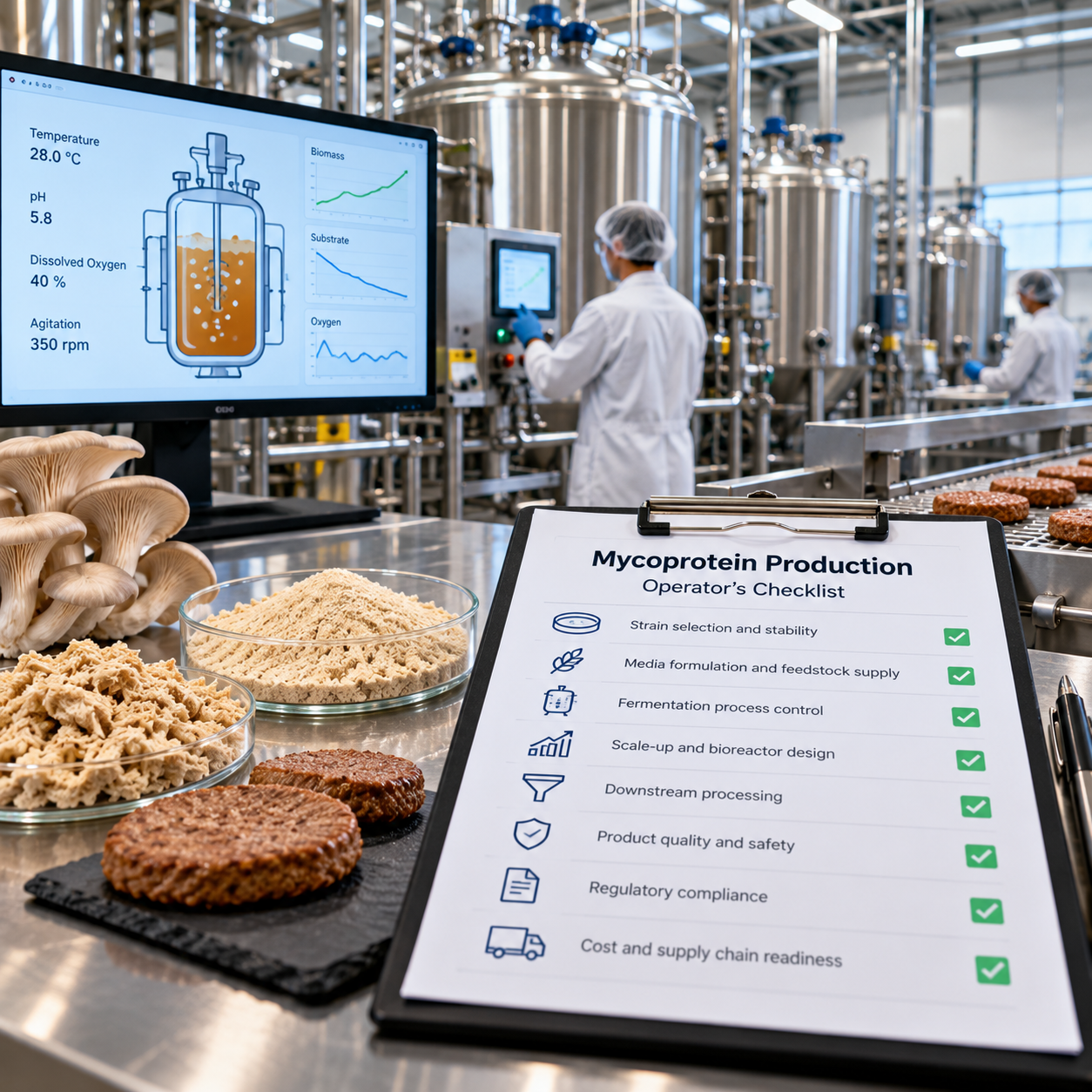
Moving mycoprotein from development to industrial production is not simply a matter of installing larger fermenters. It requires a production system that repeatedly converts feedstock into food-grade protein at an acceptable cost, while satisfying customers that specifications and delivery commitments will hold under commercial conditions.
MAASH offers a useful case through which to examine this transition. EU-Startups reports that the Brussels-based company secured a blended €12.15 million package of equity and public financing to take its mycoprotein production toward industrial scale. The financing is evidence of resources committed to scale-up—not proof that stable industrial output, target economics or qualified customer supply have already been achieved.
For food manufacturers, ingredient buyers and industrial biotech founders, the relevant question is therefore not only how much capital has been raised. It is whether that capital funds the right sequence of technical, operational and commercial de-risking.
Match the capital structure to the scale-up risks
Fermentation scale-up is capital intensive because spending precedes dependable revenue. Facilities and utilities must be engineered, equipment procured, processes transferred and commissioning completed before buyers can rely on sustained output. Working capital may also be tied up in feedstocks, consumables, testing and inventory while production is still stabilising.
A mix of equity and public financing can fit this risk profile. Equity can absorb uncertainty and fund work whose timing or return cannot be predicted precisely. Public finance can support industrial capacity, innovation or regional development where programme conditions align with the project. Combining them may reduce dependence on one source and reserve different pools of capital for different workstreams.
The structure still needs scrutiny. Operators should map each financing component to eligible expenditure, drawdown conditions, milestones and reporting obligations. They should also test whether funds cover not just construction or equipment, but validation batches, process troubleshooting, delayed ramp-up and working capital. Restricted funding that cannot cover these needs may leave a technically promising facility short of cash during its most fragile phase.
Commercial partners should ask what the €12.15 million package is intended to finance, which milestones remain contingent and whether additional capital will be required before dependable volume supply begins. Announced financing and fully funded commercial readiness are not interchangeable.
Define industrial readiness before adding capacity
“Industrial scale” needs an operational definition. Nameplate capacity describes what installed equipment is designed to produce under stated assumptions; demonstrated capacity reflects what the process has actually delivered. Saleable output is lower whenever batches fail, specifications drift, downstream recovery loses material or cleaning and maintenance reduce availability.
Before capacity claims become contractual commitments, the operator should establish:
- a defined process window for fermentation and downstream processing;
- repeatable yield and cycle-time performance across consecutive runs;
- mass-balance data from input through recovered, saleable ingredient;
- realistic assumptions for cleaning, changeovers, maintenance and sampling;
- the location and impact of bottlenecks outside the fermenter;
- clear criteria for rejecting, reworking or downgrading output.
Scale can change mixing, heat transfer, oxygen transfer and process-control behaviour. Downstream operations—including separation, concentration, stabilisation and packaging—must also keep pace. A fermenter performing as intended does not create commercial capacity if harvesting or finishing becomes the constraint.
Reliability should be measured as a distribution, not a best run. Buyers need evidence from multiple consecutive campaigns showing variability in yield, composition and processing time. Operators should track batch success rate, saleable yield, unplanned downtime, cleaning duration and deviation frequency. These measures reveal whether output can support dependable supply rather than occasional production successes.
Control inputs, contamination and downtime
Mycoprotein economics and consistency depend on more than organism performance. Feedstock quality, nutrients, water, energy, gases and processing aids can influence yield, composition and cost. Procurement teams should identify single-source dependencies and determine which input characteristics are critical to the process.
Feedstock exposure should be tested against price volatility, supplier interruption and lot-to-lot variation. A cheaper alternative is not interchangeable if it changes fermentation performance or food-quality attributes. Operators need incoming specifications, supplier qualification, traceability and change-control procedures before substitutions are introduced.
Contamination risk deserves its own operating plan. Preventive controls should cover raw-material handling, inoculum management, equipment integrity, cleaning and sterilisation, environmental monitoring and personnel flows. The response plan must define how a suspected event is detected, isolated, investigated and cleared. It should also account for the time required to dispose of affected material, clean equipment, verify readiness and rebuild the production sequence.
Downtime scenarios should extend beyond contamination. Utility failures, sensor faults, unavailable spare parts and downstream equipment breakdowns can all interrupt supply. Critical spares, preventive maintenance, escalation routes and backup utility arrangements should be designed around the consequences of failure—not merely the probability of occurrence.
Prove food quality and unit economics together
A process is not commercially ready if it delivers acceptable yield but inconsistent food functionality. The finished mycoprotein must meet defined microbiological, chemical, nutritional, sensory and physical specifications. Depending on its intended application, customers may examine composition, flavour, colour, texture, water handling, shelf stability and performance in their own processing conditions.
Quality systems should connect batch records to raw-material lots, process deviations, test results and release decisions. Operators also need validated analytical methods, allergen and foreign-material controls, traceability, recall procedures and evidence that packaging preserves the agreed specification. Regulatory status and labelling suitability must be assessed for each target market and use.
Unit economics should be calculated from saleable output rather than gross fermentation output. The model should include feedstocks, utilities, labour, consumables, quality testing, waste treatment, packaging, maintenance and downstream losses. Depreciation and financing costs matter when judging whether the process can support sustainable pricing.
Instead of relying on a single target cost, management should model sensitivity to yield, batch failure, energy and feedstock prices, utilisation and ramp-up speed. This exposes which assumptions require the strongest evidence. Procurement teams should likewise test whether quoted pricing depends on utilisation levels or process improvements that have not yet been demonstrated.
Commission in stages and qualify customers with real material
Commissioning should progress through explicit gates: equipment and utility checks, water or inert trials where appropriate, initial biological runs, repeated specification-compliant campaigns and controlled ramp-up. Each stage needs acceptance criteria and authority to pause. Pressing ahead to protect a launch date can turn unresolved deviations into recurring losses.
Customer qualification should develop alongside commissioning. Laboratory samples may establish initial interest, but they do not prove that industrial material will behave identically. Buyers should evaluate product from the intended commercial process, then test it in their formulations and manufacturing lines. Approval should address functionality, sensory performance, shelf life, regulatory documentation and acceptable variability.
Volume contracts should distinguish forecast demand from binding commitments and link ramp-up to demonstrated milestones. Early agreements may need qualification clauses, flexible volumes, specification-change controls and remedies for delayed supply. This protects buyers while avoiding obligations that force the producer to prioritise volume over process discipline.
Evidence to request before committing volume
Procurement and technical teams should request evidence proportionate to the commitment being considered:
- capacity definitions separating design, demonstrated and saleable output;
- results from consecutive representative runs, including variability and deviations;
- finished-product specifications, analytical methods and certificates of analysis;
- food-safety plans, traceability procedures and relevant regulatory documentation;
- feedstock specifications, critical supplier dependencies and change controls;
- contamination response, maintenance and business-continuity plans;
- samples produced through the intended commercial process;
- a commissioning schedule with completed and outstanding gates;
- an explanation of how pricing changes with volume, input costs or specification;
- funding coverage through commissioning, qualification and working-capital ramp-up.
MAASH’s blended financing signals an organised effort to move mycoprotein production toward industrial volume. The decisive evidence will come next: repeated saleable output, controlled food quality, resilient operations, credible economics and customer validation using representative material. Operators should stage capital and commissioning around those proofs; buyers should make volume commitments only as the corresponding evidence becomes available.