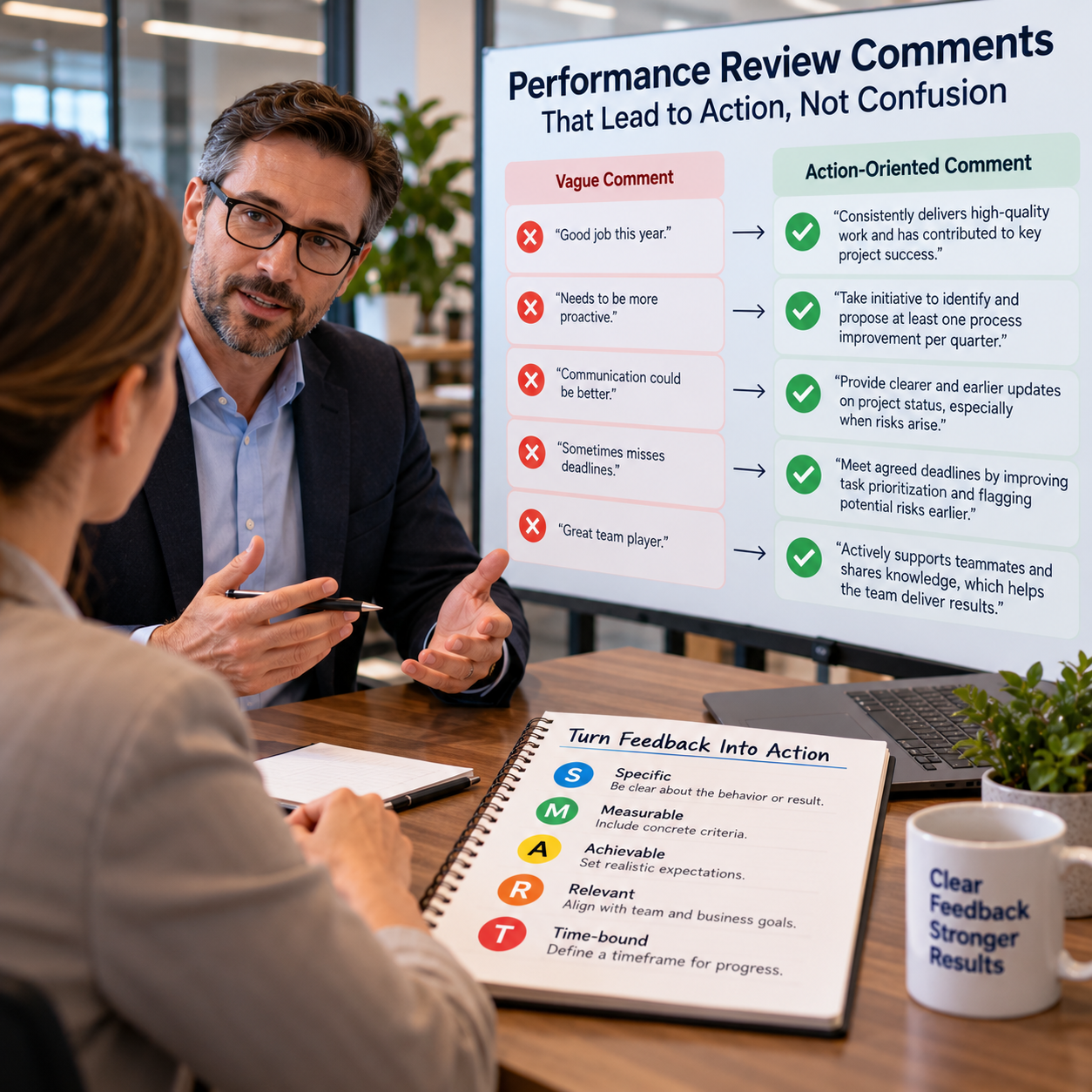
Performance review comments should help an employee understand what happened, why it matters, and what to do next. Yet many reviews rely on phrases such as “great attitude,” “needs more initiative,” or “communication could improve.” These judgments may sound familiar, but they give employees little usable direction and leave managers without a clear basis for follow-up.
The practical alternative is to connect comments to observable work. Drawing on the core performance-comment principles presented by Small Business Trends, this guide offers a repeatable method for documenting results, discussing improvement, and agreeing on next steps. The examples are an operator framework rather than legal guidance: managers should also follow their organization’s review policies and documentation requirements.
Build every comment around five connected elements
A useful performance comment can be built from five elements: observed behavior, business impact, expectation, employee input, and follow-up action. Not every sentence needs to be long, but the complete discussion should answer all five questions.
- Observed behavior: What did the employee do, deliver, or fail to complete? Refer to a project, work pattern, result, or documented example rather than a character trait.
- Business impact: What effect did it have on customers, colleagues, quality, timing, cost, or risk?
- Expectation: What standard should continue or change? Define successful performance in terms the employee can recognize.
- Employee input: What context, obstacles, or interpretation does the employee bring? A review should not turn assumptions into facts.
- Follow-up action: Who will do what, by when, and when will progress be reviewed?
For example: “In the last two client handovers, you provided the implementation team with complete notes before the agreed deadline. This reduced clarification requests and helped both launches stay on schedule. Continue using the handover template for each new account. What made this process work well, and are there obstacles to applying it consistently? We will review the next three handovers at our monthly check-in.”
This structure makes praise repeatable and criticism correctable. It also separates facts from managerial interpretation, reducing the risk that a single impression dominates the review.
Make strong-performance comments specific enough to repeat
Praise is most valuable when it identifies the behavior behind a positive outcome. A label such as “top performer” recognizes the employee but does not explain which choices should be repeated or shared with others.
Vague: “You always do excellent work.”
Actionable: “On the quarterly reporting project, you verified source data before submission and flagged two inconsistencies early. That prevented rework at the final approval stage. Continue using the verification step, and document it so the rest of the team can adopt the same approach by the next reporting cycle.”
Vague: “You show great initiative.”
Actionable: “When the supplier changed its delivery schedule, you identified the affected orders, proposed revised priorities, and informed customer service before complaints arose. That gave the team time to manage customer expectations. For future disruptions, continue escalating the issue with a proposed response rather than reporting the problem alone.”
Avoid inflating a single success into a permanent judgment. Words such as “always,” “never,” and “best” are difficult to support and can create inconsistencies across employees. Name the period, project, or recurring behavior instead.
Describe improvement needs without judging personality
Improvement comments should identify a performance gap, not diagnose motivation or personality. “Careless,” “negative,” “not a team player,” and “lacks commitment” invite disagreement because they interpret the person rather than describe the work.
Vague: “You need to be more detail-oriented.”
Actionable: “Three of the five inventory reports submitted this month contained product-code errors and required correction before processing. The standard is an accurate report by 3 p.m. each Friday. Before the next submission, use the validation checklist and ask the operations analyst to review your first completed report. We will compare error rates across the next four reports.”
Vague: “Your attitude in meetings needs improvement.”
Actionable: “During the last two planning meetings, you interrupted colleagues several times before they finished presenting their proposals. This made it harder to evaluate each option and led the facilitator to revisit points later. In future meetings, note your questions and raise them after the speaker finishes. What was happening from your perspective? We will discuss how this approach is working after the next two meetings.”
Employee input matters here because performance may be affected by unclear priorities, inadequate tools, conflicting instructions, or missing training. Listening does not remove accountability; it helps the manager choose an appropriate response. The next step might be practice, coaching, clearer workload decisions, or a defined change in behavior.
Turn development, collaboration, and goals into observable commitments
Skill development
“Improve your leadership skills” is too broad to guide development. Specify the skill, the opportunity to practice it, and the evidence that will show progress.
Vague: “You should become a better presenter.”
Actionable: “Your analysis is thorough, but the last two project updates exceeded the allotted time and did not end with a clear decision request. For the next update, organize the presentation around the decision, supporting evidence, and requested action; rehearse it with me two days beforehand. Success means finishing within 15 minutes and stating the requested decision on the final slide.”
Collaboration
Collaboration comments should describe information sharing, handoffs, conflict handling, or contribution to joint work—not popularity.
Vague: “Be more of a team player.”
Actionable: “On the last two campaigns, design received final copy less than one business day before launch, although the team schedule calls for a three-day handoff. This compressed review time and contributed to last-minute changes. For the next campaign, confirm copy readiness at the weekly planning meeting and alert design as soon as the deadline is at risk.”
Goals
Goals need a deliverable, quality threshold, due date, ownership, and review point. Where outcomes depend on factors outside the employee’s control, distinguish the result from the actions they own.
Vague: “Focus on customer satisfaction next quarter.”
Actionable: “By the end of next quarter, review the recurring themes in support feedback, recommend two process changes within your control, and implement one approved change. Bring a progress update to the monthly operations meeting, including what changed and what evidence we will use to assess the result.”
Protect fairness through evidence and consistent standards
Good wording cannot compensate for poor preparation. Review the full performance period rather than relying on the most recent event. Check project records, agreed goals, work outputs, prior feedback, and notes from regular check-ins. Distinguish direct observation from second-hand feedback, and verify material examples before including them.
Apply comparable standards to comparable roles. If timeliness, quality, customer handling, or collaboration affects one employee’s rating, managers should assess peers against the same relevant criteria. Comments may differ because the evidence differs, but the underlying expectations should not shift without a business reason.
Document both strengths and gaps with proportionate detail. Recording every error while summarizing achievements in one generic sentence creates an unbalanced picture. Conversely, avoiding a documented performance issue to keep the conversation comfortable denies the employee a fair opportunity to understand and address it.
Managers should also check whether their language reflects unsupported assumptions. Replace “does not care about deadlines” with the documented pattern of missed deadlines. Replace “naturally good with customers” with the listening, problem-solving, or follow-up behaviors that produced the result.
Prepare the conversation and close with ownership
Before the review, use this short preparation checklist:
- Confirm the role expectations and goals that applied during the review period.
- Select representative, verifiable examples—not only recent or memorable events.
- Connect each example to a business or team impact.
- Remove personality labels, absolutes, speculation, and vague intensifiers.
- Define what continued or improved performance will look like.
- Prepare questions that invite context without prejudging the answer.
- Set a realistic action, owner, deadline, and follow-up date.
- Check that comparable employees are being assessed consistently.
End the conversation by summarizing agreements in plain language. The employee should leave knowing which behavior to continue or change, what support the manager will provide, and when both parties will inspect progress. A review becomes actionable not because every comment sounds polished, but because evidence, expectations, and accountability point in the same direction.