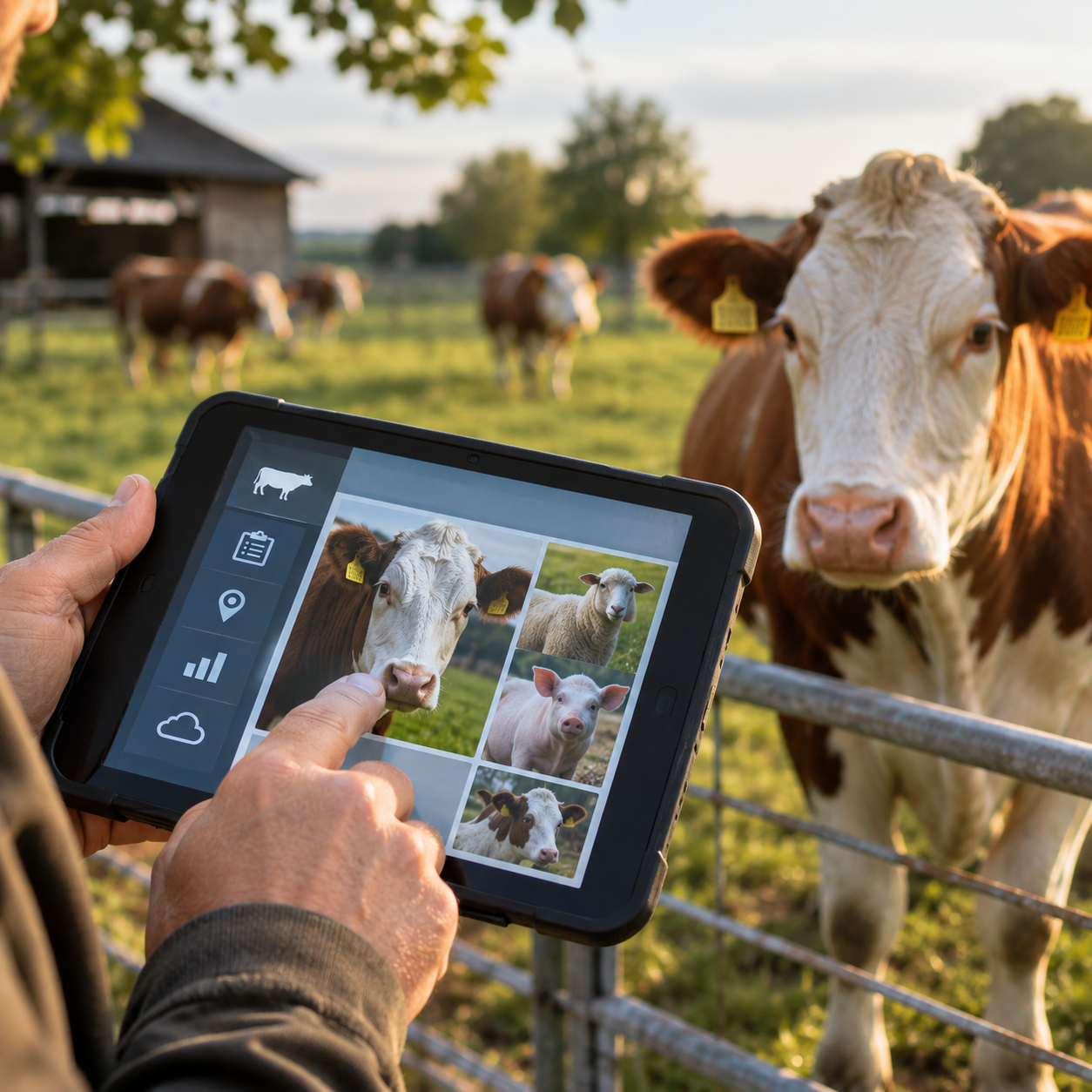
A livestock traceability platform can become much more than an electronic replacement for paper records. When one animal-level record follows cattle from birth into processing and retail, it may connect identification, production history and commercial information across businesses that have different priorities. That makes platform selection a long-term operational and data-governance decision—not simply a software purchase.
Breedr illustrates this broader model. According to EU-Startups, the livestock technology company maintains a digital record for each cow from birth through the retail supply chain. Following a reported €23 million raise, it plans to expand globally, bring more producers onto its platform and capture additional types of information, including genomic data. These are reported plans rather than proof that a particular farm will save money, improve productivity or satisfy regulatory requirements.
Farmers, ranchers and agribusinesses should therefore test two propositions separately: whether animal-level records improve their own work, and whether participation in a value-chain platform creates sufficient commercial value to justify sharing and maintaining those records.
Start with the job the record must perform
Define the procurement objective before comparing features. Is the priority to replace duplicate recordkeeping, improve internal visibility, provide verified history to buyers, support breeding decisions or connect records between producers and downstream partners? A platform may perform strongly in one role and poorly in another.
Map the proposed digital record against an animal’s actual journey through the business. Identify who creates the record at birth or arrival, who updates movements and treatments, how identification is verified, and what happens when an animal is sold, transferred, processed or lost. Include exceptional events such as a missing tag, an offline yard, a disputed identity or a correction to an earlier entry.
Ask the vendor to demonstrate these workflows using realistic herd sizes, locations, connectivity conditions and staff roles. A polished dashboard does not establish that data can be captured quickly at a crush, in a calving area or across multiple ranches. Buyers should establish whether mobile and offline functions exist, how records synchronize, and how the system prevents duplicate animals or mismatched identifiers.
Calculate the real data-entry burden
Animal-level traceability depends on record quality. The critical procurement question is not how many fields the platform offers, but how reliable information will enter those fields during routine work.
- Capture: Which events require manual entry, and which can be imported from readers, scales, breeding systems, laboratory results or other equipment?
- Timing: Must staff record information immediately, or can they enter batches later without weakening the audit trail?
- Validation: Does the platform flag impossible dates, duplicate identifiers, unusual weights or incomplete records?
- Correction: Who may amend an error, and does the system retain the original value, editor and timestamp?
- Continuity: What happens when a tag is replaced or when animals arrive with incomplete histories?
Run a pilot around several high-frequency events rather than relying on a vendor presentation. Measure time spent entering and checking information, failed scans, synchronization problems, corrections and records left incomplete. Do not assume that more available data automatically creates better decisions; every additional field introduces capture, verification and maintenance work.
Test identification and system interoperability
A traceability platform should fit the farm’s existing identification environment. Buyers need to confirm compatibility with the specific electronic identification standards, tags, readers, weigh heads and mobile devices they use—not merely accept a general claim that integrations are supported.
Interoperability also concerns data structure. Ask whether the platform can import existing herd histories and export complete animal-level records in documented, machine-readable formats. Determine whether integrations use a supported application programming interface, scheduled file transfers or manual spreadsheets. Clarify who builds each connection, who maintains it after an update and who pays when an external system changes.
Test representative data before signing. Include animals with multiple identifiers, historical movements, missing values, changed ownership and corrected entries. Reconcile imported totals and sample individual histories against the source system. If information is transformed during import, request a written mapping showing how each original field is represented.
Portability is equally important. A farmer should ask whether exported records include attachments, event histories, timestamps, identifiers, genomic results and correction logs, or only a summary. Establish how quickly data can be retrieved and in what condition if the subscription ends, the farm changes systems or the vendor is acquired.
Set ownership, permissions and value-chain access in writing
A record that follows livestock across the supply chain raises questions that a farm-only system may avoid. Different parties can contribute data, while commercial sensitivity changes as the animal moves between owners. Procurement should distinguish legal ownership, permitted use, control of access and responsibility for accuracy.
Request plain-language answers to the following:
- Who owns information entered by the producer and information generated by connected devices?
- Who controls a record after the animal is sold?
- Can a previous owner continue to view later events, and can a downstream buyer see the complete earlier history?
- May the platform aggregate, benchmark, commercialize or use farm data to develop products?
- Can access be limited by field, animal group, counterparty, purpose and period?
- How is consent recorded, changed and withdrawn?
- Who handles a disputed entry contributed by another value-chain participant?
- What security, backup, incident-notification and account-recovery arrangements apply?
Farmers should also identify what a buyer genuinely needs. Sharing proof of selected events is different from exposing full production histories, performance data or genomic information. Configure access on a least-necessary basis and test the view available to each partner role before live records are shared.
Evaluate genomic and production data by decision use
Breedr’s reported plan to capture additional information, including genomic data, expands the possible scope of each animal record. It also increases the need for disciplined evaluation. Buyers should not collect genomic or production data merely because the platform can store it.
For every proposed data type, name the decision it is expected to inform: selection, mating, replacement, grouping, marketing or another defined action. Then examine source reliability, update frequency and comparability. Genomic results may come from different laboratories or panels; production measurements may be collected under different conditions. Ask whether the platform preserves provenance, methodology, units, confidence information and the date of each result.
Determine who can interpret the information and whether staff need support from breeding advisers, veterinarians or other specialists. The software’s presentation of a score should not be mistaken for an independent recommendation. Buyers should ask how models are validated for their breeds and production context, how rankings change when data is incomplete, and whether automated suggestions can be reviewed or overridden.
Genomic information also has lasting commercial sensitivity. Contract terms should specify whether it can be shared with buyers, breeding partners or analytics providers; whether relatives can be inferred or linked; and whether derived scores belong to the farmer, vendor or another party.
Make the purchase conditional on a controlled pilot
Use a defined herd or production group to test the system through several real events and at least one transfer to a downstream participant. Include the people who will enter information, supervise records, use reports and manage partner permissions.
Before proceeding, require satisfactory answers in seven areas: workflow completion under field conditions; acceptable entry and correction effort; verified compatibility with identifiers and equipment; reconciled import and full export; written ownership and permitted-use terms; role-based downstream access; and a documented training, support and exit plan.
Set pilot acceptance criteria around observable performance, such as record completeness, error handling, synchronization, staff ability to complete core tasks and successful data retrieval. Avoid attributing savings, productivity improvements or compliance outcomes to the platform unless the vendor can substantiate them for the relevant operation and jurisdiction.
The strategic attraction of Breedr’s model is continuity: one digital identity can potentially connect information across an animal’s life and the wider value chain. The corresponding risk is dependency on the platform that maintains that continuity. A sound purchase preserves the farm’s ability to operate, control access and recover usable records even if commercial relationships, data requirements or technology providers change.