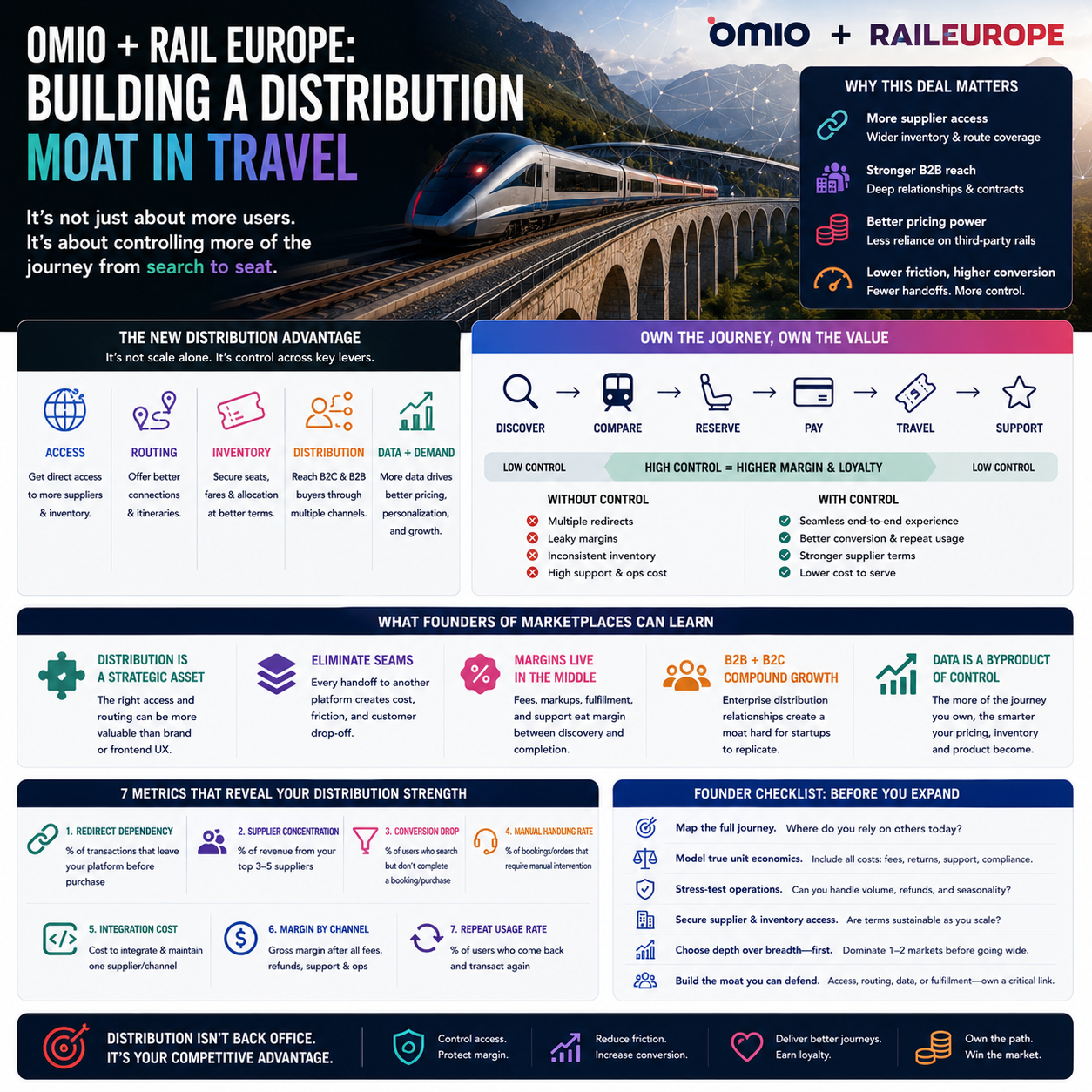
Omio’s agreement to acquire Rail Europe is more than a travel industry headline. It is a useful signal for any founder or operator building a marketplace, booking platform, or multi-channel distribution business: control over demand is only half the game. Control over access, inventory, and routing can matter just as much.
The deal suggests that in fragmented categories, the winners are often the companies that can reduce friction between suppliers and buyers while owning more of the transaction path. For operators, that raises a practical question: are you building a brand, or are you building a distribution position?
Why this acquisition matters beyond travel
Omio is already known as a multimodal booking platform, and Rail Europe adds another layer of distribution depth. That matters because travel is not just a consumer app problem. It is a supplier connectivity problem, an inventory problem, and a conversion problem wrapped into one business model.
When a platform acquires a distribution asset, it is usually trying to improve one or more of these levers: more supply coverage, better pricing power, stronger B2B reach, or lower dependence on third-party rails for fulfillment. That logic applies to e-commerce aggregators, logistics marketplaces, SaaS marketplaces, and vertical booking systems as well.
What operators should read into the deal
The most useful takeaway is not that “bigger is better.” It is that distribution businesses become more defensible when they can connect multiple sides of the market without forcing users to leave the system. In travel, that can mean B2C booking flows, B2B distribution relationships, and discovery tools all under one roof.
For founders, this is a reminder to map where value is actually created. If your company helps customers find, compare, reserve, or fulfill a product, your moat may come from controlling a critical handoff point rather than from the front-end experience alone. In practice, that can be API access, supplier contracts, fulfillment partnerships, or a proprietary routing layer that competitors cannot easily replicate.
What most people miss
Many founders look at acquisitions like this and focus only on scale. The deeper story is operating leverage. A distribution business is not just buying revenue; it is buying fewer handoffs, better routing, and more control over where margin leaks out of the system.
That matters because platform businesses often lose money in the seams: duplicate customer support, fragmented supplier integrations, manual exception handling, and weak conversion from search to checkout. If the acquisition helps eliminate those seams, the value is operational, not just strategic.
There is also a hidden product lesson here. Customers rarely reward complexity. They reward fewer steps, clearer inventory, and less uncertainty. If a business can own more of the path from discovery to booking or purchase, it can often improve conversion without needing a radically better marketing story.
How small businesses can apply this logic
You do not need to acquire a company to use the same playbook. Small businesses can apply the same principle by identifying which part of the transaction chain they can control or simplify. In travel, that might be direct supplier integrations. In e-commerce, it might be fulfillment visibility. In SaaS, it might be embedded workflows that reduce the need for external tools.
The key decision is whether you are dependent on someone else’s platform economics. If your acquisition costs keep rising, supplier access is unstable, or your conversion rate depends on too many third-party redirects, you may need to invest in distribution control rather than just in more traffic.
For founders raising capital, that also changes the pitch. Investors often understand growth; they pay closer attention when you can explain why your distribution position is hard to unbundle. The stronger the control over inventory, routing, or checkout, the more resilient the business model tends to look.
What to measure before you pursue a distribution strategy
If you are deciding whether to build, buy, or partner for distribution, the useful metrics are operational, not vanity-driven. You need to know where friction sits in the funnel and whether removing it would improve economics enough to justify the effort.
- Share of transactions that depend on third-party redirects or external checkout steps
- Supplier concentration risk: how much revenue depends on a small number of partners
- Conversion loss between discovery and booking, quote, or purchase
- Manual handling rate for exceptions, refunds, changes, or support tickets
- Integration cost per supplier, channel, or marketplace partner
- Margin by channel, especially where distribution fees compress unit economics
- Repeat usage rate for customers who complete the full transaction inside your system
For operators in e-commerce, travel, logistics, and B2B marketplaces, those numbers tell you whether distribution is a feature or the business itself. Omio’s move suggests the market still rewards companies that treat distribution as a strategic asset, not a back-office necessity.
The practical question is simple: if you cannot own the whole chain, can you at least own the most expensive or most fragile link? That is where durable leverage tends to live.