For founders planning to raise later this year, summer is often the least noisy time to get the work done that investors actually notice. The problem is rarely “lack of interest” alone; it is usually a messy process, weak materials, or missing proof points that slow momentum once meetings start.
That is why the smarter use of a quiet season is not to “work on fundraising” in the abstract, but to build a repeatable capital-raising system: target list, narrative, metrics pack, diligence room, and a process for keeping conversations moving.
Why fundraising preparation is an operations problem, not just a pitch problem
Founders often treat fundraising as a single event: a deck, a round of meetings, a yes or no. In practice, investors are judging whether the company can communicate clearly, report cleanly, and manage follow-through under pressure. If those systems are weak before the first call, they usually stay weak during the process.
That is the useful lens behind the summer prep idea. Quiet weeks are when a founder can clean up the inputs investors will later inspect: monthly numbers, customer concentration, growth drivers, unit economics, cap table, and hiring plan. A strong raise is usually built on operational clarity long before the term sheet appears.
What founders should actually build before outreach starts
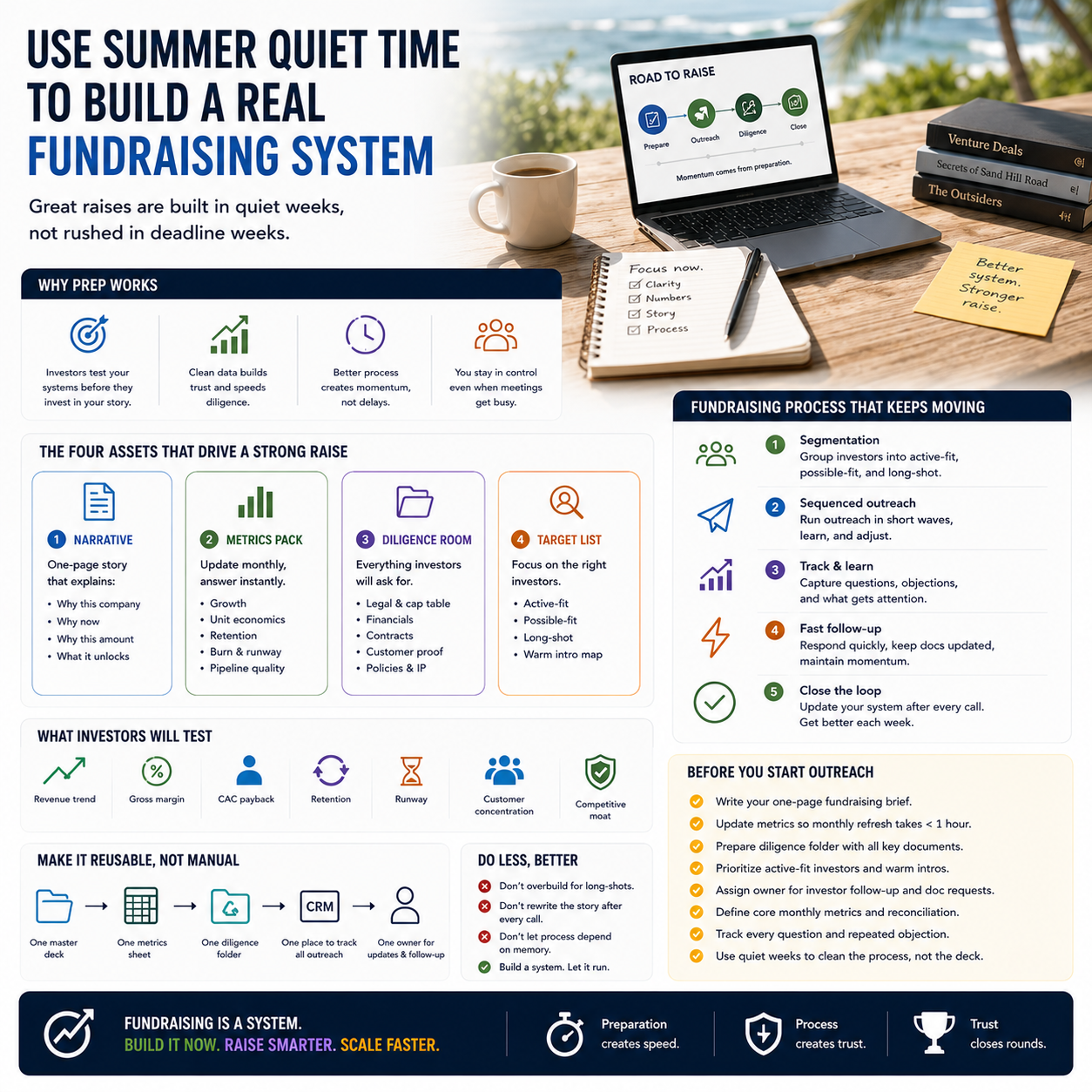
There are four assets that matter more than a generic pitch deck. First, a one-page fundraising narrative that explains why this company, why now, and why this amount of capital. Second, a metrics pack that can be updated monthly without manual panic. Third, a diligence folder with every document an investor will ask for. Fourth, a target list that separates likely investors from hopeful ones.
This is where many early-stage teams waste time. They spend days polishing slides but cannot answer basic follow-up questions quickly. If an investor asks for revenue by cohort, churn by segment, or a customer contract sample, the delay sends a message. The summer window is useful because it gives founders time to build those response systems before urgency arrives.
What most people miss
Most fundraising advice focuses on the meeting itself. The real friction is everything between meetings: who updates the data room, who answers diligence questions, how fast metrics are refreshed, and how the founder tracks which investor is waiting on which item. That workflow is often the difference between momentum and drift.
If you are running a small team, fundraising readiness should look like an internal operating process, not a side project. Even a simple workflow in a shared drive and CRM can remove repeated manual work and reduce the chance of inconsistent answers.
How to structure the fundraising process so it does not stall
A practical process starts with segmentation. Do not send the same outreach to everyone. Group investors into three buckets: active-fit, possible-fit, and long-shot. Active-fit means the fund already invests in your stage, geography, and model. Possible-fit means the thesis is close enough that a conversation could work. Long-shot means you should not spend current bandwidth there unless a strong warm introduction appears.
Next, build a simple sequencing plan. Use the summer weeks to prepare, then run outreach in short waves rather than one long blast. That lets you compare responses, refine the story, and avoid exhausting your best leads too early. It also helps you manage time: if one message produces stronger reactions than another, you can adjust quickly instead of discovering the weakness after 40 conversations.
The real goal is not just to “raise” but to create a system where every investor interaction produces usable data: which slide triggered questions, which metric got attention, which objection repeated, and which documents were requested. That becomes your internal decision loop.
What metrics investors will test before they test your story
Fundraising often breaks down when the story is promising but the metrics are not ready for close inspection. Investors want evidence that the business is understandable and measurable. Depending on stage, that may include revenue trend, gross margin, burn rate, runway, CAC payback, retention, pipeline quality, and customer concentration.
You do not need a perfect dashboard. You do need a reliable one. The difference matters because many founders build metrics manually from several tools, which creates version issues and slows response time. If your data lives across accounting software, CRM, billing, and spreadsheets, decide now who owns the final monthly numbers and how they are reconciled.
This is also where fundraising becomes useful for operations more broadly. A cleaner metrics process improves board reporting, hiring decisions, and budget control even if the raise takes longer than planned.
How to make the process investor-ready without wasting founder time
Founders should think in terms of reusable work. Every answer, document, and update should be something the team can maintain once, then reuse across the round. A simple operating model helps:
Prepare one master deck. Keep one metrics sheet. Maintain one due diligence folder. Track all outreach in one place. Assign one person, even if part-time, to own update hygiene. If the founder is doing everything manually, the round becomes a distraction instead of a managed process.
It is also worth deciding what not to do. Do not overbuild materials for investors who are not likely to invest. Do not rewrite the narrative after every call unless the feedback is consistent. Do not let the process depend on memory. The fundraising system should work even on the weeks when the founder is traveling, hiring, or dealing with product issues.
Practical checklist before you start investor outreach
- Write a one-page fundraising brief that explains the amount, use of funds, timing, and core growth logic.
- Update your metrics pack so monthly numbers can be refreshed in under an hour.
- Prepare a diligence folder with incorporation documents, cap table, financials, contracts, and key customer materials.
- Segment investors into active-fit, possible-fit, and long-shot, then prioritize outreach accordingly.
- Set one owner for investor follow-up so requests do not get lost between calls.
- Decide which metrics you will report every month and how they will be reconciled across systems.
- Track every investor question to identify repeated objections and narrative gaps.
- Use quiet weeks to clean the process, not to endlessly revise the deck.