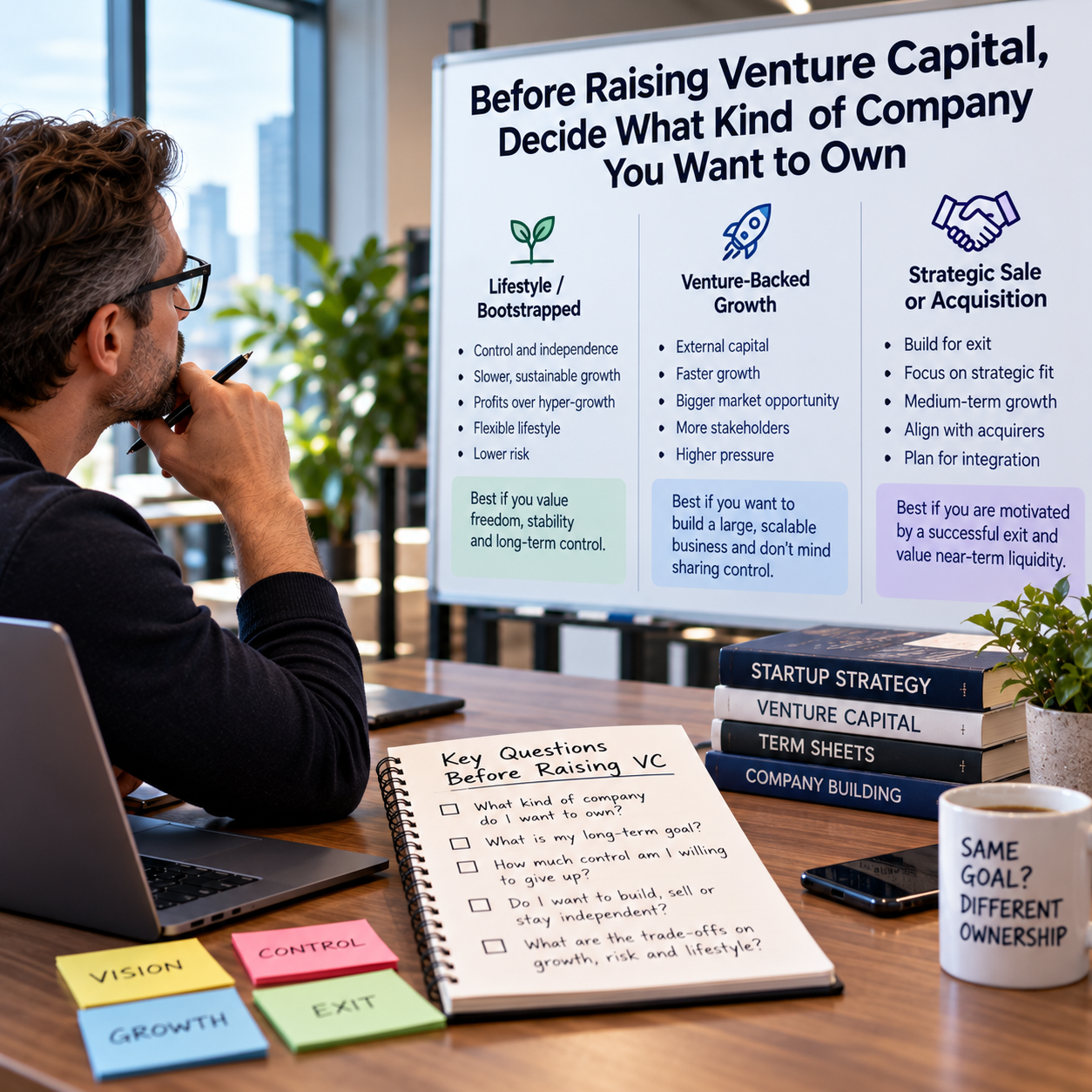
Capital does more than fund a company. It changes incentives, governance and the strategic options available to founders. Before raising venture capital, ask a more fundamental question: What kind of company do you want to own, and what are you prepared to trade to build it?
Venture capital can support faster product development, hiring and market expansion. It can be valuable when timing matters or when substantial investment is required before revenue catches up. Institutional investors also have return models, governance expectations and a need for eventual liquidity. A profitable company intended to compound over decades may not fit those requirements. Conversely, preserving ownership will not help if underinvestment causes a time-sensitive opportunity to disappear.
This is not a contest between external funding and independent ownership. It is an alignment decision involving the market, the company’s economics, the investor’s model and the founder’s intended outcome.
Start with what the market requires
Do not decide that you are a “venture founder” or an independent operator before examining what the business needs. First determine how much capital the opportunity requires, when it is required and what happens if the company grows more slowly.
- Does the market reward speed? A time-sensitive distribution opportunity or fast-moving product category may punish gradual expansion. Other markets may allow companies to win through specialization, patient execution or durable customer relationships.
- What must be funded before revenue catches up? Estimate the cash required for product development, inventory, infrastructure, sales capacity and other essential investments. Separate these needs from spending that merely makes the plan look more ambitious.
- Can customers help finance growth? Upfront payments, annual contracts, services revenue or a narrower initial product may reduce the amount of equity capital required. Test whether these options fit the business rather than assuming they do.
- What is the cost of moving slowly? Slower growth could mean losing an opportunity, but it could also provide time to improve the product, validate demand and avoid scaling an unproven model.
An EU-Startups opinion article about funding and ownership argues that financing structures can influence growth choices and exit options. Its founder stories and family-business example are illustrative, not systematic evidence. The useful principle is not that one funding route is superior, but that the financing model should fit the company’s economics and intended destination.
Complete a pre-funding ownership worksheet
A financing plan is incomplete if it includes revenue forecasts but says nothing about control, liquidity or the founder’s future role. Record the following decisions before meeting investors. The answers can evolve, but they should not remain implicit.
1. Required scale and speed
Define what must be true for the company to become viable. Does it need to enter several markets quickly, or can it build a defensible position within one segment? Which milestones genuinely require external cash, and what would happen if the company reached them later?
Prepare at least two credible plans: one with external equity and one with constrained capital. Compare funding requirements, operating risk, ownership consequences and resilience—not just projected revenue growth.
2. Realistic reinvestment needs
Estimate how much cash the business can generate and how much it must reinvest. A company that can finance expansion from operations faces a different decision from one requiring substantial investment well before profitability.
Do not treat profitability and growth as permanent opposites. Ask when profitability should become a priority, how long losses can responsibly continue and what evidence would justify further spending. Related EU-Startups coverage of sustainable growth and premature scaling discusses the tension between durable economics and pursuing scale before the underlying business is ready.
3. Acceptable dilution and loss of control
Model ownership beyond the proposed round. Later fundraising, employee equity and other issuances may further change the cap table. The objective is not to predict an exact final percentage but to determine whether a plausible ownership path remains acceptable.
Control also extends beyond share ownership. With qualified legal advice, review board composition, voting arrangements, approval rights and provisions affecting future financing or a sale. Identify which decisions would no longer be the founder’s alone and whether that is a reasonable exchange for the capital and support offered.
4. The investor’s horizon and return model
Institutional investors are not simply sources of patient cash. Their fund structure and portfolio strategy influence which outcomes are attractive to them. Founders should understand how their company is expected to contribute to that model.
Ask when the fund was raised, which stages it targets, how it approaches follow-on investment and what outcome would make the investment successful. A company can perform well operationally yet still be a poor fit if its potential scale, timing or route to liquidity does not match the fund’s objectives.
5. Profitability versus growth priorities
Specify how the company will choose between current cash generation and reinvestment. Would the founder accept several years of losses to pursue a larger opportunity? Would the investor support slower growth if it produced a resilient, profitable company? What evidence would trigger a change of plan?
Shared enthusiasm for “growth” can conceal disagreement. Replace that vague term with operating decisions: hiring pace, market launches, pricing discipline, customer-acquisition spending and the point at which the business should be able to sustain itself.
6. Exit pressure and the likely destination
Taking venture capital does not make a particular exit inevitable, but it can make investor liquidity an important factor in future decisions. Discuss whether the plausible destination is an acquisition, public listing, secondary transaction, another liquidity mechanism or continued independent ownership.
Test difficult scenarios. What happens if an acquisition offer arrives earlier than expected? What if the company becomes profitable but cannot credibly produce the return an investor seeks? What if founders and investors disagree about another round? Guidance on selling versus raising again likewise treats an exit as a negotiation involving ownership, timing and the founder’s post-sale reality—not as an automatically correct finish line.
7. Protected non-negotiables
List the outcomes the founder is unwilling to accept, even if they could increase the company’s financial value. These may concern the founder’s operating role, product direction, customer commitments, treatment of employees, location or willingness to sell within a particular period.
Keep the list short enough to be meaningful. Separate genuine boundaries from preferences that could change when new evidence emerges. If a non-negotiable conflicts with the probable economics of venture investment, identify that before accepting the money.
Questions to ask prospective investors
- What outcome would make this investment successful for your fund?
- Over what period do you expect the company to pursue that outcome?
- How would you respond if the company became profitable but grew more slowly than planned?
- Under what conditions would you support cash efficiency over faster expansion?
- What ownership and financing path do you expect in later rounds?
- Which decisions would require board or investor approval?
- How have you handled disagreements over fundraising, executive hiring or acquisition offers?
- May we speak with founders whose companies were not among your largest successes?
- How do you decide whether to provide follow-on capital?
- What happens if the company becomes a sound business but no longer fits your target return?
Request concrete examples while recognizing that past conduct cannot guarantee future behavior. References from companies with difficult or mixed outcomes may reveal more than conversations limited to prominent successes.
Warning signs of misalignment
Potential misalignment exists when an investor avoids explaining the fund’s return expectations, treats every plan as a race for maximum scale or dismisses the founder’s ownership and exit preferences as premature. It can also arise when a founder understates capital requirements, assumes control will never become contentious or expects an institutional investor to wait indefinitely without a credible route to liquidity.
Another warning sign is agreement based entirely on optimistic forecasts. Test the relationship against inconvenient scenarios: growth takes longer than planned, the next round is unavailable, profitability becomes achievable at a smaller scale, or a buyer makes an offer that rewards founders but does not satisfy investor expectations.
Make the decision against downside scenarios
For each financing option, record the required capital, expected pace, acceptable dilution, governance changes, profitability threshold, likely liquidity path and protected founder boundaries. Then test whether the plan still works if growth is slower, financing is scarcer or the attractive outcome is smaller than expected.
Venture capital may fit when speed, investment requirements and potential scale justify its trade-offs. Independent ownership may fit a company capable of financing durable growth without institutional equity. Other businesses may combine revenue with debt or different forms of capital. Each option brings its own costs and constraints.
Before choosing, write down the company’s required economics, the investor’s required outcome and the founder’s protected boundaries. If those elements cannot coexist, enthusiasm for the deal will not remove the conflict. It will only postpone it.