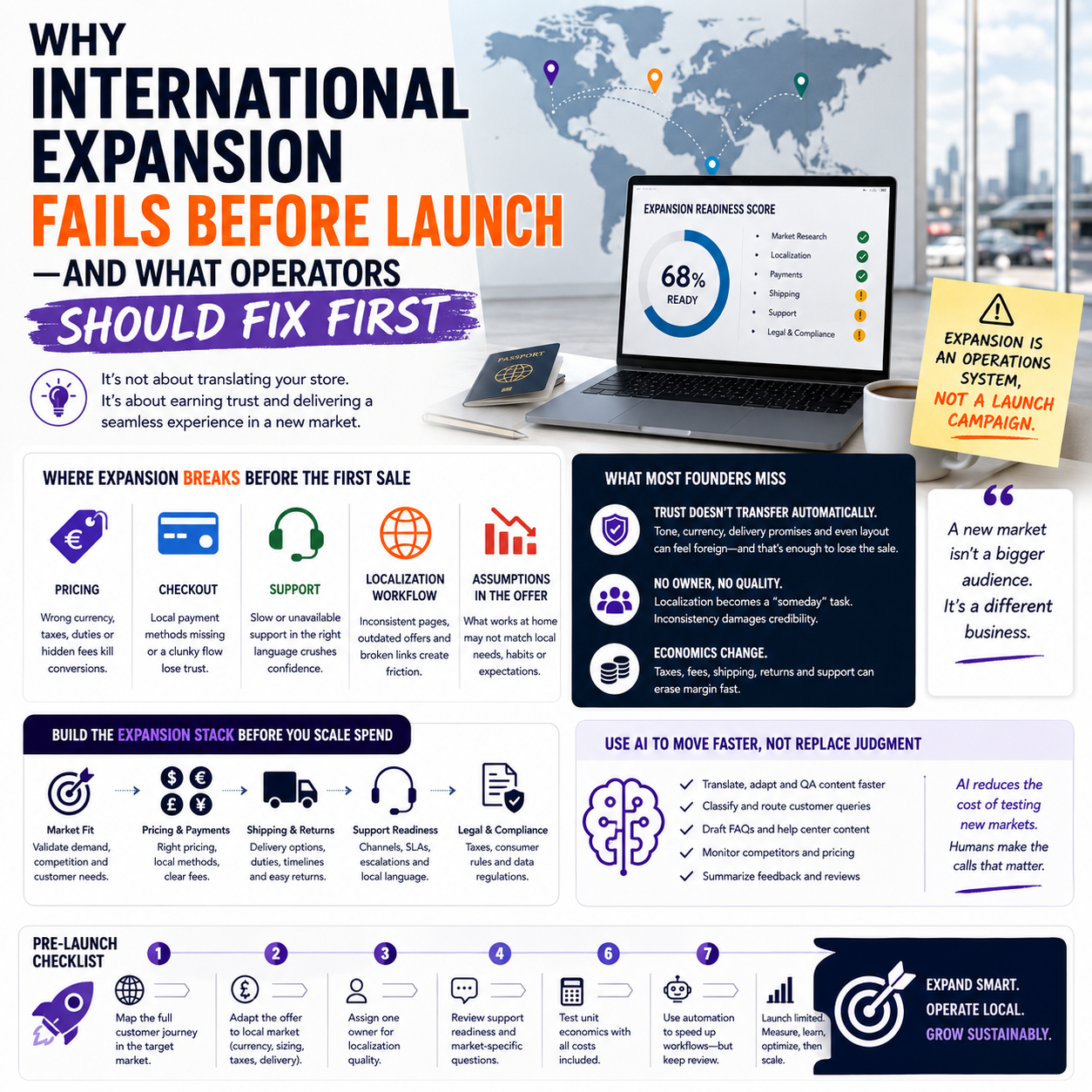
Most founders treat international expansion as a translation job. In practice, the first failures usually happen in pricing, checkout, support, localization workflow, and the assumptions baked into the offer. If you are planning to sell cross-border, the real question is not whether the product can be translated, but whether the business can be understood, trusted, and supported in a new market.
Where expansion breaks before the first sale
The EU-Startups piece on hidden expansion mistakes is useful because it points to a common founder blind spot: teams often launch with a local-market operating model and expect it to work elsewhere. That creates friction in three places. First, the customer-facing layer may look adapted while the purchase path still feels foreign. Second, the internal team may not have the process discipline to localize pages, offers, and support consistently. Third, the economics may collapse once taxes, payment methods, and returns are added.
This is why “launching in another country” is really an operations decision. If the company cannot quote the right price, accept the right payment methods, answer pre-sale questions quickly, and handle post-sale issues in the local language or channel, expansion becomes a conversion problem rather than a growth channel.
What most people miss
The most common mistake is assuming that trust transfers automatically. A brand may work well in one market because customers already know the category, the payment flow, and the service expectations. In a new market, those signals can disappear. Even small mismatches—such as using the wrong tone, missing local currency conventions, or failing to explain duties and delivery times clearly—can reduce trust before the customer ever checks out.
Another overlooked issue is internal ownership. International pages often become a “someone should update that” task. That leads to broken links, outdated offers, inconsistent product names, and support teams who are not prepared for market-specific questions. For operators, the practical lesson is simple: expansion needs a workflow, not just a translation file.
Build the expansion stack before you scale spend
Before putting paid budget behind a new market, founders should build a basic expansion stack. That means deciding who owns localization, what must be translated versus adapted, and how customer questions will be routed. It also means checking whether the e-commerce stack supports multi-currency pricing, local shipping logic, market-specific tax rules, and payment methods that actually close sales in that country.
For many businesses, the highest-leverage improvement is not a bigger ad budget but a cleaner purchase path. If a customer lands on a local page, sees local messaging, but then gets bounced into a checkout that feels generic or expensive, the campaign will underperform no matter how good the targeting is. Expansion should be tested as a system: landing page, offer, checkout, support, and fulfillment.
Use expansion to test market fit, not just geography
The article about startup conditions also matters here because it reminds founders that the current environment rewards efficiency. That changes the logic of expansion. Instead of treating each new country as a broad brand play, operators should use it to validate whether the business model translates with acceptable unit economics. A market that looks attractive on paper may still be bad if customer acquisition costs rise faster than average order value or if returns and support costs wipe out margin.
That means founders should separate “interest” from “profitability.” A market can produce traffic, signups, or even first purchases and still be a weak expansion candidate if shipping, taxes, localized content, and support load are too heavy. The decision is not whether demand exists, but whether the operating model can serve it repeatedly without creating hidden cost leakage.
How AI and automation change the expansion workflow
The current startup environment is also being reshaped by AI tools and faster build cycles. That matters for international expansion because the bottleneck is often not product code; it is the workflow around localization, content review, support triage, and market research. Teams can now automate parts of page translation, customer query classification, FAQ drafting, and competitive monitoring, but automation only helps if someone owns quality control.
Founders should think of AI as a way to reduce the cost of market testing, not as a substitute for market understanding. A machine can help generate localized variants, summarize customer feedback, or flag inconsistent product copy. It cannot tell you whether a customer in a new market expects a different payment method, proof of legitimacy, or delivery promise. Those are business decisions, not text problems.
What to do before you enter a new market
- Map the full customer journey in the target market: landing page, pricing, payment, shipping, support, and returns.
- Check whether the offer needs adaptation, not just translation, including currency, sizing, taxes, and delivery expectations.
- Assign one owner for localization quality so pages, campaigns, and help content stay consistent.
- Review support readiness: channels, response times, escalation rules, and whether the team can handle market-specific questions.
- Test unit economics with the new market included: acquisition cost, payment fees, shipping, returns, and support load.
- Use automation to speed up translation, tagging, and support routing, but keep human review on the highest-risk customer-facing assets.
- Launch with a limited scope first so you can measure conversion, refund behavior, and support volume before scaling spend.