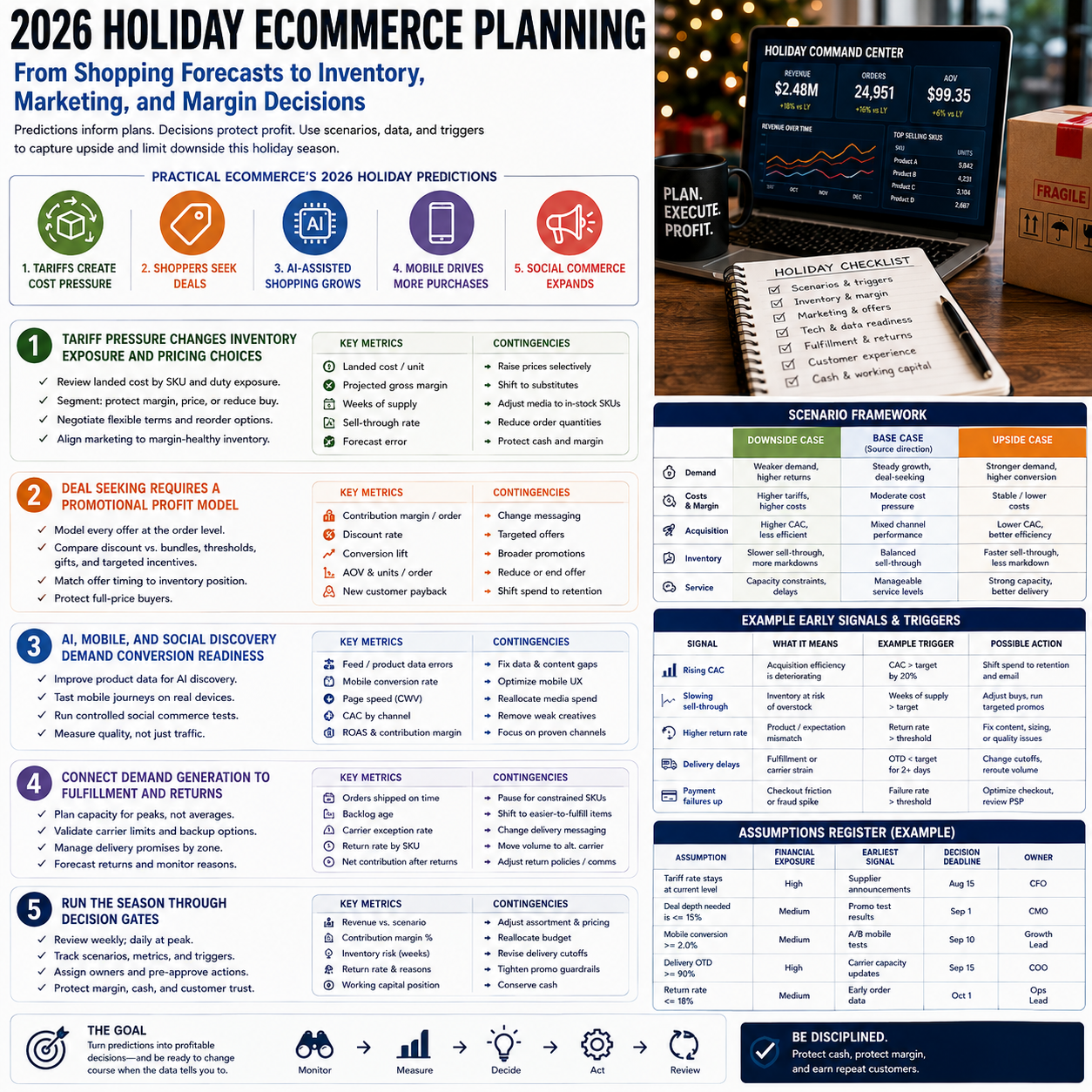
Holiday predictions become useful only when they change a decision. For ecommerce leaders, the practical question is not whether a forecast sounds plausible, but which operating assumption it challenges—and how to limit the downside if it proves wrong.
Practical Ecommerce’s five predictions for 2026 holiday shopping provide planning inputs rather than guaranteed outcomes. Merchants should use them to build scenarios across merchandising, marketing, technology, finance, and operations. The framework below translates the source’s themes—tariff-related pressure, deal-seeking behavior, AI-assisted discovery, mobile purchasing, and social commerce—into actions, metrics, and contingencies without treating any prediction as certain.
Start with scenarios, not a single holiday plan
Create a shared assumptions register before teams lock inventory or campaign budgets. For each prediction, record the affected assumption, its financial exposure, the earliest signal available, the decision deadline, and the executive responsible. This prevents merchandising from planning for premium demand while marketing prepares aggressive discounts and finance assumes stable gross margin.
Use at least three scenarios: a base case reflecting the source’s direction, an upside case in which demand or conversion is stronger, and a downside case involving weaker demand, higher acquisition costs, or deeper promotional pressure. Avoid inventing precision. Scenario ranges should come from the merchant’s own historical performance, current supplier terms, customer behavior, and approved budget.
The most important output is a set of triggers. Examples include slowing sell-through that releases a promotion, rising paid-media costs that move spending toward retention, or carrier constraints that bring forward delivery cutoffs. A trigger converts observation into action while there is still time to protect cash and margin.
Tariff pressure changes inventory exposure and pricing choices
Practical Ecommerce predicts tariffs will affect holiday shopping. The operating assumption at risk is not simply product cost; it is whether the business can preserve acceptable contribution margin while keeping prices competitive and inventory available.
Merchandising and finance should review landed cost by SKU, including duty exposure, freight, handling, and supplier changes. Segment products into items whose margins can absorb higher costs, items that require price adjustments, and items whose purchase quantities should be reduced. Pay particular attention to high-volume products with long lead times: they can create substantial cash exposure before demand is known.
Procurement should examine order flexibility, split shipments, cancellation dates, and opportunities to reorder proven sellers rather than placing one large speculative commitment. Marketing must also know which products have protected margin and reliable supply, because driving demand to constrained or uneconomic inventory wastes acquisition spend.
Track projected gross margin by SKU, open purchase-order value, weeks of supply, sell-through, and forecast error. Establish contingencies before inventory arrives: substitute products, bundles built around healthier-margin items, selective price changes, and rules for reducing media support. Do not answer cost pressure with blanket discounting; that can compound margin loss on products already affected by higher landed costs.
Deal seeking requires a promotional profit model
The source expects shoppers to seek deals. That prediction affects assumptions about promotional timing, customer response, and the amount of discount required to convert demand. It does not automatically justify earlier or deeper promotions.
Finance, merchandising, and growth teams should model each proposed offer at the order level. Include selling price, product cost, fulfillment expense, payment fees, expected returns, and acquisition cost. Compare a percentage discount with alternatives such as threshold offers, bundles, gifts, or targeted incentives. The best promotion is the one that changes customer behavior without subsidizing purchases that would have occurred anyway.
Use inventory position to determine timing. Slow-moving seasonal stock may warrant an earlier intervention, while scarce or high-converting products should not receive automatic discounts. Separate acquisition offers from retention offers and protect customers likely to buy at full price from unnecessary incentives.
Monitor contribution margin per order, discount rate, units per transaction, average order value, conversion lift, and new-customer payback. Set stop-loss rules for promotions that create revenue but fail to produce acceptable contribution. A useful contingency ladder moves from message changes to targeted offers, then broader discounts only when inventory risk warrants the sacrifice.
AI, mobile, and social discovery demand conversion readiness
Practical Ecommerce’s predictions about AI-assisted shopping, mobile commerce, and social commerce all challenge the same underlying assumption: that shoppers will begin and complete their journeys through channels merchants already understand. The response should be better product data and fewer conversion obstacles—not indiscriminate spending on every emerging surface.
For AI-mediated discovery, commerce and content teams should audit whether product information is accurate, structured, specific, and consistent. Titles, attributes, availability, pricing, variant information, shipping terms, and return policies should agree across the site and feeds. Unsupported claims or stale stock data can undermine both discovery and customer trust. Measure feed errors, product-page engagement, assisted conversions where attribution permits, and traffic quality rather than relying only on last-click revenue.
Mobile readiness requires testing real purchasing journeys on common devices and network conditions. Review page speed, navigation, search, filters, address entry, payment options, coupon behavior, and error recovery. Test promotional peaks before campaigns launch, including checkout, inventory reservation, tax calculation, and order-confirmation systems. Track mobile conversion, checkout abandonment, payment failure, page performance, and customer-service contacts associated with purchase friction.
For social commerce, distinguish discovery from profitable acquisition. Allocate controlled test budgets by platform, product, creative, and audience; reconcile platform reporting with completed orders and contribution margin. Ensure that advertised availability, prices, and delivery expectations match the destination experience. If acquisition cost or return rates exceed approved limits, redirect budget toward proven search, email, affiliates, or customer retention rather than preserving channel spend for its own sake.
Connect demand generation to fulfillment and returns
A forecast-driven campaign can succeed in generating orders and still fail economically if warehouses, carriers, support teams, or reverse-logistics processes cannot handle the volume. Marketing calendars therefore need operational sign-off.
Operations should translate each campaign into expected order lines, product mix, picking complexity, packaging needs, and dispatch deadlines. Capacity planning should account for peaks rather than averages. Review staffing, overtime authorization, carrier collection limits, backup services, packaging inventory, and the last date on which delivery promises can be changed safely.
Track orders released versus shipped, backlog age, pick accuracy, cost per shipment, on-time dispatch, carrier exceptions, cancellations, and support volume. Predefine responses such as pausing campaigns for constrained SKUs, shifting promotion toward easier-to-fulfill products, changing delivery messaging, or moving volume to an alternate carrier.
Returns require equal attention because holiday revenue is not final revenue. Identify products with historically high return rates, verify sizing and compatibility information, and make policies visible before checkout. Forecast reverse-logistics workload using internal history rather than unsupported market averages. Monitor return rate by SKU and acquisition channel, refund cycle time, disposition recovery, and net contribution after returns. Social or paid campaigns that appear successful may be uneconomic once returns are included.
Run the season through decision gates
Convert the plan into weekly decision gates, moving to daily reviews during peak periods. Each meeting should answer five questions: Has demand shifted materially from the approved scenario? Which inventory is becoming scarce or exposed? Are campaigns meeting contribution thresholds? Can fulfillment still support advertised promises? What return or service signals indicate a product-quality or expectation problem?
Assign one owner to every trigger and document the permitted response in advance. Merchandising may adjust product exposure, growth may reallocate spend, operations may revise cutoffs, and finance may block promotions that breach margin floors. This operating rhythm is more valuable than repeatedly debating whether a prediction was “right.”
Before committing the next dollar or purchase order, ecommerce leaders should be able to identify the prediction behind the assumption, the metric that will test it, the date at which action becomes necessary, and the contingency already approved. That is how a holiday forecast becomes a controlled plan rather than a seasonal bet.