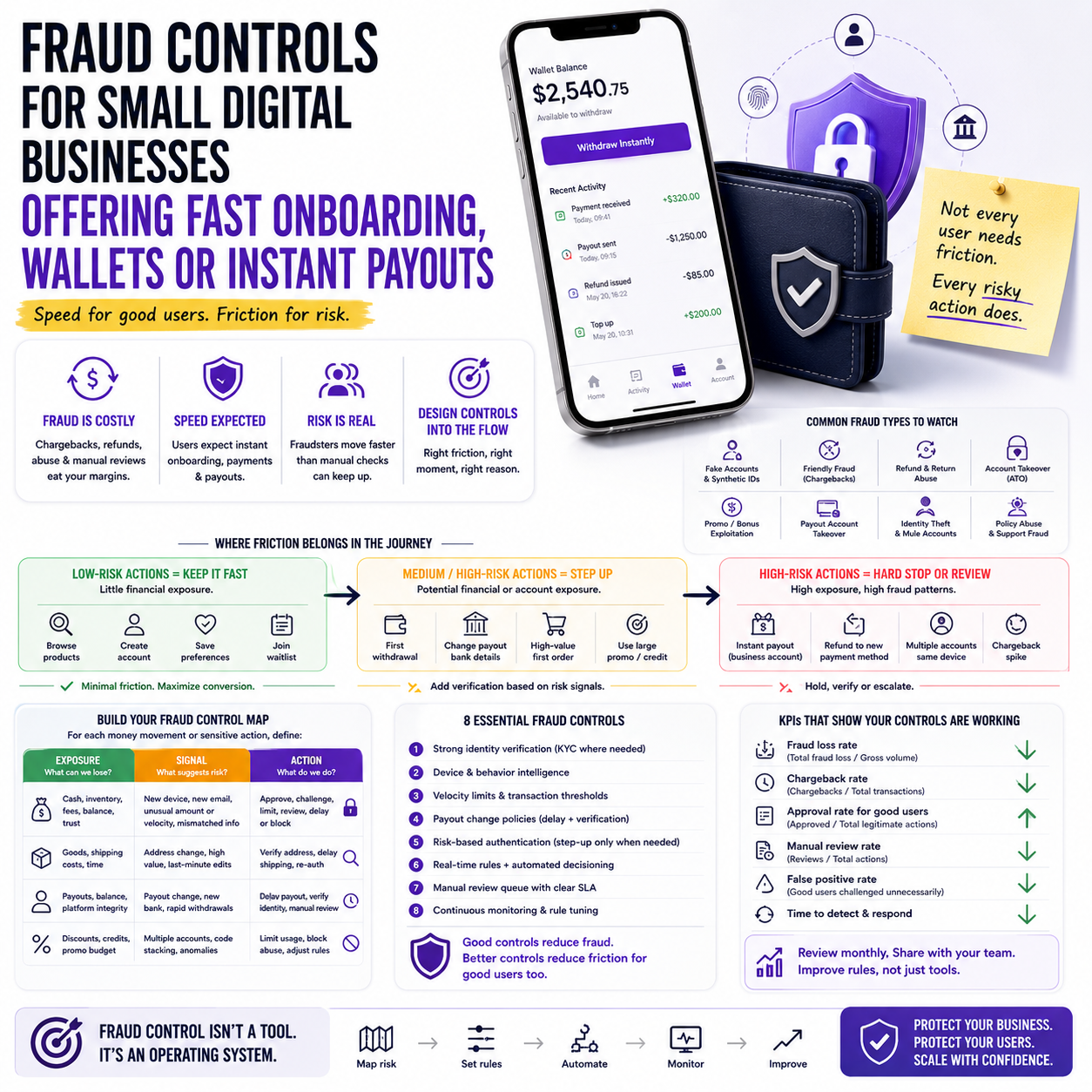
Fast onboarding, instant payouts and low-friction payments are now expected in many digital products. The operational problem is that the same speed customers value also gives fraudsters less time to be stopped. For a small fintech, marketplace, subscription platform or e-commerce operator, the real decision is not whether to add fraud checks, but where to place friction without damaging legitimate conversion.
Recent reporting on fraud pressure in European fintech and the growth of cloud-native payment processing points to the same operating reality: payments are becoming faster, more modular and more automated. That helps small teams move quickly, but it also means fraud control has to be designed as part of the workflow, not added later as a manual review queue that nobody owns.
The operator problem: speed changes the fraud budget
A small digital business usually starts by optimising for fewer abandoned sign-ups, faster account activation and smoother payments. That makes sense when the business is still trying to prove demand. But once money starts moving through the product, every extra second saved in onboarding or payout release becomes a risk decision.
The issue is not only stolen cards or fake accounts. For businesses that allow stored balances, creator payouts, marketplace withdrawals, wallet transfers, refunds, account credits or high-speed fulfilment, fraud can appear as a process failure. A fraudster may exploit weak identity checks, mismatched payout details, refund rules, voucher systems, affiliate incentives, chargeback windows or support agents under pressure to resolve tickets quickly.
Small teams often underprice this risk because fraud losses are spread across different lines of the business. Chargebacks sit with payments. Refund abuse sits with support. Fake account incentives sit with growth. Manual review time sits with operations. Payment provider fees sit with finance. When these costs are not reviewed together, the founder sees a conversion problem, not a margin leak.
The first practical change is to treat fraud as an operating cost tied to speed. Faster flows are not bad, but each fast path should have a defined control, owner and escalation rule.
Where friction belongs in a fast-payment workflow
Fraud prevention is often framed as a choice between smooth customer experience and strict verification. That is too simple for an operator. The useful question is: which actions deserve friction, and which actions can stay fast?
A small business should not add the same verification step to every user action. That creates unnecessary drop-off and trains the team to remove controls later. Instead, divide the customer journey into risk zones.
Low-risk actions that should remain fast
Browsing, creating a basic account, saving preferences, joining a waitlist, adding a product to cart, starting a quote request or subscribing to a newsletter usually do not need heavy verification. These actions create little direct financial exposure. Adding complex checks here may reduce conversion without reducing meaningful loss.
High-risk actions that need conditional friction
The control point should move closer to financial exposure. Examples include first withdrawal, changing payout bank details, requesting a refund to a different payment method, redeeming large credits, placing an unusually high-value first order, using multiple discount codes across accounts, changing delivery address after payment, or triggering same-day fulfilment on a new account.
This is where step-up verification makes sense. A user can move normally until a risky action appears. Then the business can request additional confirmation, delay payout, ask for identity verification, require payment method re-authentication, or route the event to manual review.
A practical fraud map for small teams
Before buying more tools, map the money paths. A fraud map does not need to be complicated. It should show where value is created, moved, refunded, withdrawn or converted into goods.
For an e-commerce seller, the map might include payment authorisation, discount application, fulfilment release, address change, refund approval and chargeback response. For a marketplace, it may include seller onboarding, buyer payment, seller payout, dispute handling, refund rules and account suspension. For a SaaS platform with usage credits, it may include trial creation, credit allocation, payment upgrade, cancellation, refund request and API usage spikes.
Each point should have three labels: exposure, signal and action.
- Exposure: What can the business lose at this step? Cash, inventory, service time, advertising budget, partner trust, account balance or processor standing.
- Signal: What data suggests risk? Device mismatch, repeated cards, new email domain, unusual order size, address changes, payout account changes, refund frequency, support pressure or velocity across accounts.
- Action: What happens automatically? Approve, delay, request verification, limit value, queue review, block, or escalate.
This map becomes the basis for tool selection. Without it, a business may buy an identity tool when the real loss is refund abuse, or install a chargeback product when the real weakness is payout account changes.
What most people miss
The expensive fraud events are often not the first fraudulent action. They are the second or third action after a harmless-looking account has been allowed to build trust inside the system.
A new seller on a marketplace may pass basic onboarding, complete a few small orders, then request faster payouts. A customer may buy normally once, then use support to redirect delivery. A user may verify an account, then later change the payout destination. A fraudster may exploit promotional credit not by stealing one large amount, but by creating many small accounts that stay below review thresholds.
This is why static approval at sign-up is not enough. Small operators need event-based controls. The account can be trusted for low-value activity but challenged when behaviour changes. This is more useful than treating verification as a one-time gate.
The missed cost is staff time. If the team relies on manual review without rules, support and operations become the fraud engine. They spend time interpreting edge cases, arguing with customers, checking spreadsheets, asking founders for approval and reversing decisions. That time rarely appears in fraud reports, but it slows fulfilment, customer support and finance reconciliation.
Build controls around business actions, not around fear
A workable system for a small team should be built around a few business actions that create loss. Start with five to seven actions, not fifty rules.
For many digital operators, the first control set should include:
- First payout or withdrawal from a new account.
- Change of payout bank account, wallet address or payment destination.
- Refund request above a defined value or outside the normal refund path.
- High-value first order or unusually fast repeat orders.
- Multiple accounts using shared device, card, delivery address or payout details.
- Manual support request that changes money movement, fulfilment or account ownership.
- Promotional credit redemption that exceeds the normal customer pattern.
Each action should have a default response. For example, a first payout may be delayed until the delivery or service milestone is confirmed. A payout detail change may freeze withdrawals for a short review window. A refund to a different payment method may require manager approval. A high-value first order may require address validation before fulfilment.
The point is not to block more customers. The point is to stop treating every risky exception as a new conversation.
The tool stack should match the loss pattern
Small businesses can waste money by buying fraud tools before knowing the pattern of loss. A payment processor’s built-in risk controls may be enough for a basic store, but not enough for a marketplace with seller payouts. An identity verification tool may reduce fake accounts but will not solve refund abuse if support agents can override the process. A chargeback management tool may help with disputes but will not prevent inventory from leaving the warehouse too quickly.
A practical stack can be layered:
- Payment-level controls: processor risk settings, 3D Secure where appropriate, velocity limits, card checks and chargeback monitoring.
- Account-level controls: email, phone, device, IP, account age, login pattern and repeated identity signals.
- Transaction-level controls: order value, SKU risk, address mismatch, refund history, coupon use and shipping speed.
- Payout-level controls: beneficiary verification, payout delay, bank account change rules and withdrawal limits.
- Support-level controls: restricted agent permissions, approval workflows and logs for money-related overrides.
Automation should handle repeatable decisions. Humans should handle judgement calls where the data is incomplete, the customer value is high or the account has a complex history. The mistake is using humans as the first filter for every suspicious event. That creates slow reviews and inconsistent outcomes.
Cost decisions: what to measure before adding more checks
Fraud prevention has a cost even when it works. It may reduce conversion, delay payouts, create support tickets, add tool subscriptions or require manual review. The founder’s job is to compare that cost against actual loss and operational drag.
Track the numbers in a simple monthly view. Do not wait for a complex risk dashboard. A spreadsheet or lightweight business intelligence view is enough if the definitions are clear.
- Gross fraud loss: confirmed losses from chargebacks, unrecovered refunds, unpaid balances, stolen inventory or payout abuse.
- Manual review volume: number of cases reviewed and average time per case.
- False positive rate: legitimate customers delayed or blocked by fraud controls.
- Payout delay exceptions: how often payouts are held and why.
- Refund exception rate: refunds that required approval outside the normal process.
- Chargeback ratio by product, channel or country: useful for spotting where the risk is coming from.
- Support override count: how often agents change payment, delivery, refund or account details.
The aim is not to eliminate every loss. That may be too expensive. The better goal is to know which losses are acceptable, which are increasing and which are caused by a design flaw that can be fixed once.
A realistic scenario: the fast payout trap
Consider a small marketplace that connects buyers with digital service providers. To attract suppliers, it offers fast payouts after an order is marked complete. At first, this improves seller acquisition. Then disputes rise. Some seller accounts complete low-value jobs, build a short history, switch payout details and push several larger orders through quickly. Buyers complain after payouts have already been released.
The wrong response is to manually review every seller payout. That would slow the marketplace and increase staff work. A better response is to separate payout speed by risk state.
New sellers can receive standard payouts after a waiting period. Sellers with stable history, consistent buyer feedback and unchanged payout details can qualify for faster payouts. Any change to payout destination resets the payout speed temporarily. High-value orders from new buyers or newly changed seller accounts move into review. Support agents cannot approve faster release without a logged reason and manager permission.
This approach keeps the product attractive for legitimate sellers while making the most exploitable path slower. It also gives the team a way to explain decisions internally: payout speed is earned by account behaviour, not granted permanently.
Implementation sequence for the next 30 days
Start with the money path, not the software. The following rollout is suitable for a small team that cannot dedicate a full risk department to the problem.
- Days 1-3: List every action where money, inventory, credit, access or payout value leaves the business. Include support overrides and manual exceptions.
- Days 4-7: Pull the last three months of chargebacks, suspicious refunds, payout disputes, blocked orders and support escalations. Group them by failure point rather than by customer complaint wording.
- Days 8-12: Choose the five highest-risk actions. Write one default rule for each: approve, delay, verify, review, limit or block.
- Days 13-18: Add event triggers in the tools already used: payment processor, Shopify or WooCommerce settings, marketplace admin, CRM, helpdesk, automation tool or internal database.
- Days 19-23: Restrict support permissions for money-related changes. Create approval paths for refund method changes, payout detail changes, address changes after payment and account ownership changes.
- Days 24-27: Create a weekly fraud operations view with losses, review volume, false positives, payout holds and support overrides.
- Days 28-30: Review the first results and remove any rule that creates friction without catching meaningful risk. Tighten the rules that catch repeat patterns.
The most useful fraud system for a small operator is not the harshest one. It is the one that makes risky money movement visible, slows down the few actions that create real exposure and gives the team rules they can run without asking the founder every time.