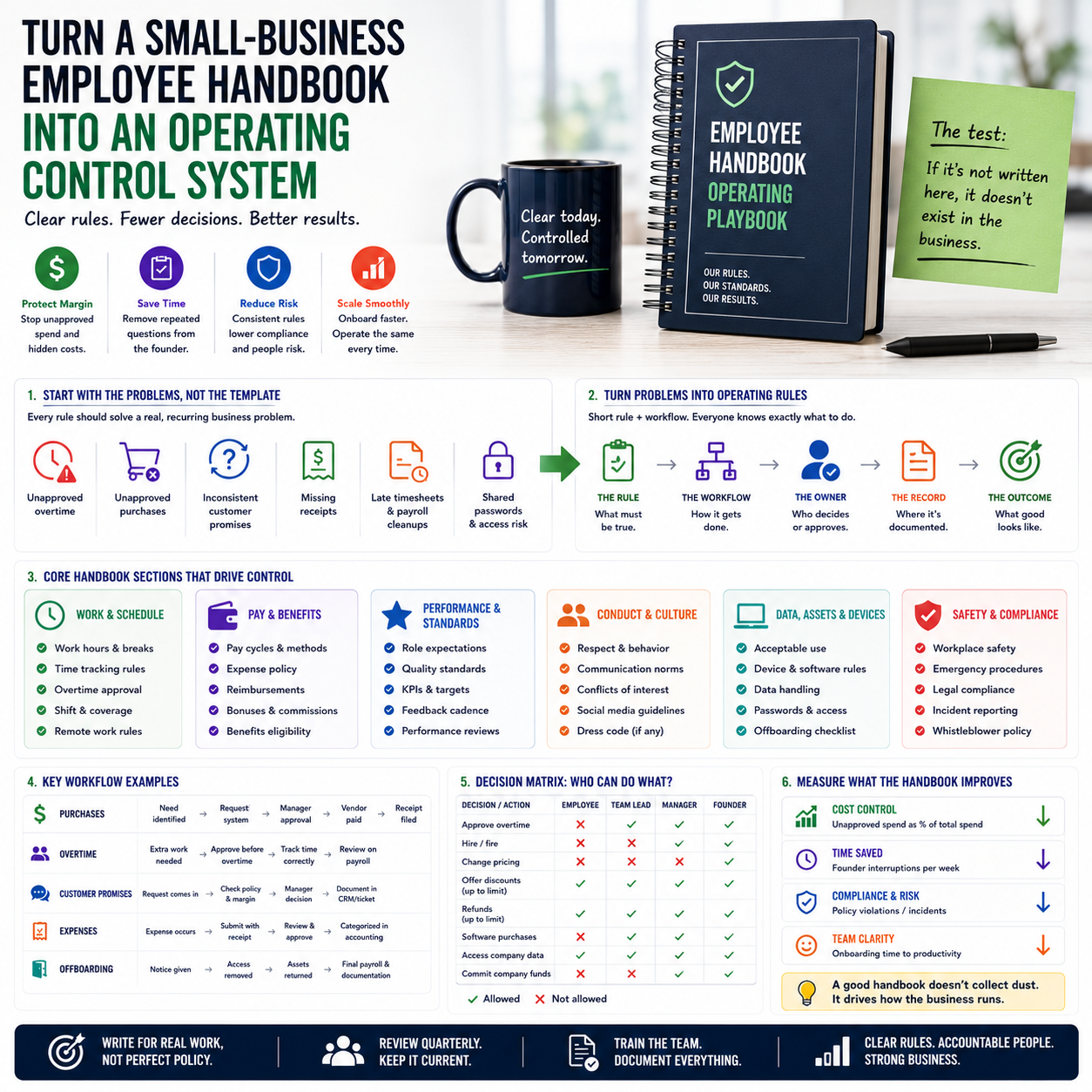
A small-business employee handbook is usually treated as an HR document. That is why many of them sit unread after onboarding. For a small team manager or founder, the better use is operational: the handbook should define who can approve what, how work is recorded, where exceptions go, and which behaviours create cost, compliance or customer risk.
This article is for owners and operators with a growing team, especially service businesses, e-commerce teams, agencies, local operators and small digital companies where informal rules have started to break down. The goal is not to create a polished policy booklet. The goal is to remove repeated decisions from the founder’s desk.
The handbook becomes useful when it controls recurring decisions
Most small companies do not need more documentation. They need fewer interruptions, fewer inconsistent approvals and fewer payroll clean-up sessions. A handbook is worth building only if it changes how common decisions are made.
The Small Business Trends article on employee handbook components points to familiar sections such as workplace policies, compensation, benefits, leave, conduct and safety. Those categories are useful, but the operator question is sharper: which of these sections prevents a recurring business problem?
For example, a leave policy is not just about employee rights. It affects shift coverage, order cut-off times, customer support queues and the owner’s weekend workload. A device policy is not just about acceptable use. It affects password exposure, customer data, replacement costs and access removal when someone leaves. A timekeeping policy is not just payroll administration. It determines whether job costing, project margins and staffing plans are based on real labour input or guesswork.
The handbook should therefore be written around repeatable operating decisions:
- Who approves overtime before it happens?
- Who can promise a customer an exception?
- Which expenses need approval before purchase?
- Where is work time recorded, and by when?
- Which systems must be updated before an order, project or ticket is considered complete?
- What happens when an employee cannot follow the normal workflow?
If a section does not clarify one of those decisions, it may still be legally or culturally useful, but it is not yet carrying operational weight.
Map policies to cost leakage, not to document categories
A common mistake is to start with a template and fill every section evenly. That produces a handbook that looks complete but does not match the actual risk profile of the business. A small e-commerce brand with warehouse assistants has different leakage points from a digital agency with remote contractors. A local service business with field staff has different risks again.
Start with the places where unclear rules already cost money or time. For many small businesses, the list is not abstract:
- Unapproved overtime because staff stay late without a manager deciding whether the extra labour is justified.
- Refunds or discounts promised by employees without a margin rule.
- Software subscriptions purchased on personal cards and reimbursed without owner visibility.
- Late timesheets that force payroll corrections.
- Customer messages handled outside the CRM, leaving no record for the next employee.
- Shared passwords that remain active after someone leaves.
Each of these belongs in a handbook, but not as a long lecture. The useful version is a short rule plus the workflow. For instance, instead of writing, “Employees must follow the company’s overtime policy,” write the operating rule: “Overtime must be approved in the scheduling tool before the shift is extended. If approval is not recorded, the manager must review the exception before payroll is submitted.”
This turns the handbook into a control layer between everyday work and financial outcomes. The founder is no longer relying on memory, goodwill or Slack history to work out whether a cost was authorised.
The finance connection: why HR rules affect the chart of accounts
The candidate article on essential accounts in accounting is about financial reporting, but it connects directly to handbook design. If employee behaviour creates costs, those costs need to land in the right accounts and be reviewed in the right cadence. Otherwise, the handbook and the accounts operate as separate worlds.
Consider a small business that wants to understand labour cost by function. If employees do not record time consistently, payroll becomes a single expense block. The owner can see total wages, but cannot see whether support, fulfilment, sales admin or project delivery is absorbing the margin. That makes pricing and staffing decisions weaker.
The handbook can support accounting discipline by defining the behaviour that creates clean data. It should say where time is logged, which job or department codes must be used, how expenses are categorised, and when supporting receipts or notes are required. This is not finance bureaucracy. It is the operating input that makes management accounts useful.
For small businesses using tools such as Xero, QuickBooks, Zoho Books, Sage, Shopify reports, POS exports, time-tracking apps or payroll systems, the same principle applies: the policy must match the data structure. If the accounts separate software, contractor labour, advertising, refunds, travel and payroll taxes, then employee workflows should not blur those costs at the point of entry.
What most people miss
The handbook is often written after a problem, but the system fields are often left unchanged. A policy says “all expenses require approval,” yet employees still have no approval field in the expense app. A policy says “customer refunds must follow the refund matrix,” yet Shopify, WooCommerce, Stripe or the helpdesk still allows too many people to issue refunds without a reason code. A policy says “remote work requires manager approval,” yet the calendar, HR system and payroll notes are not connected.
This is where small companies lose the value of documentation. The handbook says one thing, the workflow allows another, and the founder becomes the manual integration point. A useful handbook should trigger tool changes: permission levels, required fields, approval routes, notification rules and reporting views.
Write policies as workflows employees can actually follow
A policy that depends on interpretation will be interpreted differently by every manager. A better approach is to write the section as a lightweight workflow. The format can be simple: trigger, required action, system of record, approver, deadline and exception path.
Take expenses. A weak rule says employees should keep spending reasonable. A useful rule defines the workflow:
- Trigger: an employee needs to buy something for work.
- Required action: submit the item, supplier, cost and business reason before purchase if it is above the internal threshold.
- System of record: expense app, accounting inbox or shared approval form.
- Approver: direct manager for routine items; owner for subscriptions or recurring commitments.
- Deadline: receipt uploaded within a defined number of business days.
- Exception path: urgent purchases are flagged after purchase with a reason and reviewed weekly.
The exact threshold depends on the business, currency, margins and trust model. The point is not the number. The point is that the handbook prevents accidental recurring costs and gives accounting a clean trail.
The same structure works for leave, shift swaps, remote work, customer discounts, software access, equipment, overtime, complaints, data handling and termination handovers. The more operational the business, the more valuable this format becomes.
Where automation belongs, and where a manager must stay involved
Small businesses often automate too late or automate the wrong layer. A handbook can help decide which decisions should be automated and which should remain human.
Automate routine routing and evidence capture. That includes reminders for missing timesheets, approval requests for expenses, notifications when leave overlaps, access removal checklists, onboarding tasks, receipt collection, policy acknowledgement and recurring compliance refreshers. These do not require managerial judgment every time; they require consistency.
Keep human review for decisions that change cost, risk or customer commitments. Overtime approval, refund exceptions, disciplinary issues, role changes, data access for sensitive systems, commission disputes and performance concerns should not be hidden inside automation. The workflow can collect information, but a manager should still own the decision.
For a small digital operator, this may mean connecting the handbook to tools already in use rather than buying an HR suite immediately. Examples include:
- Google Workspace or Microsoft 365 for policy access and version control.
- Notion, Confluence or an internal wiki for searchable procedures.
- Trello, Asana, ClickUp or Monday.com for onboarding and offboarding checklists.
- Slack or Teams for automated reminders, not policy storage.
- Payroll or time-tracking software as the system of record for hours.
- Accounting software for expense categorisation and approval evidence.
- Password managers and device-management tools for access control.
The handbook should name the system of record for each process. If employees have to guess whether the official instruction is in an old email, chat thread, spreadsheet or PDF, the document will fail operationally.
A practical scenario: the founder who is still the approval engine
Imagine a small online retailer with a founder, two customer support staff, a part-time fulfilment assistant and a freelance marketer. The business has grown beyond improvisation, but not enough to justify a full HR department. The founder still approves refunds in chat, answers questions about shift swaps, checks software invoices and resolves payroll questions at month-end.
The first version of the handbook should not try to cover every possible employment issue in detail. It should attack the founder’s recurring decision load. The highest-value sections might be:
- Refund and discount authority: which customer issues support can resolve alone, which need approval, and where the reason is logged.
- Timekeeping and fulfilment cut-off: when hours are recorded, how late shifts are approved, and how overtime is reviewed.
- Software and subscription control: who may start a trial, who may convert it to a paid plan, and how recurring costs are recorded.
- Customer data and access: which systems require individual logins, how passwords are stored, and what happens during offboarding.
- Leave and coverage: how leave requests are submitted, what notice is expected, and who checks order-volume risk before approval.
That handbook is not merely an employee document. It becomes a way to protect gross margin, reduce avoidable refunds, avoid subscription sprawl and keep customer operations traceable.
What to measure after rollout
The handbook has worked if the operating metrics move in the right direction. Do not measure success by whether the PDF exists. Measure whether fewer exceptions reach the founder and whether the data becomes cleaner.
Useful metrics include the number of payroll corrections per cycle, unapproved overtime incidents, refunds issued without reason codes, software subscriptions without named owners, late expense submissions, missing receipts, unresolved access removal tasks after departures, and repeated questions already answered by a policy. These metrics do not need a complex dashboard at first. A monthly review in a spreadsheet is enough if the owner acts on the pattern.
The implementation risk: copying a template without changing the business
A free employee handbook template can be useful as a starting point, but the risk is that it creates false confidence. A template will not know which employee can issue a refund, which warehouse task blocks dispatch, which sales promise hurts margin, which accounting categories the owner tracks, or which software systems contain customer data.
The operator should treat a template as a checklist of areas to consider, not as the finished system. Each section needs to be localised to the actual business model, tools and decision rights. For regulated employment, legal review may be appropriate depending on jurisdiction and employee type. But even then, the operational layer still has to be designed by the business.
There is also a tone risk. Small-business handbooks often swing between two bad options: too casual to be useful or too legalistic to be read. The best version is plain, specific and enforceable. Employees should be able to tell what they are expected to do on Monday morning, not just understand the company’s values in theory.
Build the handbook in this order
The rollout should start with the areas where unclear decisions already create cost, rework or risk. A complete handbook that takes three months to write may be less useful than five high-control sections implemented properly this week.
- List the recurring interruptions. Review the last month of founder or manager questions: approvals, exceptions, payroll fixes, customer promises, tool access and missing information.
- Pick five control points. Choose the policies most connected to money, customer risk, employee scheduling, data access or accounting accuracy.
- Define the workflow behind each rule. For every policy, specify the trigger, action, approver, system of record, deadline and exception route.
- Match each policy to a tool setting. Add required fields, approval routes, access permissions, templates or reminders so the workflow does not depend on memory.
- Assign an owner. Every policy needs someone who keeps it updated when tools, roles or business rules change.
- Publish in a searchable place. Use a shared workspace, internal wiki or HR system rather than a buried attachment.
- Require acknowledgement only after training. Employees should not simply tick a box. Walk through the workflows that affect their role.
- Review exception logs monthly. If the same exception appears repeatedly, either the policy is unclear, the tool setup is wrong, or the business rule needs changing.
The final test is simple: when an employee faces a routine decision, the handbook should tell them what to do, where to record it, who approves it and what happens if the normal path does not fit. If it cannot do that, it is still a document rather than an operating control system.