AI agents are moving from demos to real workflows, and that changes more than the software stack. If agents start acting across the open internet, businesses will need a way to identify which systems are legitimate, what they are allowed to do, and how to manage the risk when they touch customer data or external services.
The reason this matters is operational, not philosophical. Once an agent can browse, buy, post, submit forms, or negotiate on behalf of a company, identity becomes part of cost control, security, and liability.
Why agent identity is becoming a business problem
Vint Cerf’s work on identifying AI agents points to a practical gap: humans already have decades of login, authorization, and fraud controls, but autonomous software does not fit neatly into those systems. For small and midsize businesses, that gap shows up when an AI tool is asked to do something outside a sandbox, such as contacting suppliers, handling support requests, or interacting with public websites.
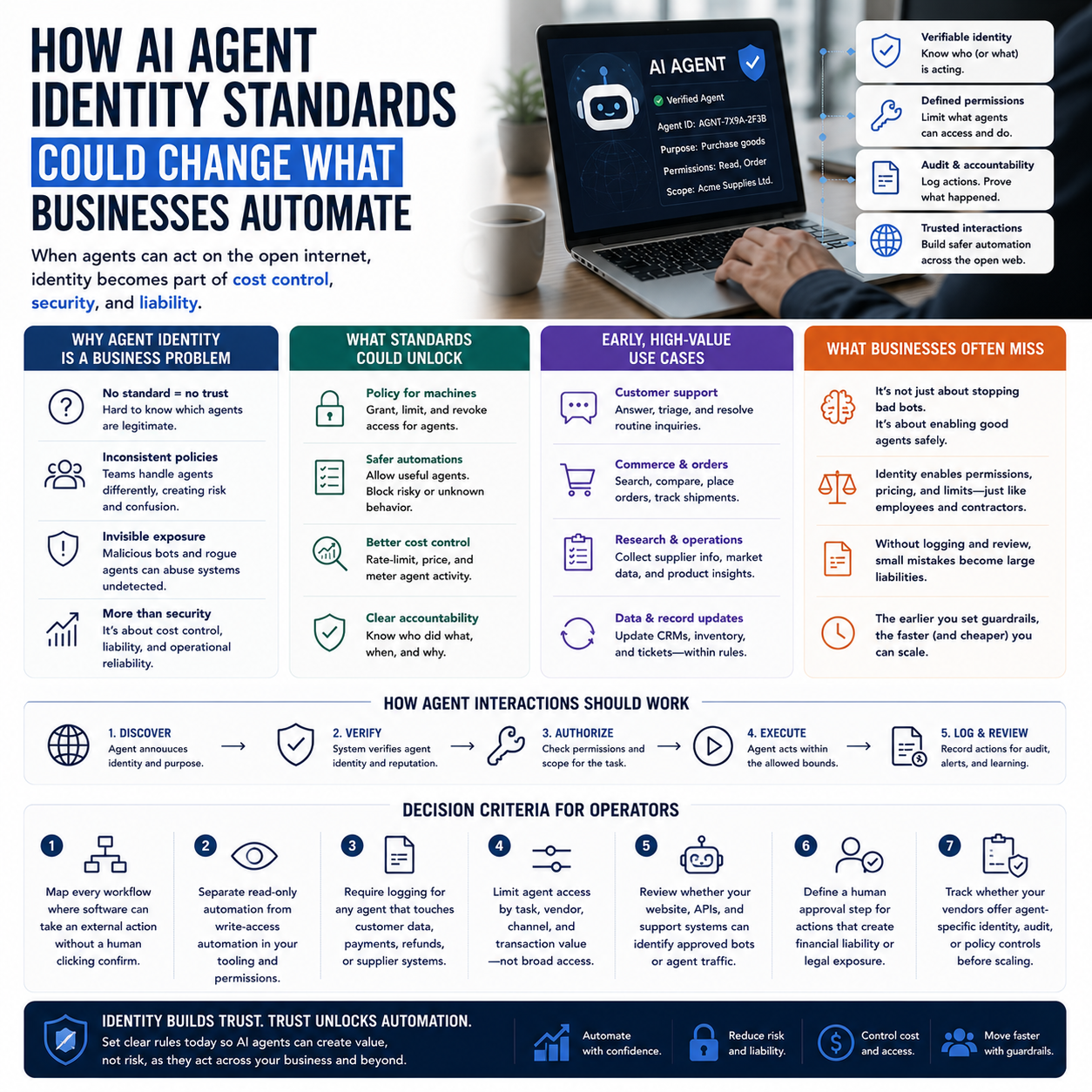
Without a standard way to recognize agents, every business will end up making its own trust decisions. That creates inconsistency. One team may allow an agent to place low-value orders, another may block the same tool entirely, and a third may unknowingly expose its site to automated abuse because it cannot tell a helpful bot from a malicious one.
What a standard could change in day-to-day operations
If agent identity becomes standardized, operators will be able to define policies around machines, not just people. That means a company could grant a purchasing agent access to specific vendors, limit a support agent to a narrow set of actions, or require extra verification when an agent tries to initiate payments.
For e-commerce teams, this is especially relevant. AI agents may eventually interact with storefronts, product feeds, returns systems, and customer communication tools. If the internet develops clearer rules for identifying these agents, merchants can make better decisions about which automated interactions to allow, which to rate-limit, and which to treat as suspicious traffic.
What most people miss
The real value of agent identity is not just stopping bad bots. It is giving businesses a way to price, log, and limit automated action the same way they already do with employees and contractors. Once an agent can be identified consistently, it becomes easier to assign permissions, audit actions, and prove who or what initiated a transaction.
Where the first useful use cases will show up
The earliest business value will likely come from narrow, high-frequency workflows. Think of customer support agents that answer routine questions, internal research agents that gather supplier data, or commerce agents that fill in order forms and update records. These are not fully autonomous business replacements. They are workflow accelerators that still need guardrails.
That is why identity matters. A company does not need a universal AI treaty to get value from automation. It needs enough trust infrastructure to separate approved agents from unknown traffic, and enough logging to review what happened when something goes wrong.
In practice, this could affect how businesses design approval flows. A founder may decide that an AI agent can draft a refund but not issue it, can prepare a vendor purchase but not send payment, or can scrape product data but not publish changes without review. The more agent activity expands, the more these boundaries need to be documented.
What founders should do now
Most small businesses do not need to rebuild their systems today. They do need to prepare for the fact that AI tools will increasingly act as participants in external workflows, not just internal assistants. That means procurement, security, legal review, and operations should stop treating automation as a single software purchase and start treating it as a permissions model.
If you run an e-commerce store or service business, ask where an AI agent would create the most exposure. The answer is usually anywhere money, customer data, or external platforms are involved. Those are the workflows that should be documented first, even if the automation itself comes later.
Decision criteria for operators
- Map every workflow where software can take an external action without a human clicking confirm.
- Separate read-only automation from write-access automation in your tooling and permissions.
- Require logging for any agent that touches customer data, payments, refunds, or supplier systems.
- Limit agent access by task, vendor, channel, and transaction value instead of giving broad account permissions.
- Review whether your website, APIs, and support systems can identify approved bots or agent traffic.
- Define a human approval step for actions that create financial liability or legal exposure.
- Track whether your current vendors offer agent-specific identity, audit, or policy controls before expanding automation.