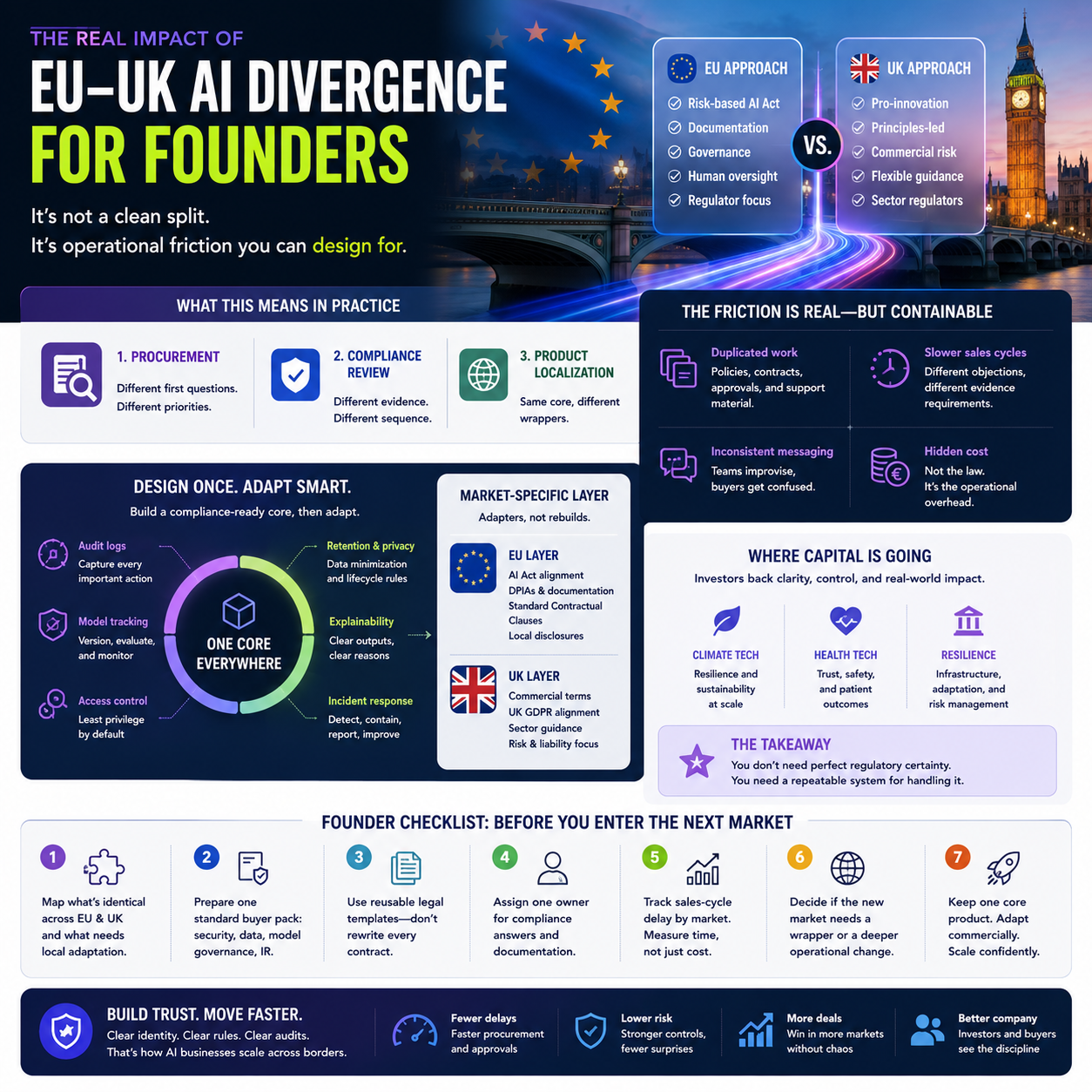
Founders building AI products across Europe keep hearing the same warning: the EU and UK are diverging, so expansion is becoming harder. The practical question is less dramatic and more useful: where does this actually change your operating model, compliance burden, and launch sequence?
The answer is not to freeze. It is to separate product design from market entry, then decide which rules apply to which version of your business.
Why this topic matters for operators
The strongest signal in the candidate set is not just policy drift. It is the combination of a broader debate around EU-level company formation and the separate reality that AI companies still have to navigate different regulatory interpretations, product expectations, and commercial norms on each side of the Channel. For a founder, that means the question is not “EU or UK?” in the abstract. The real question is whether your stack, your contracts, and your go-to-market process can handle two operating environments without doubling your overhead.
The EU conversation around a single incorporation regime, often framed as EU Inc., points to the value of reducing friction. But the AI-specific issue is more immediate: if your product touches regulated sectors, personal data, model risk, or automated decision-making, you need a structure that can absorb different compliance paths without forcing a full rebuild each time you enter a new market.
What changed for AI founders
The article on EU-UK AI divergence argues that the fear of a clean split is overstated. That does not mean there is no friction. It means the friction is uneven. The practical difference usually shows up in three places: procurement, compliance review, and product localization.
For example, a founder selling an AI workflow tool to mid-market firms may find that UK buyers care most about commercial risk, contractual liability, and data handling terms, while EU buyers may ask earlier questions about model governance, lawful basis, and documentation. Neither market is impossible. But the sequence of objections changes, and that changes how you structure sales enablement and legal prep.
In other words, the cost of divergence is often not regulation itself. It is duplicated operational work: separate policy sets, separate contract addenda, separate internal approvals, and separate support materials. If you ignore that early, the first expansion looks cheap and the second one becomes messy.
What most people miss
Most founders treat regulation as a legal problem and product-market fit as a commercial problem. In AI, those are now linked. If your product architecture cannot produce the evidence a buyer needs, your sales cycle slows down even when the product is strong.
This is why the smartest move is often to build a compliance-ready product layer once, then reuse it across markets. That can mean audit logs, model version tracking, explanation fields, retention controls, and a standard response pack for security and governance questions. The point is not to over-engineer. The point is to stop every deal from becoming a custom compliance project.
The operating decision founders should make
If you are early, the right decision is usually not whether to incorporate in the EU or UK first. It is whether your company can serve both with one core product and two market-specific wrappers. That includes commercial terms, privacy notices, incident response, and customer due diligence responses.
For AI startups, this matters even more when you work in health, finance, insurance, HR, or public-sector workflows. Those buyers rarely purchase “AI” as a feature. They buy a controlled process with an acceptable risk profile. If you cannot show that profile clearly, the country-specific compliance burden becomes a sales blocker rather than a back-office issue.
The candidate on Norrsken Evolve is also useful here because it shows where capital is going: climate, health, and resilience. Those sectors tend to involve higher trust requirements, longer diligence, and more operational scrutiny. If you are building in those areas, divergence between jurisdictions is less about headline law and more about whether your operating documentation is good enough for conservative buyers.
How to structure expansion without doubling work
The most useful model is a hub-and-adapter setup. Keep one product core, one evidence base, one incident process, and one internal governance standard. Then layer market-specific content on top: terms, disclosures, data transfer language, pricing page copy, and procurement answers.
This approach also helps with fundraising and partnerships. Investors and larger customers want to know whether your company can move into adjacent markets without rebuilding core operations. A business that can explain its cross-border control stack clearly is easier to diligence, easier to underwrite, and easier to scale.
The EU startup-funding article on Buenavista is a reminder that capital still flows where operators show discipline and a clear deployment plan. The same logic applies to AI companies: you do not need perfect regulatory certainty, but you do need a repeatable system for handling uncertainty.
Use this checklist before entering the next market
- Map which parts of your product are truly identical across the EU and UK, and which need market-specific language or controls.
- Prepare one standard buyer pack covering security, data handling, model governance, and incident response.
- Separate legal review into reusable templates instead of revisiting each contract from scratch.
- Identify the one person responsible for compliance answers so sales does not improvise.
- Track sales-cycle delay by market so you can see where divergence is costing time, not just money.
- Decide in advance whether a new country launch needs only a commercial wrapper or a deeper operational change.