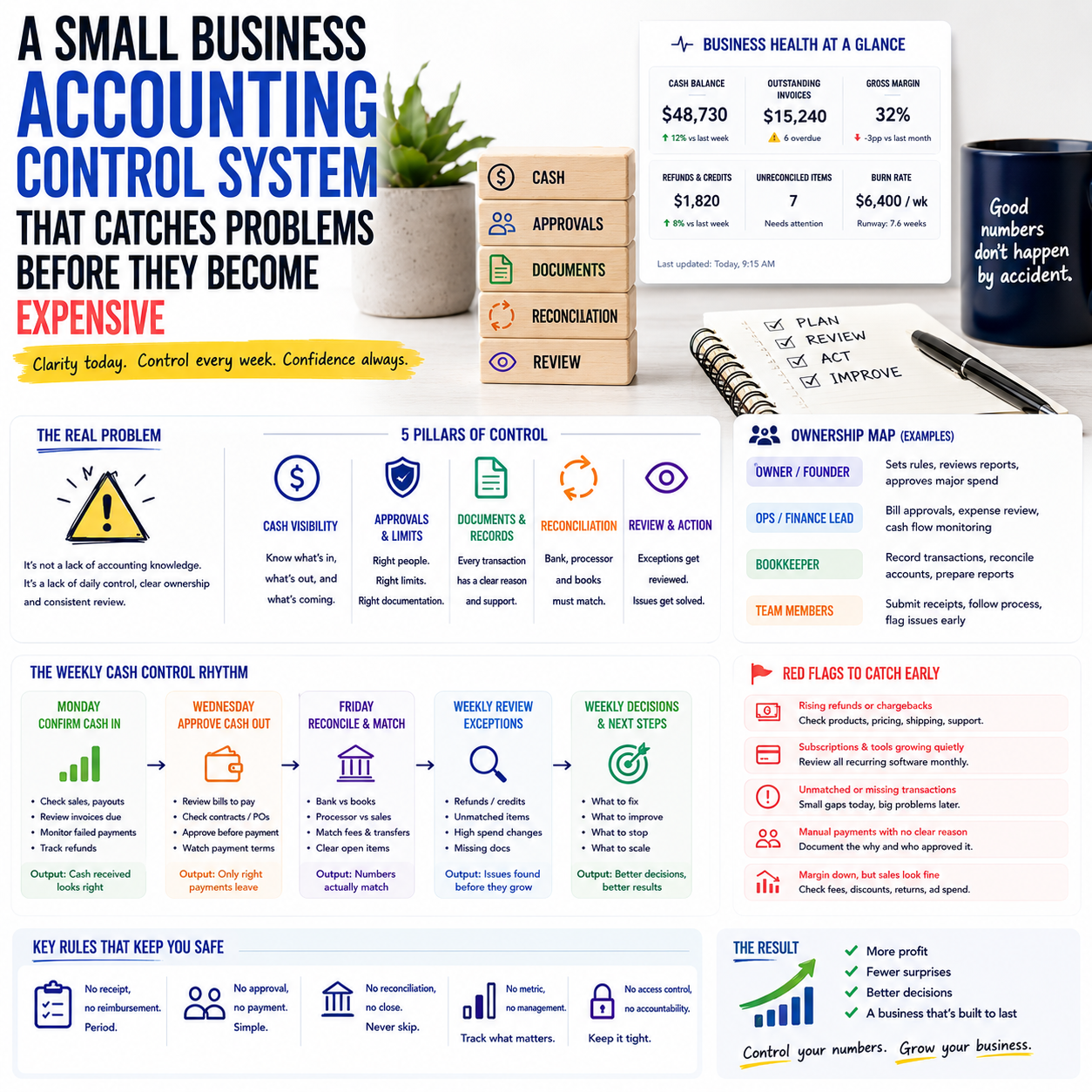
Most small companies do not fail because the owner cannot read an accounting textbook. They get into trouble because nobody owns the daily flow of money, documents, approvals and reconciliations. A recent Small Business Trends accounting guide is useful as a reminder that basic financial literacy matters, while a separate report on a money laundering guilty plea shows the harder operational lesson: weak financial controls can become a business risk long before anyone calls it fraud.
This playbook is for small business owners, e-commerce operators, agencies, local service companies and digital teams that have outgrown spreadsheet guessing but are not ready for a finance department. The goal is not to turn the founder into an accountant. The goal is to design a working control system that shows what money came in, what went out, who approved it, what documents support it and which numbers need attention every week.
The real problem is not accounting knowledge, it is accounting ownership
Many owners treat accounting as an after-the-fact reporting task. Sales happen, bills arrive, payments are made, card charges accumulate, and then someone tries to reconstruct the month. That creates a dangerous gap between operations and the books.
The operational question is simple: who is responsible for each financial event before it reaches the accountant? In a small business, that may be the founder, an operations assistant, a bookkeeper, or a part-time finance contractor. What cannot happen is shared ambiguity.
A workable ownership map should define five points:
- Who creates or approves customer invoices.
- Who verifies supplier bills before payment.
- Who has permission to spend from company cards, PayPal, Stripe, marketplace accounts or bank accounts.
- Who reconciles bank and payment processor activity.
- Who reviews exceptions, such as refunds, chargebacks, missing receipts and manual transfers.
This is where many small operators underbuild the system. They buy accounting software, connect the bank feed and assume the problem is solved. Software records activity; it does not automatically decide whether the activity is legitimate, properly approved, profitable or correctly classified.
Build the workflow around money movement, not around tax season
A small company accounting system should be designed around the moments where money moves. Tax reporting, profit reports and management dashboards are outputs. The operating system starts earlier.
For a service business, the workflow may begin when a project is accepted, a deposit invoice is issued, expenses are approved and final payment is collected. For an e-commerce seller, the workflow may begin with an order, payment capture, shipping cost, platform fee, refund window and payout reconciliation. For a digital operator, it may involve subscriptions, contractors, ad spend, payment processors and recurring SaaS tools.
Each workflow needs a simple rule: no money movement without a matching business reason and supporting record. That does not mean bureaucracy. It means every payment, refund, transfer or adjustment should have a traceable explanation.
What most people miss
The weak point is usually not the large invoice. Owners notice large invoices. The weak point is the recurring small transaction that nobody reviews: software trials that became paid plans, duplicate subscriptions, unprofitable ad campaigns, payment processor fees that are never checked, manual refunds with no reason code, and owner expenses mixed into operating costs.
These small leaks distort decision-making. A founder may think gross margin is falling because suppliers raised prices, when the real issue is rising refund costs. An e-commerce seller may think a marketplace channel is profitable because revenue looks high, while settlement reports show fees, promotions, returns and shipping adjustments eating the margin. A service business may assume a client is valuable because invoices are large, while unrecovered contractor costs tell a different story.
The practical control is not complicated: create a weekly exception review. Do not review every transaction with equal energy. Review categories where error, abuse or margin damage can hide.
- Refunds and credits above a set internal threshold.
- Manual bank transfers.
- Unmatched card transactions.
- Supplier payments without purchase approval or service confirmation.
- Recurring software charges.
- Payment processor discrepancies between sales reports and bank deposits.
The weekly cash control rhythm for a small team
Small businesses often wait until month-end to look at the books. That is too late for operating decisions. A weekly rhythm catches issues while memories, receipts and customer context are still available.
A practical weekly cash control rhythm can be handled in 45 to 90 minutes if the business keeps clean inputs. The owner does not need to do all the work, but the owner should see the exceptions.
Monday: confirm incoming money
Start with cash received, not revenue booked. For e-commerce, compare store orders, marketplace sales and payment processor payouts. For a service business, compare invoices due against payments received. For a subscription or digital product business, check failed payments, cancellations, refunds and disputes.
The useful metric is not only total sales. Track cash collected, overdue invoices, payment failures and refund value. These numbers affect payroll, supplier payments and ad budget decisions more directly than a headline revenue figure.
Wednesday: approve outgoing money before it leaves
Bill approval should happen before payment, not after the bank balance falls. A small company can use accounting software, a shared approval inbox, a project management board or a structured spreadsheet. The tool matters less than the rule: supplier bills and contractor invoices need confirmation that the work, product or service was received and belongs to the business.
For small teams, the most practical split is operational approval plus payment approval. The person who confirms the work was delivered should not always be the same person who releases payment. Even in a two-person business, this creates a useful pause.
Friday: review exceptions and update the dashboard
End the week by reviewing only the items that need judgment: missing receipts, unusual expenses, refunds, chargebacks, bank feed mismatches, unpaid invoices, and margin anomalies. Then update a short dashboard that the owner can actually read.
The dashboard should fit on one screen. Useful fields include cash balance, invoices overdue, payables due in the next two weeks, refund value, chargebacks or disputes, gross margin by main channel, unpaid tax set-aside if relevant to the jurisdiction, and software subscription spend.
Where automation helps and where it should stop
Automation can reduce accounting workload, but it can also hide errors if rules are created too casually. Bank feeds, receipt capture, invoice reminders, recurring billing and payment matching are useful. Fully trusting automated categorisation without review is where small businesses create messy books and poor management data.
Automation is strongest for repeatable, low-judgment tasks:
- Importing bank and card transactions.
- Capturing receipts from email or mobile uploads.
- Matching invoice payments to bank deposits.
- Sending payment reminders for overdue invoices.
- Flagging transactions without receipts.
- Generating recurring invoices or subscription charges.
Human review is still needed where business context matters. For example, software may categorise a payment as advertising, but only the operator knows whether that campaign belongs to a product launch, a client pass-through cost or an experimental channel that should be tracked separately. A refund may look ordinary, but the reason matters: damaged item, late delivery, customer error, fraud suspicion, or product mismatch.
The boundary should be documented. Let automation collect, match and flag. Let a human approve, interpret and change rules. That separation keeps the system fast without turning the books into a black box.
Controls that protect the owner from avoidable risk
The report about a guilty plea involving laundering over $7 million is not something most small business owners will see as close to their daily reality. But the operational lesson is relevant: when money flows are not documented, reviewed and separated, risk becomes harder to detect. Small businesses do not need enterprise compliance departments, but they do need controls that make unusual activity visible.
Start with access control. The same person should not have unlimited ability to create suppliers, approve bills, make payments and reconcile the bank account without review. In very small businesses, perfect separation is not always possible, but review can still exist. The founder can review payment runs. An external bookkeeper can reconcile accounts. A manager can confirm supplier work before the owner pays.
Second, reduce informal payment methods. Payments through personal accounts, undocumented cash handling, untracked wallets or mixed owner-business cards make accounting harder and riskier. They also make it difficult to understand margins, taxes, reimbursements and true operating costs.
Third, create a supplier and contractor file. For every recurring payee, keep basic records: contract or engagement terms, payment details, approval owner, service description and usual payment frequency. This helps prevent duplicate payments, fake supplier setups, outdated retainers and confusion when staff change.
A practical scenario: the e-commerce seller with clean sales and dirty payouts
Consider a small e-commerce seller using a web store, a marketplace, a payment processor, a shipping app and paid advertising. The owner sees healthy order volume in the store dashboard and assumes the business is improving. The bank account, however, feels tighter than expected.
The issue may not be sales. It may be payout complexity. Marketplace payouts can include sales, fees, refunds, shipping adjustments, promotional costs and reserves. Payment processors may deposit net amounts after fees. Ad platforms may charge on a different schedule from revenue collection. If the accounting system records bank deposits as sales without breaking out fees and refunds, the owner loses sight of channel profitability.
The fix is a payout reconciliation workflow:
- Download or connect settlement reports from each sales channel.
- Separate gross sales, platform fees, payment fees, refunds, shipping income, shipping cost and adjustments.
- Match the net payout to the bank deposit.
- Track gross margin by channel, not only total store revenue.
- Flag any payout that does not match the expected settlement report.
This workflow changes decisions. The owner may discover that one channel produces volume but weak cash contribution after fees and returns. That affects pricing, free shipping rules, ad spend, bundle strategy and whether to push customers toward a direct store instead of a marketplace.
The cost of a lightweight control system
The cost is not only software. A small operator should think in three categories: tools, time and review quality.
Tool costs may include accounting software, receipt capture, payroll, payment processor reporting, inventory or order management integrations, and possibly a forecasting or dashboard tool. The cheapest stack is not always the best if it creates manual reconciliation work. The most expensive stack is not always justified if the business has simple transactions.
Time cost is often larger than owners expect. Someone must upload receipts, approve bills, review bank matches, check settlement reports and answer the bookkeeper’s questions. If those tasks are squeezed into random evenings, errors increase. A weekly finance block is cheaper than a quarterly rescue project.
Review quality is the hidden cost. A low-cost bookkeeping setup that only classifies transactions for compliance may not give the owner usable operating information. A more useful arrangement defines management categories: product margin, channel fees, fulfilment cost, contractor cost by project, recurring software, owner draws, failed payments and refunds. The business then gets numbers it can act on.
The numbers worth watching every week
A small business does not need a complex finance dashboard. It needs a small set of numbers tied to decisions. If a metric does not change an action, it probably does not belong in the weekly view.
For most small operators, the weekly dashboard should include:
- Cash available after known payables due soon.
- Invoices overdue and the oldest unpaid invoice.
- Upcoming supplier, payroll or contractor obligations.
- Refunds, chargebacks and customer credits issued that week.
- Gross margin by main product, service line or sales channel.
- Unmatched bank or card transactions.
- Recurring software and subscription spend.
- Manual adjustments or transfers requiring owner review.
These metrics support operating decisions. If overdue invoices rise, the owner tightens credit terms or changes deposit requirements. If refunds cluster around a product, the product page, fulfilment process or supplier quality needs review. If software spend grows quietly, the team needs a subscription audit. If margin falls on a channel, pricing or promotion rules need attention before more ad spend is added.
Implementation checklist for the next 14 days
Use this as a rollout sequence rather than a theory exercise. The aim is to create a control system that is visible, repeatable and light enough to survive a busy week.
- Day 1: List every place money enters or leaves the business: bank accounts, cards, payment processors, marketplaces, wallets, cash, financing accounts and owner reimbursements.
- Day 2: Assign one owner for each flow: invoicing, supplier bills, card spend, refunds, payroll or contractor payments, bank reconciliation and weekly review.
- Day 3: Create approval rules for supplier bills, contractor invoices, refunds and manual transfers.
- Day 4: Clean up access permissions in banking, accounting software, payment processors and sales platforms.
- Day 5: Choose the exception list you will review weekly: missing receipts, unmatched transactions, refunds, chargebacks, duplicate suppliers, unusual transfers and overdue invoices.
- Day 6: Connect or export bank, card and payment processor data into the accounting workflow.
- Day 7: Build a one-screen weekly finance dashboard with cash, payables, overdue receivables, refunds, gross margin and unmatched transactions.
- Day 8: Audit recurring subscriptions and cancel or reassign anything without a current owner.
- Day 9: Create supplier and contractor records for recurring payees, including approval owner and payment terms.
- Day 10: Define how marketplace or payment processor payouts will be reconciled to bank deposits.
- Day 11: Separate categories that matter for management decisions, such as channel fees, fulfilment cost, ad spend, contractor cost and refunds.
- Day 12: Schedule a fixed weekly review slot and decide who attends.
- Day 13: Ask your bookkeeper or accountant which recurring errors slow down month-end and turn those into review checks.
- Day 14: Run the first review, record unresolved items and adjust the workflow before the next week begins.


