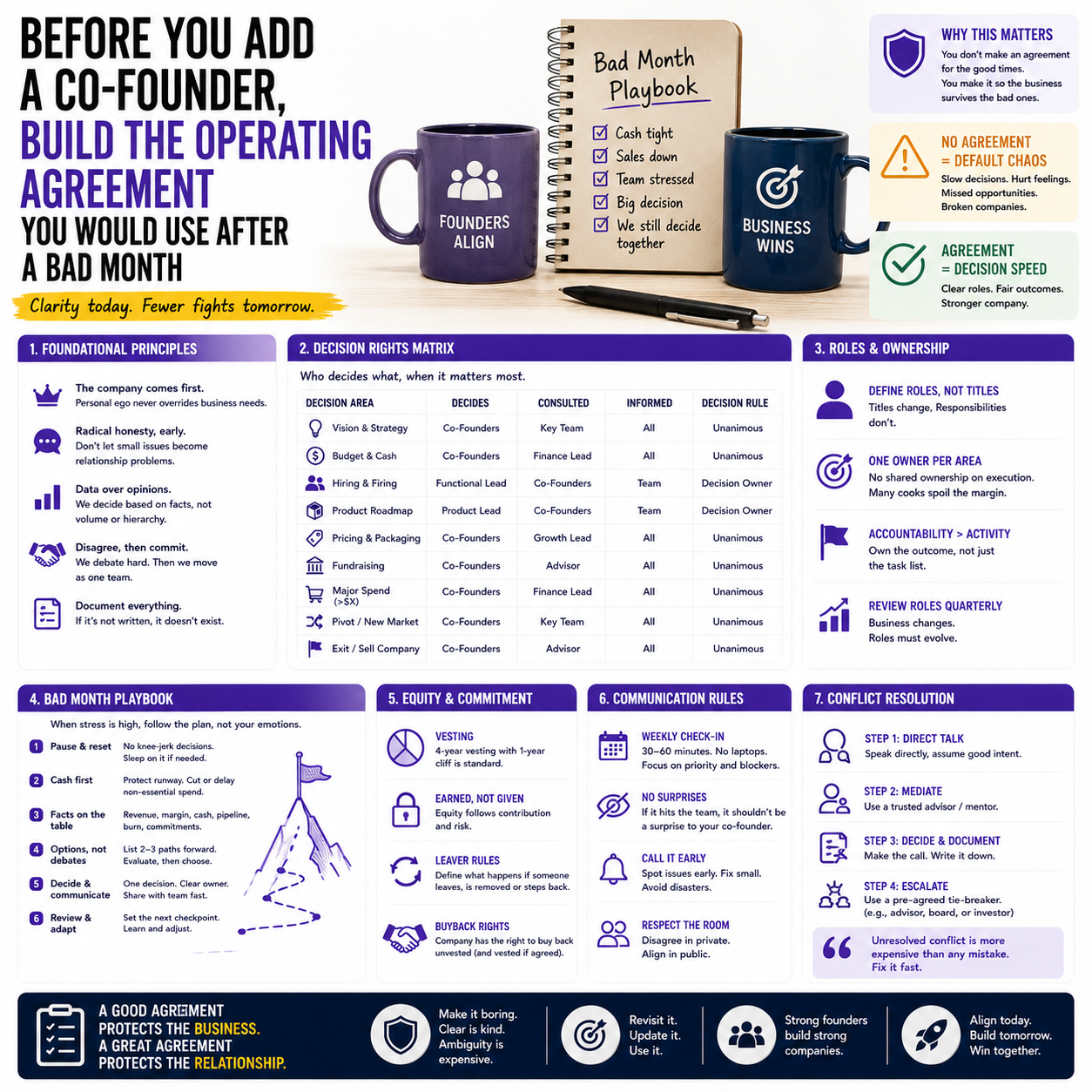
Choosing a co-founder is not a networking decision. For a small founder-led business, it is an operating system decision: who can commit money, who can change pricing, who owns delivery quality, who talks to customers, and what happens when one person stops doing the work.
EU-Startups recently highlighted the founder-risk problem through the lens of co-founder selection, citing Noam Wasserman’s work on founder dilemmas and the high cost of people problems at the top. The useful lesson for small digital businesses is not “pick someone you trust.” It is this: test the working relationship before you share control of the company.
The co-founder question is really a control question
A co-founder changes the company’s decision architecture. If you are running a small e-commerce operation, SaaS tool, agency, content business, marketplace shop or automation service, adding a second founder can speed things up. It can also make simple decisions slower and more expensive.
The wrong split is not only an emotional problem. It creates operational drag. A founder who owns 40% but does not own a clear delivery function can block hiring, pricing, reinvestment, acquisition offers, financing, product pivots or shutdown decisions. A founder who is “strategic” but not accountable for a measurable part of the business can become a permanent cost in the cap table.
Before you discuss titles, ask what decisions will become shared. In a small company, the highest-risk decision areas usually include:
- Cash commitments: subscriptions, contractors, inventory, ad spend, software, developers and freelancers.
- Customer promises: delivery dates, refund policy, support response times, scope changes and service-level expectations.
- Revenue model: pricing, discounts, channel mix, wholesale terms, marketplace dependency and recurring revenue plans.
- Data access: bank accounts, analytics, customer records, supplier accounts, ad accounts and automation tools.
- Equity and exit: vesting, buyback rights, founder departure, sale approvals and deadlock handling.
If those areas are vague, the co-founder relationship is not ready. Friendship, shared ambition or complementary skills do not fix unclear authority.
Do not split equity before mapping the work
The most common early mistake is treating equity as a symbol of commitment rather than a price for future contribution. Equal equity can be fair, but only if equal responsibility, risk and time are real. If one founder keeps a full-time job, another funds initial development, and a third owns customer acquisition, equal ownership may produce resentment quickly.
A practical way to handle this is to create a role-to-value map before any final split. This does not need to be a complex legal document at first. It should be a working table that lists the business functions required over the next 12 months and names the person accountable for each one.
For a small digital business, the table might include product build, customer acquisition, financial control, operations, support, supplier management, analytics, compliance coordination, automation maintenance and hiring. Each function should have a measurable output. “Marketing” is too vague. “Generate qualified demo calls under a defined cost per lead” is useful. “Operations” is too vague. “Keep fulfilment errors, refund cases and unresolved tickets inside agreed thresholds” is useful.
What most people miss
The biggest gap is not whether two founders have different skills. It is whether their work creates different kinds of risk.
A technical founder may create the product but control little cash. A commercial founder may control ad spend, partnerships and pricing decisions. An operations-focused founder may carry customer complaints, supplier problems and delivery failures. Those risks are not interchangeable, and they should be visible before equity is finalised.
Small businesses often treat the co-founder deal as an ownership conversation and ignore the management system underneath it. That is backwards. Build the management system first. Then use equity to reflect commitment, risk, scarcity of contribution and replacement cost.
Run a 30-day operating trial before creating permanent ownership
A founder trial is not about whether you like working together. It is about whether the business runs better when both people are inside the system. A 30-day trial should use real work, real deadlines and real numbers.
For example, imagine a solo founder running a Shopify store that sells specialised accessories across several EU markets. Revenue exists, but growth is inconsistent. A potential co-founder claims they can improve paid acquisition and supplier negotiations. Instead of immediately offering 30% equity, the founder can design a trial with three workstreams:
- Audit paid acquisition and produce a channel-level margin view, including product margin, return rate, payment fees, ad spend and fulfilment cost.
- Renegotiate or benchmark two supplier terms, with clear evidence of improved lead time, minimum order quantity or unit cost.
- Build a weekly dashboard that shows contribution margin by product group and campaign, not just revenue.
This trial reveals whether the person can work with messy data, respect existing systems, communicate clearly and make decisions that improve profit rather than vanity metrics. It also shows whether they need constant direction. A co-founder should reduce founder bottlenecks, not create another management layer.
The trial should end with a decision meeting. The question is not “Did we work hard?” The question is “What part of the business is now measurably better, and should this person own that function long term?”
Convert founder promises into operating clauses
Many founder disputes begin with promises that sounded clear in conversation but were never converted into operational rules. Small companies should translate promises into clauses early, even before paying for a full legal document. A lawyer can formalise the agreement later, but the founders need to know what they actually want.
Useful clauses for a small founder-led business include:
- Time commitment: expected weekly hours, availability windows and what happens if one founder takes employment elsewhere.
- Decision thresholds: what can be approved alone, what needs both founders, and what requires written approval.
- Spending authority: maximum monthly spend on contractors, software, inventory, ads or tools without approval.
- Data and account ownership: which business email, payment, ad, analytics, marketplace and hosting accounts must be company-controlled.
- Vesting: how equity is earned over time rather than granted fully on day one.
- Exit process: what happens if a founder leaves, stops contributing, becomes unavailable or wants to sell shares.
- Deadlock handling: how unresolved decisions are handled when both founders disagree.
The goal is not to make the relationship cold. The goal is to prevent daily operations from depending on memory, mood or informal power. A founder agreement should reduce uncertainty when the business is under pressure.
The cost of a bad co-founder is hidden in slow decisions
Bad co-founder fit rarely appears first as a dramatic breakup. More often, it appears as delayed decisions. A campaign is not cut because one founder wants to “give it more time.” A supplier issue is not escalated because nobody owns it. A refund policy is inconsistent because sales wants flexibility and operations wants control. A product pivot is delayed because one founder is emotionally attached to the first version.
For small operators, delay is expensive because the company has fewer buffers. A large company can absorb slow meetings. A small business may lose cash, ad account learning, seasonal demand, supplier credibility or customer trust in a few weeks.
Track co-founder friction as an operating metric. You do not need complex software. A shared decision log is enough. Record the decision, owner, date opened, target date, financial exposure and status. If the same decision types keep getting stuck, the issue is structural, not personal.
Useful friction metrics include:
- Number of unresolved decisions older than seven days.
- Cash value of delayed decisions, such as paused campaigns, unsold stock or unpaid invoices.
- Number of decisions reopened after agreement.
- Number of tasks with no clear owner.
- Customer or supplier issues delayed because founders disagreed internally.
This is where many founders need to be honest. If the relationship only works when the business is calm, it is not yet a durable co-founder relationship.
Where automation helps, and where it should not replace judgment
Small digital businesses can use lightweight tools to make co-founder operations cleaner. A shared Notion, Airtable, ClickUp, Trello or Linear workspace can hold role ownership, decision logs, meeting notes, customer issues, experiment results and financial tasks. Accounting tools, Shopify analytics, Stripe, Google Looker Studio and ad dashboards can reduce arguments based on opinion.
Automation can help with reminders, recurring reviews and data visibility. For instance, a weekly automation can pull sales, refunds, ad spend and gross margin into a dashboard before the founder meeting. A task system can flag supplier follow-ups or overdue customer issues. A CRM can show whether a sales founder is actually moving opportunities forward.
But automation should not decide founder judgment calls. It cannot resolve risk appetite, values, trust, ethics, willingness to dilute equity, appetite for debt or whether to shut down a product line. Those are founder-level decisions. The point of automation is to make the facts harder to avoid.
Use tools to remove ambiguity, not accountability
A bad setup is a shared workspace full of tasks that nobody owns. A better setup has named owners, due dates, decision status and financial exposure. If a founder owns paid acquisition, they should also own the reporting rhythm and explain why spend is increasing, decreasing or moving between channels. If a founder owns operations, they should bring supplier risk, fulfilment errors, refund causes and support load into the same meeting.
Tools should make responsibility visible. They should not become a place where founders hide unfinished work.
A founder fit scorecard for small operators
Before giving away equity, use a scorecard that reflects the actual business you are building. A service agency does not need the same co-founder profile as a marketplace seller or SaaS tool. Score each area with evidence from work, not conversation.
- Execution under constraints: Did the person complete useful work without perfect information or a large budget?
- Commercial judgment: Do they understand margins, cash timing, customer acquisition cost, refunds, churn or repeat purchase behaviour?
- Operational discipline: Do they document decisions, update systems and close loops with customers, suppliers or contractors?
- Conflict behaviour: Do disagreements become clearer decisions, or do they become emotional resets?
- Tool maturity: Can they work inside shared systems without creating parallel spreadsheets, private accounts or hidden workflows?
- Risk alignment: Are they aligned on debt, reinvestment, salaries, outside funding, dilution and personal runway?
- Customer proximity: Have they spent time with actual customers, tickets, complaints, sales calls or product feedback?
The scorecard should expose whether the person is a co-founder, early employee, contractor, advisor or commercial partner. Those are different relationships with different costs. Equity is only one instrument, and it is often the most expensive one.
The pre-signing sequence to run this week
If you are considering a co-founder now, do not start with a pitch deck or title discussion. Start with a short operating process that produces evidence.
- Day 1: Write the next 12 months of business functions on one page. Include sales, product, fulfilment, support, finance, data, marketing, supplier management and automation.
- Day 2: Assign provisional ownership for each function. Mark which decisions can be made alone and which require joint approval.
- Day 3: Agree on a 30-day trial project tied to one measurable business problem, such as margin visibility, lead conversion, refund reduction, delivery reliability or product launch speed.
- Day 7: Create a shared decision log and spending authority table. Add every open decision with an owner and target date.
- Day 14: Review the first evidence: completed work, blocked tasks, data quality, communication rhythm and customer or supplier impact.
- Day 30: Decide whether the relationship should be equity-based, paid, advisory, contractor-based or paused. Do not use enthusiasm as the deciding metric.
- Before signing: Put vesting, exit rules, account ownership, decision thresholds and spending limits into a written agreement for legal review.
The practical test is simple: after 30 days, the business should be clearer, faster or better controlled because the other person joined the operating rhythm. If the main output is more discussion, more ambiguity or more unresolved decisions, the cost of equity is already showing up.