Zazume’s reported €2.5 million raise to scale an AI-powered rental management platform is not just another PropTech funding note. For small landlords, boutique property managers and service operators handling residential portfolios, the useful question is narrower: which parts of the rental workflow should be automated, and which parts still need human judgment?
The answer matters because rental management is full of small operational leaks: missed follow-ups, slow document collection, unclear responsibility between owner and manager, late maintenance triage, scattered tenant messages and weak cash visibility. AI tools can reduce some of that friction, but only if the operator redesigns the workflow instead of simply adding another dashboard.
The operator this matters for is not the venture-backed platform
The business signal from Zazume’s funding is that the rental lifecycle is being treated as a process that can be digitised end to end: acquisition of portfolios, tenant communication, documentation, maintenance, owner reporting and rent operations. A small operator should not read this as a reason to copy a funded platform. The useful lesson is that property management is moving away from inbox-based coordination and toward workflow ownership.
This is relevant if you manage a small residential portfolio, run a local property management service, operate short-to-mid-term rentals, or handle rental administration as part of a real estate agency. In those businesses, margin is often lost in handoffs rather than in headline pricing. A tenant asks for a repair in WhatsApp, the owner wants approval by email, the contractor replies by phone, and the manager updates a spreadsheet later. No single step looks expensive, but the process creates delay, rework and liability risk.
AI rental management should therefore be evaluated as an operations layer, not as a clever chatbot. The buying question is not, “Does it use AI?” The better question is, “Which recurring decisions can this system route, classify, draft, remind or reconcile without increasing risk?”
Start with the rental lifecycle, not the software demo
Before comparing tools, map the lifecycle of one rental unit from listing to renewal or exit. The map should include every operational touchpoint where a person currently has to remember, chase, verify or update something. For a small property operator, the core stages usually look like this:
- Owner onboarding and property data collection
- Listing preparation and channel publication
- Lead capture, screening and viewing coordination
- Application documents and identity checks
- Contract preparation and signing
- Deposit and first rent tracking
- Tenant move-in instructions
- Maintenance requests and contractor coordination
- Rent collection monitoring and arrears follow-up
- Owner reporting and profitability tracking
- Renewal, price review or move-out process
The point is not to automate every stage. The point is to find the stages where repeated manual coordination causes measurable cost. For a two-person property management team, the biggest gains may come from document chasing, message classification and owner reporting. For a landlord with several units, the pain may be rent tracking and repair approvals. For a letting agency, it may be lead response time and viewing coordination.
If the workflow is not mapped first, a tool demo can be misleading. A platform may look impressive because it offers tenant messaging, AI summaries and reporting. But if your business still approves every repair manually through a private email thread, the system will not remove the bottleneck. It will simply produce cleaner records of a slow process.
Where AI can remove real operating cost
AI is most useful in rental management when the work is repetitive, text-heavy and rules-based enough to be routed safely. That does not mean replacing the manager. It means shrinking the time spent translating messy inputs into organised next actions.
Message triage and routing
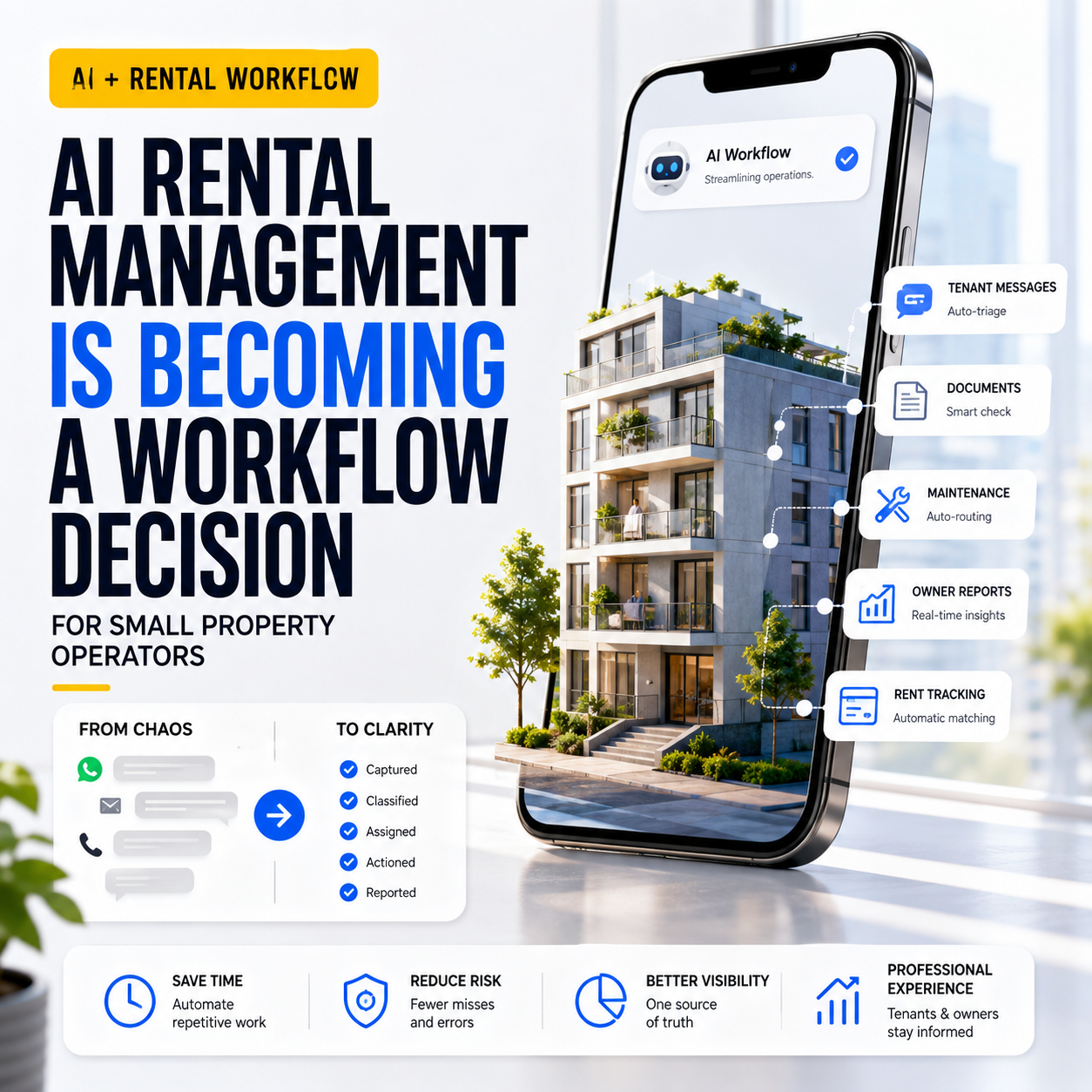
Tenant and owner messages are rarely structured. One message may include a repair request, a complaint, an attachment and a time constraint. AI can classify the message, extract the property, identify urgency, create a task and suggest the next reply. The human operator then approves, edits or escalates.
This is valuable because the cost of missed context is high. A slow response to a water leak is different from a slow response to a broken blind. A system that routes maintenance by urgency, property and responsibility can reduce the manager’s need to manually scan every message thread.
Document collection and missing-field checks
Rental administration involves documents that are often incomplete. AI-supported workflows can check whether required files are present, flag missing signatures, extract dates and remind the correct party. For small teams, this is less about advanced intelligence and more about preventing the same person from checking the same folder ten times.
The automation boundary is important. A system can identify missing fields and prepare reminders. It should not make legal judgments about contract enforceability unless the operator has a jurisdiction-specific process reviewed by a qualified professional.
Owner reporting that is generated from operations data
Many small managers lose time producing owner updates from scattered notes: rent received, maintenance status, upcoming renewals and unresolved issues. If tasks, payments and messages are captured in one workflow, reporting can become a by-product rather than a separate monthly chore.
This is where AI summaries can be useful, provided the underlying data is accurate. A generated owner report based on incomplete task records is worse than a short manual update. The operational discipline comes first: every request, cost and approval needs to enter the system in a consistent way.
What most people miss
The main risk in AI rental management is not that the software fails dramatically. The more common risk is partial automation: the system handles visible communication while the real decision logic remains undocumented in the operator’s head.
For example, a tool may draft replies to tenant repair requests. That looks efficient. But if the business has not defined which repairs require owner approval, which contractors are assigned by area, what budget threshold triggers escalation, and how emergencies are handled after hours, the AI is only accelerating ambiguity.
Small operators should write down the rules before automating the messages. A simple maintenance decision table is more valuable than a polished chatbot:
- Emergency issue: call approved contractor immediately, notify owner after action
- Safety issue: manager reviews within same working day, contractor quote required
- Cosmetic issue: acknowledge request, group with next scheduled maintenance window
- Tenant-caused damage: collect photos, check deposit process, escalate to manager
- Owner-funded improvement: prepare quote and wait for written approval
Once this logic exists, AI can classify incoming messages against it. Without it, the operator is just using automation to produce faster but still inconsistent decisions.
The cost calculation should include switching pain, not just subscription price
A rental management platform may charge per unit, per portfolio, per user, per transaction, or through a service model. But the visible subscription is only part of the decision. Small businesses need to include migration and workflow cost.
The real cost categories are usually:
- Software subscription or platform fees
- Data migration from spreadsheets, inboxes and legacy tools
- Template setup for messages, contracts, reports and reminders
- Staff training and new process enforcement
- Integration work with accounting, payment, signing or CRM tools
- Time spent correcting poor historical data
- Risk controls for privacy, permissions and document access
A platform can be good and still be the wrong purchase if the operator has too few units, inconsistent records or no appetite to standardise work. In that case, a lighter stack may be better: shared inbox, task manager, property database, e-signature tool, cloud document storage and a basic reporting dashboard. AI can be added selectively through message drafting, document extraction or support-ticket classification.
The decision should be based on the monthly cost of unmanaged complexity. If a manager spends several hours each week chasing documents, updating owners and reconstructing maintenance history, a dedicated workflow tool may pay for itself. If the portfolio is small and stable, the better move may be to tighten the current process before buying a larger system.
A practical scenario: moving from inbox management to controlled automation
Consider a small property management team handling a growing residential portfolio. The team uses email for owners, WhatsApp for tenants, a spreadsheet for rent status, cloud folders for documents and a separate accounting tool. Nothing is broken enough to force a change, but every new unit adds coordination pressure.
The first mistake would be to buy an AI rental platform and migrate everything at once. The safer rollout is to choose one workflow with a clear before-and-after metric. Maintenance is often a strong starting point because it has visible handoffs and operational risk.
The team could create one intake route for all maintenance requests, even if tenants still send messages through familiar channels. Every request is copied or forwarded into the same task system. AI classifies the request by property, urgency and category. The manager reviews the classification, assigns a contractor or requests owner approval based on predefined rules, and the system stores the thread, photos and invoice against the property.
The first metric is not “AI accuracy” in the abstract. It is the reduction in untracked maintenance requests, time to first response, number of owner approval chases, and percentage of completed jobs with invoice and photo attached. Those are operational metrics tied to margin and risk.
After maintenance is stable, the team can automate document reminders for new tenants. After that, owner reporting can be generated from the captured activity. The order matters: reporting should come after data capture, not before.
The human boundary: where a manager must stay in the loop
The EU-Startups article on coaches and mentors is about career support rather than property operations, but it points to a useful distinction for small teams: not every form of support is interchangeable. In rental management, AI can support execution, but the operator still needs judgment around trust, negotiation and exceptions.
Keep a human in the loop for decisions involving disputes, deposit deductions, rent arrears escalation, contract interpretation, vulnerable tenants, owner conflict, pricing changes and non-standard repair approvals. These are not just tasks; they affect relationship risk, legal exposure and reputation.
AI can prepare context for those decisions. It can summarize a tenant history, list unpaid items, extract previous promises, draft a neutral response or identify missing documents. But the manager should make the call where the business consequence depends on local rules, relationship history or commercial judgment.
This boundary should be written into the process. Otherwise, staff may either overtrust the system or avoid using it. A simple rule works well: AI can classify, draft, remind and summarize; humans approve anything that changes money, legal position, tenant status or owner commitment.
Tool stack choices for a small rental operation
Small operators do not need to choose immediately between manual chaos and a full PropTech platform. There are three realistic stack levels, and each fits a different stage of operational maturity.
Level one: structured manual stack
This is suitable for a very small portfolio or an operator cleaning up operations before automation. Use a shared inbox, cloud folders with consistent naming, a task board for maintenance and renewals, e-signature for documents, and a spreadsheet or accounting export for rent status. The aim is to create one source of truth for each property.
The risk is discipline. If staff keep side conversations outside the system, the process breaks. The metric to watch is the percentage of active issues recorded in the task board versus handled privately.
Level two: workflow automation around the current stack
This fits an operator that has repeatable processes but is not ready for a full rental management platform. Use automation tools to move form submissions into tasks, trigger reminders, label emails, extract document fields and produce weekly status summaries. AI can help classify messages and draft updates.
The risk is integration fragility. If automations depend on inconsistent subject lines, file names or manual forwarding, they will fail quietly. The metric to watch is exception volume: how many tasks still need manual correction after automation runs.
Level three: dedicated rental management platform
This fits a portfolio where unit count, owner reporting, maintenance volume or compliance burden makes a dedicated system worthwhile. The value is not just AI features. The value is having tenant, owner, property, document, payment and task data in one operating environment.
The risk is lock-in and migration cost. Before moving, export a sample of your current data and test how the platform handles your real workflow: multi-owner properties, partial payments, urgent repairs, contractor invoices, renewals and owner statements. A polished demo with clean sample data is not enough.
Metrics to track before and after automation
A small property operator should measure the workflow before buying software. Otherwise, the business cannot tell whether automation improved operations or merely changed where the work happens.
Track a small set of metrics for four to six weeks:
- Average time to first response for tenant requests
- Number of open maintenance issues by age
- Percentage of repair jobs with documented approval
- Percentage of active tenancies with complete document files
- Time spent preparing owner reports
- Number of rent exceptions that require manual follow-up
- Number of tasks handled outside the agreed system
These metrics expose whether the bottleneck is communication, data capture, approvals, payments or reporting. They also prevent overbuying. If the biggest issue is missing documents, a document workflow may solve more than a broad platform. If the issue is multi-party maintenance approval, a task and approval system may be the first investment.
Decision checklist before adopting AI rental management
Use this checklist before committing to an AI-powered rental management system or building automations around your existing tools:
- Portfolio fit: Do you have enough units, owners or maintenance volume to justify a system change?
- Workflow clarity: Are your rules for repairs, approvals, arrears and renewals written down?
- Data readiness: Are property records, tenant documents and owner details complete enough to migrate?
- Human approval points: Have you defined which decisions AI may only draft or summarize?
- Integration needs: Does the tool connect with your accounting, payment, signing and document systems, or will staff duplicate work?
- Cost visibility: Have you included setup time, training, migration and process enforcement, not only subscription fees?
- Operational metrics: Do you know which metric should improve within the first month of rollout?
- Exit option: Can you export property, tenant, task, payment and document data if the tool does not fit?
The practical move is to automate the most expensive coordination problem first, not the most impressive demo feature. For many small rental operators, that means maintenance routing, document completion or owner reporting. If those workflows become cleaner, faster and easier to audit, AI is doing useful operational work. If not, the business has bought another place to copy information into.