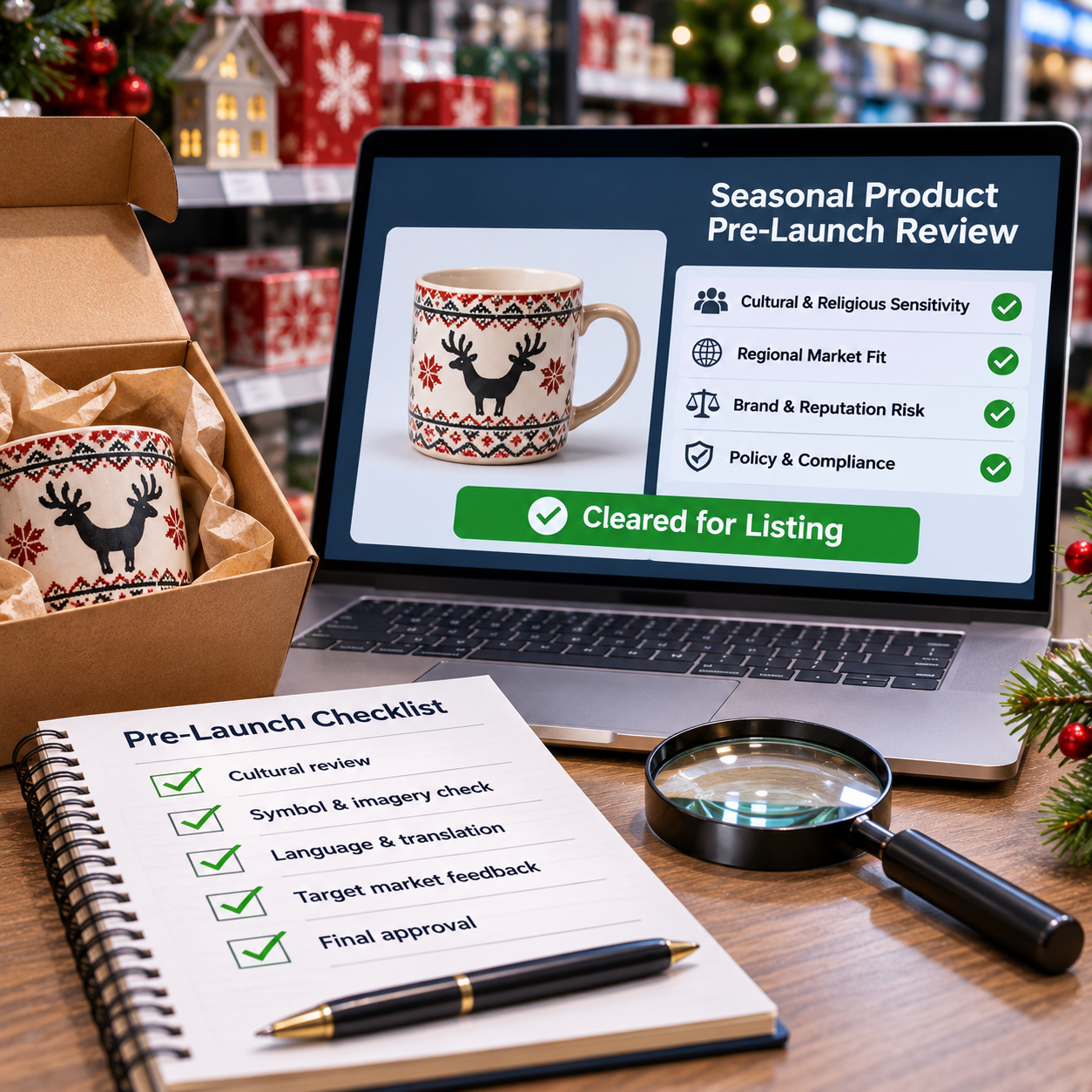
Seasonal merchandise moves quickly: buying windows are compressed, suppliers submit large assortments, and products may reach stores and digital channels almost simultaneously. That speed creates a particular governance risk. A costume, decoration or product name can pass routine commercial checks yet still evoke a harmful cultural stereotype when customers see the complete item and its marketing.
Retail Dive reported that Target apologized and acted after criticism of a Halloween costume described as offensive. That episode matters to retail operators not as an invitation to speculate about the product or Target’s internal process, but as evidence of a recurring control problem: ordinary approval workflows may not identify cultural risks early enough.
The practical answer is a defined product-risk system connecting merchandising, sourcing, legal, marketing, ecommerce and stores. Its purpose is narrower than resolving political or cultural debates. It is to detect foreseeable harm, assign decisions clearly and enable a fast, consistent response.
Put cultural-risk evidence into supplier submissions
Product review cannot work if decision-makers receive only a sample, wholesale price and short description. Seasonal suppliers should submit a complete representation of how an item will appear to customers: product name, packaging, accessories, imagery, descriptive copy, intended age range, proposed category placement and any cultural or historical references used in its design.
Contracts and submission forms should require suppliers to disclose whether a product depicts or imitates an identifiable culture, ethnicity, nationality, religion, Indigenous community, disability or historical identity. Disclosure is not automatic grounds for rejection. It is a routing mechanism that sends potentially sensitive products to an enhanced review instead of leaving individual buyers to recognize every possible issue.
Suppliers should also confirm that the final production version will match the reviewed materials. A benign sample can acquire risk through revised packaging, an added accessory or marketing copy. Change-control terms should therefore require resubmission when culturally relevant design elements, naming or imagery change.
Retailers should preserve an approval record containing the submitted materials, comments, decision-maker and version number. This creates accountability without turning the exercise into paperwork for its own sake. If criticism arises, teams can establish exactly what was reviewed rather than reconstructing the process from email.
Review the complete customer-facing proposition
A cultural-risk assessment must consider the product as shoppers encounter it. Naming, photography and merchandising context can change the meaning of a physical item. Reviewers should inspect the product detail page, search keywords, packaging, mannequin or model styling, social creative and planned shelf adjacency—not just the sample on a conference table.
Useful review questions include:
- Does the item reduce a living culture or identity to a costume, caricature or comic device?
- Are physical traits, accents, sacred symbols, ceremonial clothing or experiences of oppression being used as entertainment?
- Could the name or description intensify a stereotype that is less obvious in the product alone?
- Does combining otherwise ordinary components create a recognizable and demeaning portrayal?
- Would children or adults be encouraged to impersonate an identity rather than a fictional character or occupation?
- Could the retailer explain its decision respectfully to customers represented by the product?
These questions are product-governance tests, not verdicts on every contested cultural question. Reviewers do not need unanimous agreement about social meaning. They need enough evidence to identify a reasonably foreseeable reputational, customer-harm or employee-relations risk and route it to the right authority.
Create escalation rules that survive seasonal pressure
A buyer should not carry sole responsibility for ambiguous cultural questions while also being measured on assortment delivery and sales. Retailers need explicit escalation criteria. Enhanced review should be triggered by identifiable cultural references, complaints during sampling, uncertainty among reviewers, prior controversy involving similar products, or supplier claims that a design is “traditional,” “tribal,” “ethnic” or otherwise representative of a group.
The review group should include merchandising, sourcing, legal or compliance, brand or communications, and colleagues with relevant lived or professional perspectives. Diversity improves the chance that assumptions will be challenged, but retailers should not make one employee speak for an entire community. Where internal knowledge is insufficient, a qualified external adviser or relevant community organization may provide context.
Decision rights must be settled before the peak launch period. The group needs authority to approve, request modifications, restrict marketing, pause the item or reject it. A short written rationale should accompany the result. Revenue forecasts and committed inventory may inform consequences, but sunk cost should not lower the risk standard.
Governance also needs a final checkpoint. Digital listings and campaign assets should be compared with the approved record before publication, while stores should receive only approved product versions and presentation instructions.
Build a withdrawal procedure before criticism arrives
When a product triggers credible criticism, the first operational requirement is control. A cross-functional incident lead should rapidly verify the exact SKU, channels, locations, inventory status and marketing assets involved. The lead should have authority to place a temporary sales hold while the retailer evaluates the concern.
A workable withdrawal sequence is:
- Disable ecommerce purchasing and paid promotion for the identified SKU.
- Send stores a precise stop-sale and removal instruction with the SKU, image and handling requirements.
- Quarantine remaining inventory so it cannot be replenished or transferred back to sale.
- Pause scheduled email, social, affiliate and marketplace content.
- Give customer-service and store teams consistent response language and an escalation route.
- Decide whether customers who already purchased the item may return it under simplified terms.
- Record completion by channel and location rather than assuming a message equals execution.
Speed should not eliminate verification. Teams must avoid withdrawing similarly named products accidentally or making unsupported statements about motives. However, waiting for a perfect consensus while the item remains promoted can increase harm and complicate the response.
Communicate the action without debating affected customers
Customer communication should identify the action taken, acknowledge the concern and explain what happens next. If review confirms that an item should not have been sold, a direct apology is generally more credible than language suggesting that people merely “took offense.” Retail Dive’s report that Target apologized illustrates the public-facing importance of acknowledging a product concern and responding to it.
The statement should not speculate about internal intentions, shift blame to a supplier or turn a merchandise decision into a broad political argument. Customers need to know whether the product has been removed, whether returns are available and how the retailer intends to prevent recurrence. Employees need an internal version containing operational instructions, not just a link to the public statement.
Communications teams should monitor questions and misinformation, but avoid prolonged arguments on social platforms. The objective is to remedy a product failure and provide accurate information—not to win every exchange.
Convert the incident into stronger assortment controls
After containment, the retailer should trace where the warning signal was missed. The review should compare the supplier submission, sample, final item, copy, imagery and approvals. It should ask whether the issue was invisible in the materials, noticed but not escalated, or introduced after approval.
Corrective actions should match that finding. They may include adding mandatory submission fields, broadening reviewer participation, revising trigger terms, retraining buyers, tightening supplier change controls or improving store withdrawal confirmation. Supplier performance records should capture incomplete disclosure or unauthorized changes.
Retailers can monitor the system without inventing a simplistic “offensiveness score.” More useful operational measures include the share of flagged products reviewed before commitment, time from escalation to decision, time from incident confirmation to stop-sale, store compliance with withdrawal instructions, and recurrence of previously identified risk patterns.
Before the next seasonal range is finalized, operators should confirm four things: complete customer-facing materials are available for review; cultural-risk triggers automatically escalate; one role has authority to pause launch or sale; and every channel can execute and verify a rapid withdrawal. Those controls will not remove judgment from merchandising. They ensure that judgment is informed, shared and exercised before customers discover the risk on the retailer’s behalf.